🛡️ Licensed by Ministry of External Affairs · RA:
B-3413/DEL/COM/1000+/5/11419/2026
📞 +91 96259 66817
📍 15, 2nd Floor, South Patel Nagar, Delhi-110008
📌 What You'll Learn
Once you start receiving your stipend in Germany, many trainees want to send money home to support their families. This blog covers the best services for transferring money from Germany to India, how fees and exchange rates work, what amounts are realistic on an Azubi budget, and whether there are any tax implications you need to know about.
The decision to do Ausbildung in Germany is not made in isolation. For most Indian families, it is a household decision — parents have often contributed to the programme fee, younger siblings are watching, and everyone has expectations about what life in Germany will eventually mean for the family's financial situation. Sending money home — even modestly — is both a practical act of support and an emotionally significant one.
The good news is that Germany places absolutely no restrictions on international money transfers. You can send as much or as little of your stipend as you choose, as often as you like, to any Indian bank account. The only constraints are practical ones: service fees, exchange rates, and what you can actually afford after covering your own living costs.
This blog gives you the complete picture — which services to use, what things actually cost, what exchange rates to expect, and how to build a sustainable remittance routine on an Azubi stipend.
Before planning how much to send home, it helps to understand your realistic monthly budget in Germany. Here is a typical breakdown for an Ausbildung trainee in a medium-sized German city:
| Expense | Typical Monthly Cost (€) | Notes |
|---|---|---|
| Rent (shared flat or employer housing) | €200 – €450 | Many employers provide subsidised housing in Year 1; shared flat (WG) is typical from Year 2 |
| Health insurance contribution | €80 – €120 | Deducted from stipend; paid by employer and trainee jointly |
| Food (cooking at home) | €150 – €220 | Indian cooking is budget-friendly in Germany |
| Public transport (Deutschlandticket) | €29 – €58 | Monthly national rail/bus pass — widely used by Azubis |
| Phone (SIM + data plan) | €10 – €20 | Prepaid or contract SIM from Aldi Talk, Lidl Connect, etc. |
| Miscellaneous (clothing, toiletries, outings) | €50 – €100 | Variable — controllable |
| Total estimated monthly costs | €519 – €968 | Wide range depending on city size and housing situation |
On a net stipend of €850 to €1,100 per month, most trainees have €100 to €400 available for savings and remittances after covering their own costs. In the first year — when accommodation is often employer-provided and you are still building a German social life — many trainees find they can send €150 to €300 per month.
There are several reliable options for transferring EUR to INR. The most important factors to compare are the exchange rate (how much INR your euros actually buy), the transfer fee (what the service charges per transaction), and the transfer speed (how quickly the money arrives).
| Service | Fee per Transfer | Exchange Rate | Speed | Best For |
|---|---|---|---|---|
| Wise (formerly TransferWise) | €0.50 – €3.00 (varies by amount) | Mid-market rate (best available) | 1–2 business days | Best overall — lowest cost, most transparent |
| Revolut | Free (up to monthly limit on free plan) | Mid-market rate up to limit, then small markup | Instant to 1 day | Good for smaller, frequent transfers |
| Western Union (online) | €1–5 approx. | Slightly below mid-market | Minutes to 1–2 days | Fast delivery; not cheapest option |
| PayPal / Xoom | €2–5 approx. | Below mid-market — markup applied | Minutes to 1 day | Convenient but costlier than Wise |
| Your German bank (SWIFT) | €15–30 per transfer | Bank rate (significantly below mid-market) | 2–5 business days | Avoid for regular remittances — high fees |
| Google Pay / PhonePe (via partner) | Low to zero (varies) | Competitive rates | Instant to 1 day | Growing option — check availability in your city |
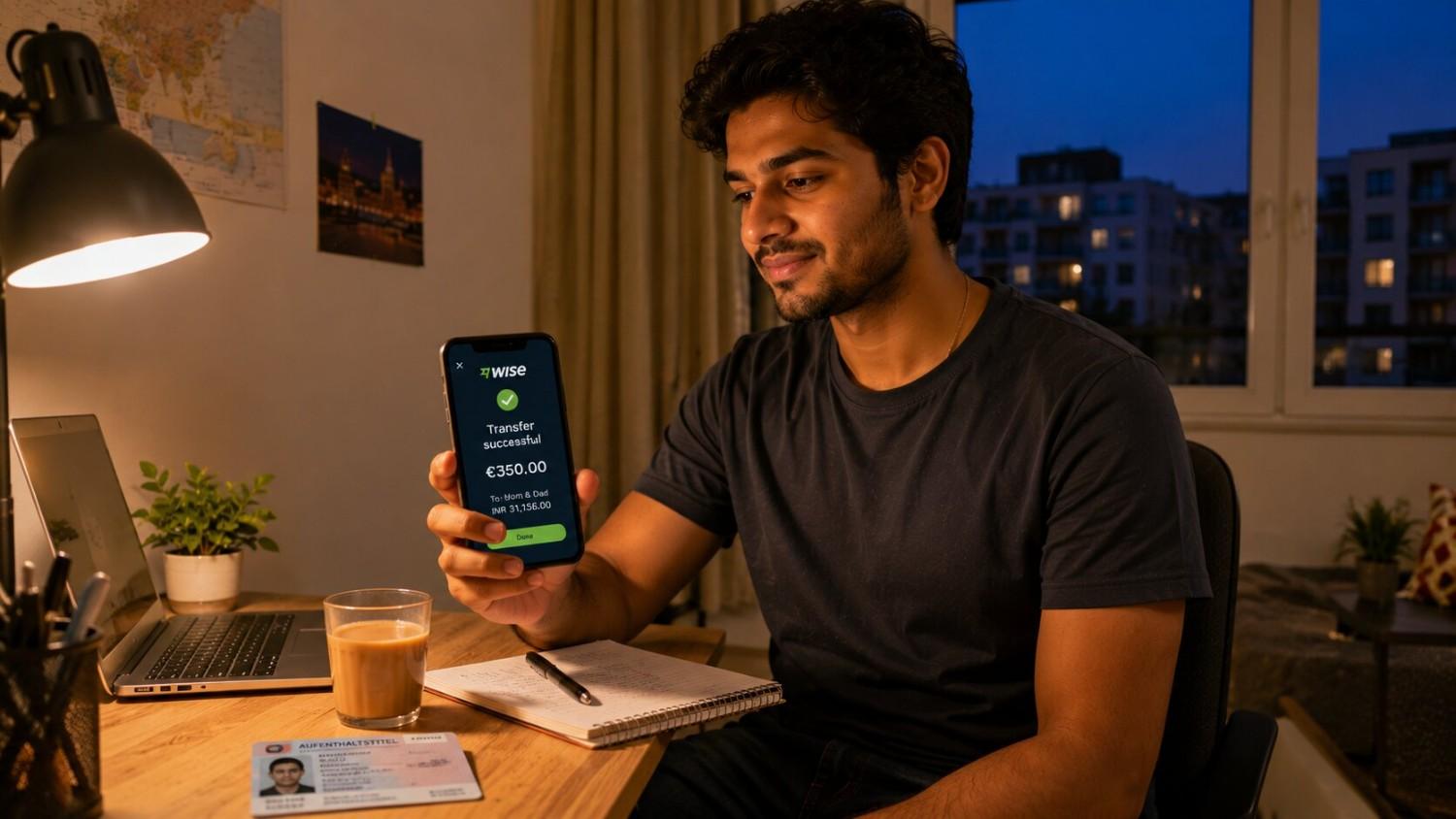
Among Indian Ausbildung trainees and Indian professionals in Germany broadly, Wise is consistently the most recommended service for sending money home. The reason is simple: Wise uses the mid-market exchange rate — the same rate you see on Google when you search EUR to INR — and charges a small, transparent fee rather than hiding a markup inside a worse exchange rate.
Consider the difference: if you send €300 home through your German bank using a SWIFT transfer, you will pay a €20 to €30 fee and receive a bank exchange rate that might be 2 to 3 percent below the mid-market rate. On €300, a 2 percent rate difference alone costs you €6 in hidden losses — on top of the explicit fee. Over 12 months of regular transfers, this difference adds up to real money.
With Wise, the fee on €300 is typically under €2, and you receive the full mid-market rate. The savings are not dramatic on a single transfer — but over the course of three years of Ausbildung, they accumulate meaningfully.
💡 Step-by-Step: How to Set Up Wise
1. Download the Wise app or go to wise.com. 2. Create an account with your email and verify your identity using your passport. 3. Add your German bank account as the source of funds (you will need your IBAN). 4. Add your family member's Indian bank account as the recipient (you need their IFSC code and account number). 5. Enter the amount you want to send and confirm the fee and exchange rate. 6. Initiate the transfer. Money typically arrives in 1–2 business days.
The exchange rate between EUR and INR fluctuates daily based on global currency markets. As a rough reference, 1 EUR has typically been worth between INR 88 and INR 95 in recent years, though this varies. For your planning purposes, assume approximately INR 90 per EUR as a conservative working figure — check the current rate on Google or in the Wise app before each transfer.
One practical tip: if you have some flexibility in timing, you can observe rate movements over a few days and transfer when the rate is slightly more favourable. For regular remittances, however, most experienced Azubis simply set a fixed date each month and transfer regardless of minor fluctuations — the benefit of consistency outweighs the unpredictable gains from timing the market.
On €300 at an INR 90 rate, your family receives approximately INR 27,000. On €400, they receive approximately INR 36,000. These are meaningful amounts in most Indian household contexts — and they come on top of the fact that you have eliminated your own cost-of-living burden on the family.
This is a common concern and the answer for most Ausbildung trainees is straightforward: no Indian income tax is due on money you receive from abroad as a gift or family remittance. Under Indian income tax rules, money received from a close relative (including a child sending money to parents) is exempt from gift tax. Your parents do not need to declare your transfers as income.
From the German side, there is no tax on money transfers themselves. You have already paid German income tax and social contributions on your stipend before it reaches your account — what you do with your net income is entirely your decision, including sending it abroad.
One nuance: if your transfers are very large and frequent (well beyond typical personal remittances), banks may flag them for routine monitoring under standard financial regulations. For the amounts typical of an Ausbildung trainee — €100 to €400 per month — this is not a concern you need to think about.
The most sustainable approach is to treat your monthly remittance like a fixed expense: decide on a realistic amount, set it up as a recurring transfer in Wise or your chosen app, and execute it on the same date each month — for example, the 5th of each month, a few days after your stipend arrives. This removes the decision-making burden and ensures consistency.
A reasonable starting target for Year 1 might be €150 to €200 per month — after housing, food, transport, and a small personal buffer. As your stipend increases in Years 2 and 3 (Ausbildung stipends typically increase slightly each year), you can review and adjust. After qualifying as a Fachkraft on €2,500+ per month, the capacity to send significantly more increases.
⚠️ Remember
Sending money home is a meaningful part of the Ausbildung journey for many Indian trainees — but it should not compromise your own financial stability in Germany. Keep 1–2 months of living expenses as a buffer in your German account. Germany is a low-risk country, but having a small emergency fund is good financial practice anywhere in the world.
📞 Book Your Free Consultation — Jet Set Jobs × Destination Germany
Call / WhatsApp: +91 96259 66817
Email: support@jetsetjobs.in | www.jetsetjobs.in
Ausbildung Programme Germany 2027
Eligibility: Age 18–25 | Class 12 pass | Science background preferred
Programme Fee: ₹2,50,000 + GST in 3 instalments
Free German A1–B2 training included | Stipend: €1,000–€1,300/month