🛡️ Licensed by Ministry of External Affairs · RA:
B-3413/DEL/COM/1000+/5/11419/2026
📞 +91 96259 66817
📍 15, 2nd Floor, South Patel Nagar, Delhi-110008
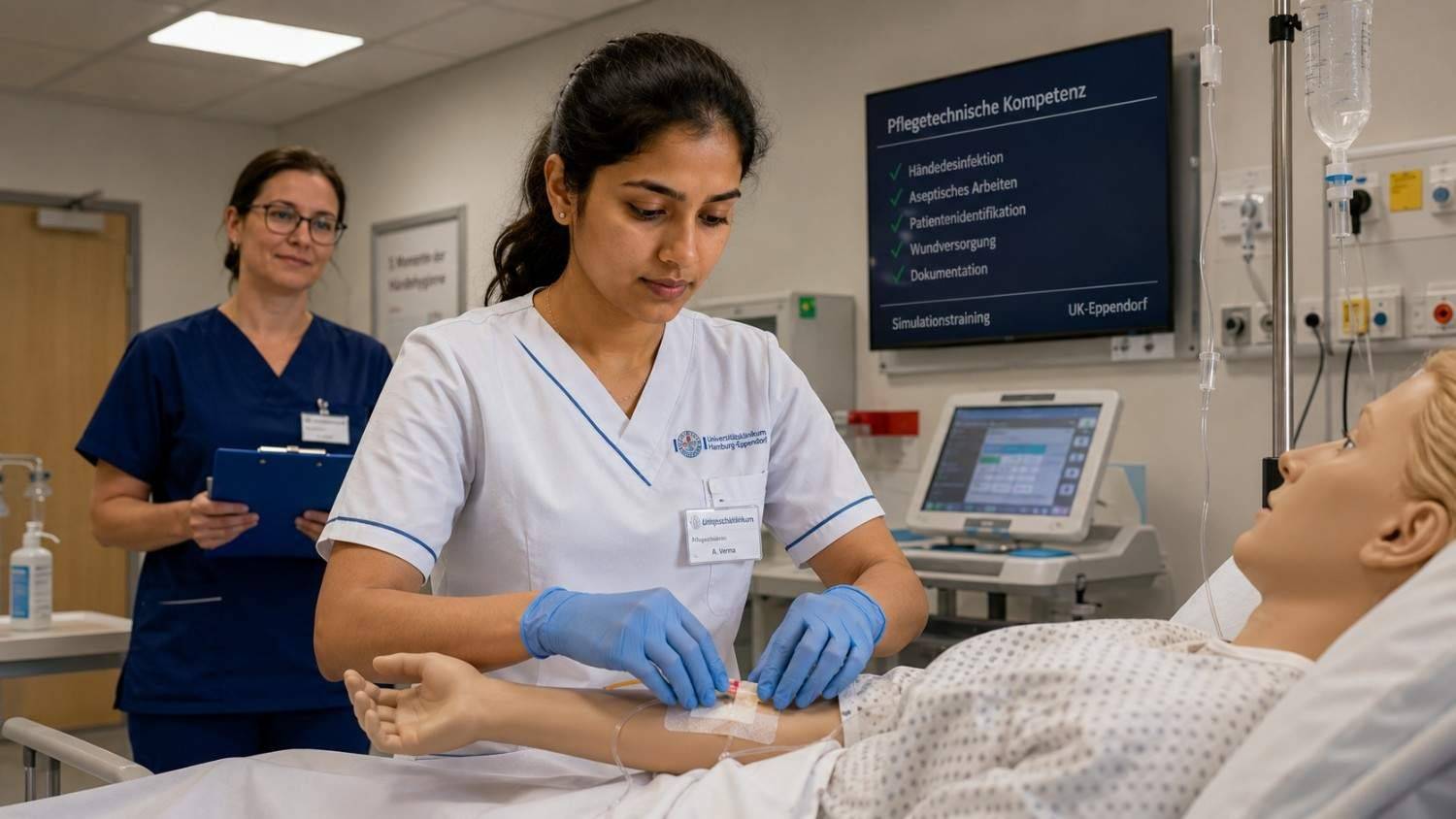
Most Indian nurses going through the Section 16d Recognition Visa pathway will complete their German recognition through an adaptation period (Anpassungsqualifizierung) - a supervised work phase in a German hospital where their clinical skills are assessed against German nursing standards. For most nurses, this is sufficient to receive full recognition.
However, there is a second route: the Kenntnisprüfung. This is a formal examination that assesses whether a nurse's knowledge and practical skills meet German nursing standards. Not every nurse needs it - but for those who do, understanding what it involves and how to prepare can make the difference between passing on the first attempt and an extended delay in achieving full recognition.
Kenntnisprüfung translates directly as 'knowledge examination' or 'aptitude test.' In the context of German nursing recognition, it is a formal exam conducted by the state recognition authority (Landesprüfungsamt) to assess whether a foreign-qualified nurse's professional knowledge meets the standards of the German Pflegefachmann / Pflegefachfrau qualification.
Unlike the FSP - which tests language and communication skills - the Kenntnisprüfung tests clinical and professional nursing knowledge. It may include practical components (demonstrating nursing procedures) as well as written or oral examination elements, depending on the state authority conducting it.
The Kenntnisprüfung exists because German nursing standards are highly specific. When a foreign nurse's qualification is reviewed and found to have substantial gaps compared to what a German-trained nurse would know, the recognition authority can require them to demonstrate competency through this examination rather than through the longer adaptation period.
| Factor | Adaptation Period | Kenntnisprüfung |
|---|---|---|
| What it is | Supervised work phase in a German hospital where clinical skills are assessed over time | A formal examination testing clinical nursing knowledge and skills |
| Duration | Typically 6–24 months depending on assessed gaps | Exam is a single assessment event (or series of assessments) |
| Who decides which route? | The state recognition authority after reviewing your qualifications | The state recognition authority - offered as an alternative to adaptation period |
| Can you choose? | Usually - in most states you can choose between the two routes | Yes - in states that offer a choice, you can opt for Kenntnisprüfung instead of adaptation period |
| Income during the process? | Yes - you are employed during adaptation period | Depends - some nurses take a short preparation period, others prepare while working |
| Common for Indian nurses? | Yes - most Indian nurses use this route | Less common but relevant for nurses with specific qualification gaps |
The Kenntnisprüfung is required (or offered as an option) in specific circumstances. Whether it applies to you depends on the assessment by the German state recognition authority after they review your submitted qualification documents.
It is important to understand that being required to take a Kenntnisprüfung does not mean your qualification is inferior or that you are not a good nurse. It simply means the German recognition authority identified specific areas where formal examination is needed to confirm equivalency. This is a regulatory requirement, not a personal judgment.
The content and format of the Kenntnisprüfung varies by German state - there is no single national standard. However, the examination typically covers the core competencies of the German nursing qualification:
| Area | Examples of What Is Assessed |
|---|---|
| Clinical nursing procedures | Wound care, medication administration, infusion management, catheterisation, injections |
| Patient assessment and monitoring | Vital sign interpretation, patient observation, deterioration recognition and escalation |
| Care planning and documentation | Nursing assessment, care plan development, German documentation standards |
| Nursing theory and evidence base | German nursing models, evidence-based practice, professional ethics |
| Hygiene and infection control | German infection control standards, sterilisation, isolation procedures |
| Emergency response | Basic life support, emergency assessment, escalation protocols in German hospitals |
| Specialisation areas | Depending on your placement - geriatric care, surgical nursing, medical ward care |
The examination format depends on the German state, but typically includes some combination of the following:
A written paper testing theoretical nursing knowledge - case studies, clinical scenarios, or short answer questions. This may include questions on anatomy, pharmacology, nursing procedures, and patient safety. Written in German.
A practical skills demonstration in a simulated or real clinical environment. You may be asked to demonstrate specific nursing procedures, conduct a patient assessment, or manage a simulated clinical scenario under observation. The assessor evaluates both your technical skill and your professional conduct.
An oral examination where you discuss clinical cases, explain nursing decisions, or respond to hypothetical patient scenarios in German. This component also assesses your professional reasoning and communication skills.
In many German states, yes - when the recognition authority identifies qualification gaps, you are offered a choice: complete a supervised adaptation period to address the gaps through practical work, or take the Kenntnisprüfung to demonstrate competency through examination.
The right choice depends on your situation. If you are a confident, experienced nurse with strong clinical skills and are motivated to pass an exam, the Kenntnisprüfung can be faster - especially if the required adaptation period would be long. If you prefer to learn and demonstrate skills over time in a supportive work environment, the adaptation period may suit you better.
Most JSJ nurses opt for the adaptation period as it allows them to earn a full salary while working towards recognition. However, for specific situations, the Kenntnisprüfung is a valid and sometimes preferable route. Discuss this with your Jet Set Jobs advisor and your German employer before making a decision.
Once you pass the Kenntnisprüfung, the state recognition authority issues your Berufserlaubnis (provisional nursing licence) or, in some cases, progresses your application towards full Approbation (permanent nursing licence). From this point, you are fully recognised as a qualified nurse in Germany and can practice without the restrictions of the adaptation period.
Full recognition also typically means a salary increase - from the pre-recognition rate of approximately €2,800–€3,000 per month gross to the post-recognition rate of approximately €3,300–€3,500 per month gross, depending on your employer's collective agreement and the state you are working in.
The Kenntnisprüfung is a step that happens in Germany - not in India. At Jet Set Jobs, we do not conduct Kenntnisprüfung preparation as part of our India-based training programme. What we do is ensure that every nurse we place understands the recognition process fully before they leave India - including the possibility of the Kenntnisprüfung - and that our employer partners are experienced in supporting nurses through this process.
You will never arrive in Germany and be surprised by the Kenntnisprüfung. It will be discussed with you as part of your recognition pathway, and your employer will guide you through the specific requirements of your state. Our role is to make sure you arrive informed, prepared in language skills, and matched with an employer who is experienced in international nurse recognition.
📞 Book Your Free Consultation
Call / WhatsApp: +91 96259 66817
Email: support@jetsetjobs.in | www.jetsetjobs.in
500+ nurses are on their way to Germany & Austria with us. Free B2 training. Zero recruitment fees.