🛡️ Licensed by Ministry of External Affairs · RA:
B-3413/DEL/COM/1000+/5/11419/2026
📞 +91 96259 66817
📍 15, 2nd Floor, South Patel Nagar, Delhi-110008
📌 What You'll Learn
The Berufsschule is the classroom half of your Ausbildung - and for many Indian trainees, it is the most challenging part. This blog explains what the Berufsschule is, how it works, what subjects you will study, and practical strategies to study effectively in German and pass your exams.
Germany's Ausbildung system is called the duale Ausbildung - the dual system - because training happens in two places simultaneously. Your Ausbildungsbetrieb (training company) is where you learn by doing: hands-on work, practical skills, real employer supervision. Your Berufsschule (vocational school) is where you learn the theoretical and academic side: written knowledge, regulatory frameworks, business calculations, and sector-specific theory.
These two components are not separate - they are designed to reinforce each other. What you study in the Berufsschule directly connects to what you do in the workplace. A Mechatroniker learns electrical theory at Berufsschule and applies it to machines at the employer. A Kaufmann im Gesundheitswesen studies accounting and documentation theory at Berufsschule and uses those skills in their employer's administrative processes every day.
Attendance at the Berufsschule is legally mandatory. Your employer cannot ask you to skip it. German law under the Berufsbildungsgesetz gives you the right to attend - and the obligation to attend. Missing Berufsschule without a medical certificate (Krankmeldung) counts as an unexcused absence and can affect your final assessment.
Different sectors and Ausbildung occupations have different Berufsschule schedules. Most operate on one of two models:
Your specific schedule will be communicated to you by your employer and the Berufsschule at the start of your Ausbildung. You do not choose the model - it is set by the Ausbildungsordnung (training regulation) for your specific occupation.
Berufsschule curricula are nationally standardised for each Ausbildungsberuf. While the specific content varies by occupation, most programmes cover a mix of occupation-specific subjects and general education:
| Subject Category | Examples (vary by occupation) | Exam Relevance |
|---|---|---|
| Occupation-specific theory | Anatomy basics (care sector); Electrical engineering theory (mechatronics); Logistics systems (Fachlagerist) | High - directly tested in Abschlussprüfung |
| Business and economics (Wirtschaft) | Cost calculation, business processes, customer service, contract law basics | High - tested in written exams |
| German language and communication | Business correspondence, documentation, professional writing | Moderate - ongoing assessment |
| Politics and social studies (Sozialkunde) | German labour law, workers' rights, civic knowledge | Lower - but required attendance |
| Practical applications | Role-play scenarios, case studies, problem-solving exercises | Moderate - assessed in oral or practical exams |
| Mathematics / Calculations | Cost accounting, unit calculations, dosage calculations (care sector), logistics quantity calculations | High - common weak area for international trainees |
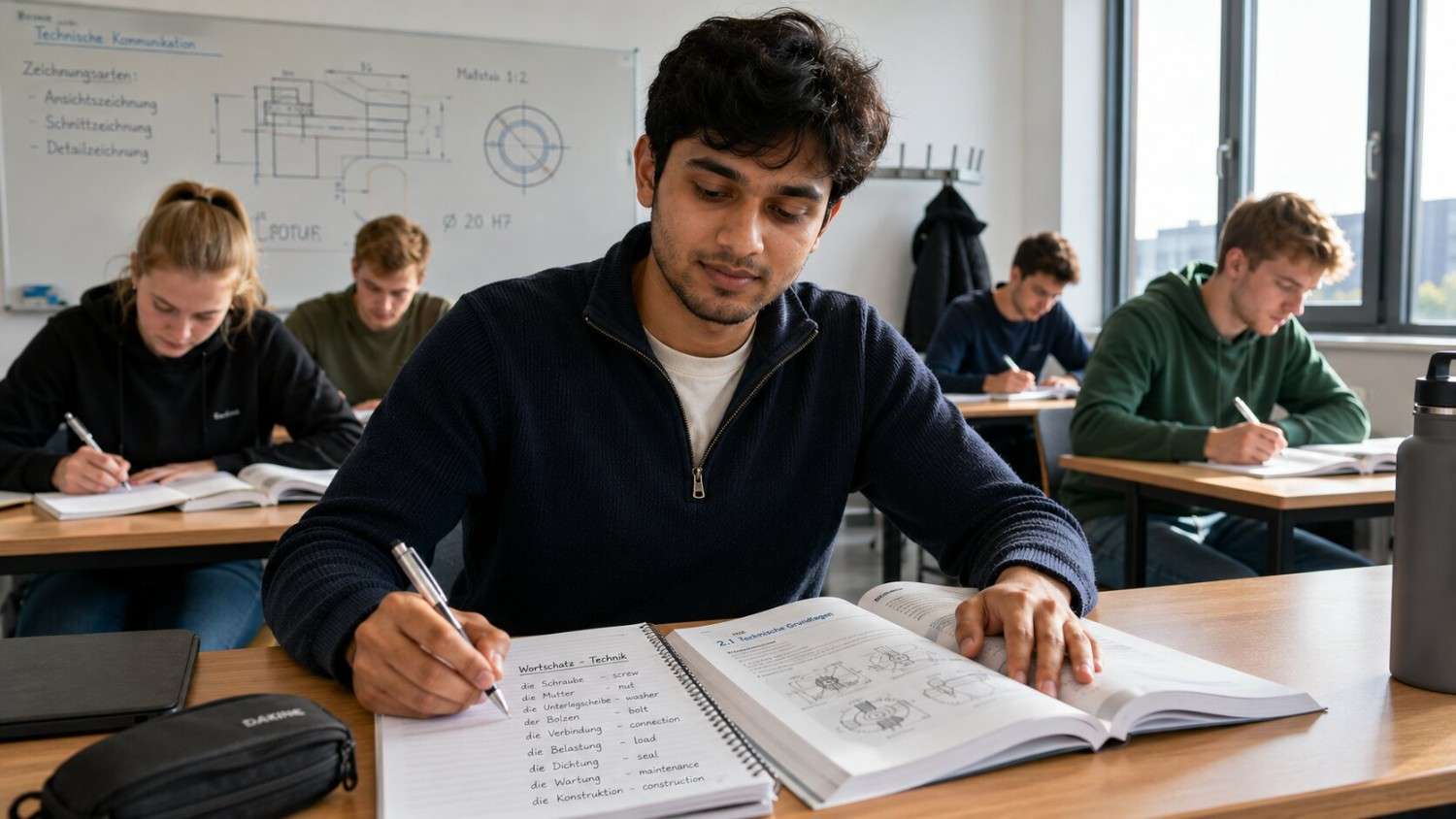
Here is the part that no one explains clearly enough before candidates leave India: the Berufsschule is conducted entirely in German. Not A1 German. Not basic conversational German. Subject-specific, technical, sector-level German - taught at a pace set for students who have grown up in Germany and attended German school.
For Indian trainees who arrive at B2 level, this is challenging but manageable. For trainees who arrive at the lower end of B2 or a strong B1, the first semester of Berufsschule can feel overwhelming - particularly the written assignments, the vocabulary of your specific occupation, and the speed of teacher explanations. This is normal, it is expected, and it passes.
The JSJ language training programme takes you from A1 to B2 in 10 to 12 months specifically so that you arrive at Berufsschule with a functional base. But arriving at B2 is the start, not the finish. Your German will continue to develop throughout your Ausbildung, and the classroom environment - despite its initial difficulty - is one of the fastest ways to build professional-level language proficiency.
💡 Practical Tip
In your first Berufsschule semester, record every lesson (ask your teacher's permission first - most agree). Listen back during your commute or before bed. German audio comprehension builds faster through repetition than through reading alone. Many Indian trainees report that their classroom German improved significantly between Month 2 and Month 6 simply through consistent listening.
Indian students in general have strong study habits and exam discipline - a genuine advantage in the German Berufsschule system. Here are the strategies that experienced Indian Ausbildung graduates consistently recommend:
Approximately halfway through your Ausbildung - usually after 12 to 18 months - you will sit your Zwischenprüfung. This is a formal intermediate exam administered by the relevant competent body (IHK, Pflegekammer, etc.). It does not count toward your final qualification on its own, but it gives you and your employer a clear picture of where you stand and what you need to work on before the final exam.
The Zwischenprüfung typically consists of written papers covering the theory you have studied in Berufsschule up to that point. Many trainees find it more manageable than expected - because by Month 12 to 18, their German has improved significantly from where it was on arrival.
The Abschlussprüfung is the examination you sit at the end of your three-year Ausbildung. It is the exam that awards you your Berufsabschluss - the German vocational qualification, valid across all 27 EU member states. For most occupations, it consists of multiple written papers, a practical examination component, and sometimes an oral element.
The preparation you invest in your Berufsschule over three years - the vocabulary notebook, the study partnerships, the past papers - all feeds into this moment. The national pass rate for Ausbildung final exams in Germany is around 90 percent. For motivated, prepared trainees who have taken the Berufsschule seriously, there is every reason to be confident.
📌 The Bottom Line
The Berufsschule is challenging. It is conducted in German. It tests your occupation-specific knowledge at a professional level. But it is also the part of Ausbildung that transforms you from a student into a certified Fachkraft. Every Indian trainee who has gone through this system and stayed the course has said the same thing: the Berufsschule was hard, and it was worth every bit of the effort.
📞 Book Your Free Consultation - Jet Set Jobs × Destination Germany
Call / WhatsApp: +91 96259 66817
Email: support@jetsetjobs.in | www.jetsetjobs.in
Ausbildung Programme Germany 2027
Eligibility: Age 18–25 | Class 12 pass | Science background preferred
Programme Fee: ₹2,50,000 + GST in 3 instalments
Free German A1–B2 training included | Stipend: €1,000–€1,300/month