🛡️ Licensed by Ministry of External Affairs · RA:
B-3413/DEL/COM/1000+/5/11419/2026
📞 +91 96259 66817
📍 15, 2nd Floor, South Patel Nagar, Delhi-110008
📌 A Note Before You Begin
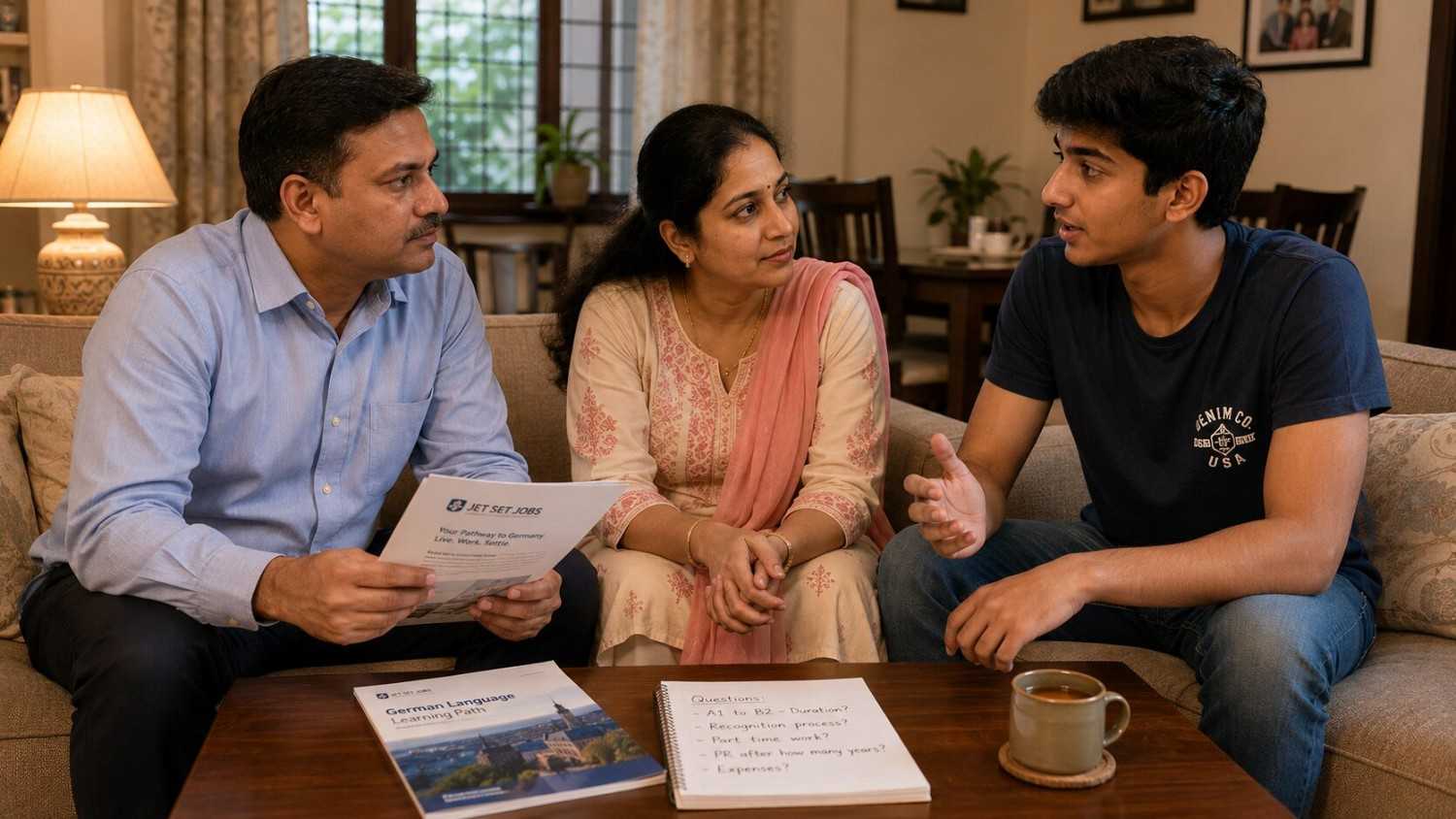
This blog is written for parents. Not for students, not for recruiters — for the mother or father reading this alone, after their son or daughter mentioned Germany, who wants honest answers before this conversation goes any further. Every question in this blog is a real question that JSJ counsellors hear from parents every week. Every answer is the honest one.
If your child has come to you with information about going to Germany for three years to work and study, your first reaction was probably not excitement. It was likely something closer to concern. Where will they live? Who will look after them if they get sick? What kind of employer is this? Can I visit? What if something goes wrong?
These are not obstacles to the conversation. They are the conversation. Any parent who is not asking these questions is not paying attention. This blog addresses each of them directly — not to convince you of anything, but to give you the information you need to make a sound decision alongside your child.
Germany consistently ranks among the safest countries in the world by crime index and quality of life measures. The cities where most Ausbildung trainees are placed — including cities in Baden-Württemberg, Bavaria, North Rhine-Westphalia, Hesse, and Lower Saxony — have very low violent crime rates by global and Indian urban standards.
Indian students have been living, studying, and working in Germany for decades. There is an established Indian community across German cities — cultural associations, temple communities, and informal networks that many new arrivals connect with. Your child will not be the first Indian person in their city, and they will not be isolated.
Germany has a comprehensive legal system that protects workers and trainees. An Ausbildung trainee has the same labour rights as any German employee — including the right to medical care, the right to safe working conditions, and the right to report employer violations to German labour authorities. These are enforced rights, not theoretical ones.
Your child's welfare in Germany is structured around three layers of support:
From Day 1 of Ausbildung in Germany, your child is enrolled in Germany's statutory health insurance system (gesetzliche Krankenversicherung or GKV). This is compulsory — it cannot be skipped. The cost is shared between the trainee and the German employer. Your child's personal contribution of approximately €80 to €110 per month is already factored into the net stipend figures.
Under GKV, your child has access to GP visits at no cost, specialist consultations with a GP referral, emergency hospital treatment at no cost, prescription medicines at a small copayment, dental check-ups twice a year, and mental health support through a licensed therapist. Germany has one of the most comprehensive public health systems in Europe. Your child will never face a situation where they cannot access medical care because of cost.
For non-emergency concerns, your child registers with a local GP (Hausarzt) near their accommodation. For genuine emergencies, any hospital emergency department treats anyone regardless of documentation. The emergency number is 112 — the same format as India's 112.
Yes. As a parent of an Indian national living and working legally in Germany, you can apply for a Schengen tourist visa to visit. The Schengen visa allows stays of up to 90 days within any 180-day period across 26 European countries including Germany.
To support your visa application, your child will provide an invitation letter confirming their address, their Ausbildungsvertrag (training contract), and their Meldebestätigung (official address registration). Your own documents will need to show sufficient funds for the visit and a return ticket. Schengen visa applications for parents of employed Indian nationals in Germany have a generally good approval rate when documentation is complete.
Most families plan a visit in the summer months. Many parents who visit return with a very different perspective — seeing the workplace, the city, the structured environment, and their child's visible progress replaces abstract worry with concrete reassurance.
A typical week for an Ausbildung trainee has two components. Most trainees spend three to four days per week at their employer — working alongside qualified German colleagues, performing real tasks in their sector, and receiving hands-on training under an assigned supervisor (Ausbilder). One to two days per week are spent at the Berufsschule (vocational school), where theoretical subjects are taught in German by qualified teachers.
In healthcare and caregiving roles, your child works in a hospital, care home, or clinical environment supporting patients under qualified supervision. In mechatronics, they work in a factory or engineering workshop with machinery, electrical systems, and technical processes. In business administration, they work in an office managing documentation, communication, and administrative processes.
The work is structured. Hours are fixed — typically 35 to 40 per week. The Ausbildungsordnung (training regulation) for each occupation specifies exactly what must be taught at each stage of the three years. There is no ambiguity.
India and Germany are 3.5 to 4.5 hours apart in time zones (depending on daylight saving). WhatsApp video calls are the standard communication channel for most Indian families with members in Germany. Network quality in German cities is generally excellent. Your child will have a German SIM card from their first week.
Most families settle into a routine of regular calls a few times per week. Many parents say that the pattern of regular calls from Germany — where their child is visibly settled, earning, and progressing — is actually less stressful than when the same child was in a distant Indian city for college.
Your family's investment in this programme is ₹2,50,000 plus GST, paid in three instalments aligned to milestones. This is real money, and it is non-refundable. Before committing, every family should do the calculation clearly.
Against this investment, your child begins earning €1,000 to €1,300 per month from Day 1 in Germany. After living costs of approximately €700 per month (lower in Year 1 if employer provides subsidised housing), most trainees have €200 to €300 available monthly that can be saved or sent home. Over three years, this surplus accumulates to €7,000 to €10,000 — approximately ₹6.3 to ₹9 lakh — that your family can receive as regular transfers.
After three years, your child qualifies as a Fachkraft and earns €2,500 to €3,600 per month. At that income level, their capacity to support the family while building their own life in Germany is substantially higher than most India-based career alternatives for a Class 12 or degree graduate.
📌 For Parents Who Are Still Uncertain
Call JSJ directly: +91 96259 66817. Not your child — you, as the parent. Ask every question you have. JSJ counsellors speak to parents regularly and will answer your specific concerns about safety, supervision, health, the employer, the city, and the financial structure. A 20-minute call often resolves months of background worry. You are entitled to that conversation before your family makes this decision.
📞 Book Your Free Consultation — Jet Set Jobs × Destination Germany
Call / WhatsApp: +91 96259 66817
Email: support@jetsetjobs.in | www.jetsetjobs.in
Ausbildung Programme Germany 2027
Eligibility: Age 18–25 | Class 12 pass | Science background preferred
Programme Fee: ₹2,50,000 + GST in 3 instalments
Free German A1–B2 training included | Stipend: €1,000–€1,300/month from Day 1