🛡️ Licensed by Ministry of External Affairs · RA:
B-3413/DEL/COM/1000+/5/11419/2026
📞 +91 96259 66817
📍 15, 2nd Floor, South Patel Nagar, Delhi-110008
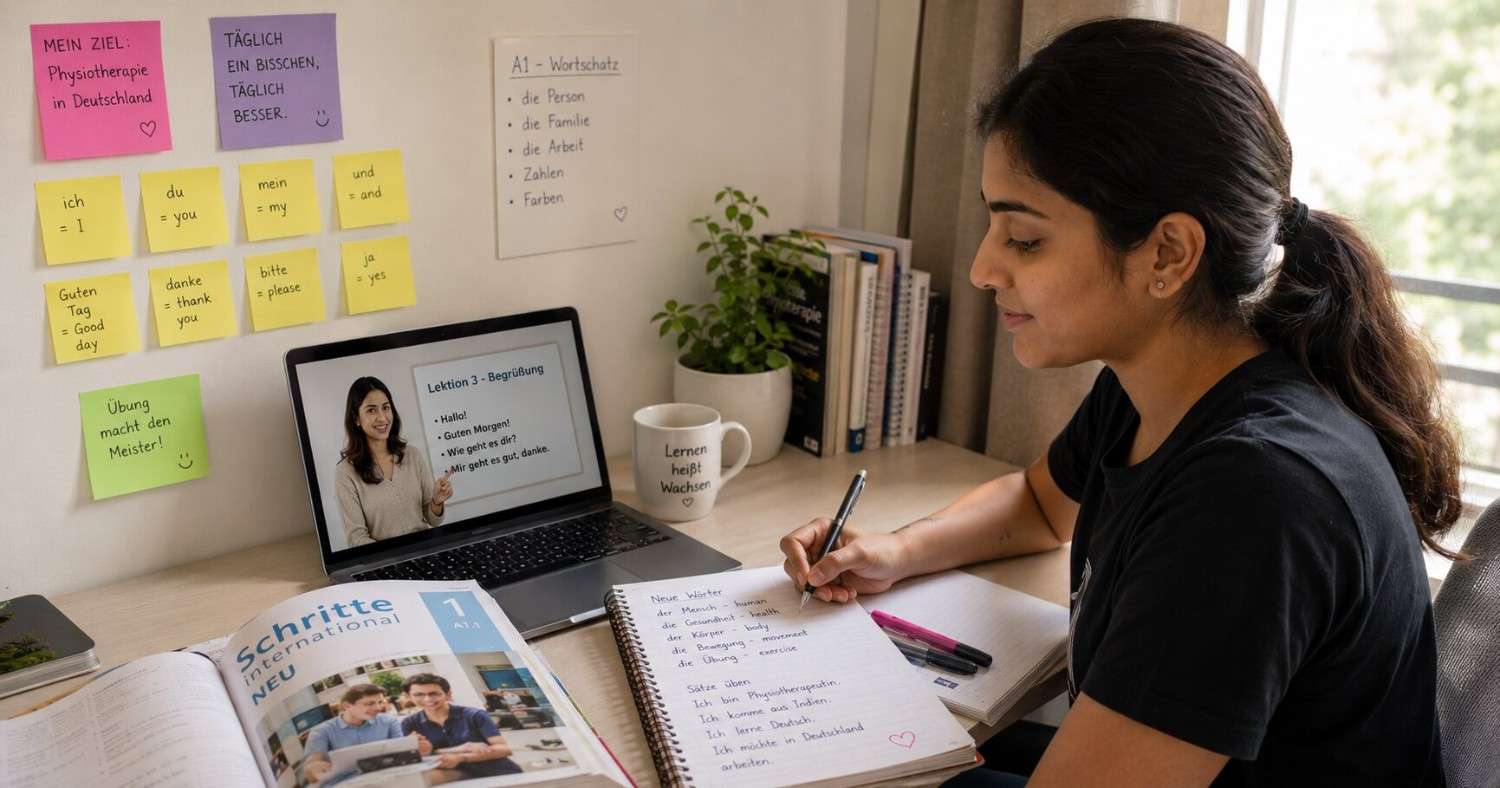
For most Indian physiotherapists, the single most intimidating part of the Germany pathway is the language. 'I have never learned German. I don't know a single word. How can I possibly reach a professional working level?' This anxiety is completely understandable - and completely surmountable. Thousands of Indian healthcare professionals who started with zero German now work confidently in Germany.
Learning German from scratch is not about talent or being 'good at languages'. It is about a structured method, consistent daily effort, and the right support. If you can commit to the process, the language is learnable.
German proficiency is measured using the Common European Framework of Reference for Languages (CEFR), which defines six levels from A1 (beginner) to C2 (mastery). For the Germany physiotherapy pathway, you need to reach B2 - upper-intermediate, professional working proficiency.
| Level | What You Can Do | Role in the Pathway |
|---|---|---|
| A1 - Beginner | Introduce yourself, basic greetings, simple everyday phrases, numbers, present tense | Foundation - your starting point from zero |
| A2 - Elementary | Handle routine daily situations, simple conversations, past tense, basic needs | Pre-screening milestone - Conditional Offer Letter stage |
| B1 - Intermediate | Hold conversations on familiar topics, express opinions, handle most travel situations | Bridge level - building toward professional fluency |
| B2 - Upper-Intermediate | Communicate fluently and spontaneously, understand complex texts, work professionally | The target - required for visa, employment, and recognition |
Each level builds on the previous one. You cannot skip levels - the foundation of A1 makes A2 possible, and so on. This is why a structured, sequential approach matters so much: rushing or skipping creates gaps that cause failure at the B2 exam or struggles in the clinical environment in Germany.
Many Indian learners are pleasantly surprised once they begin. Several features of German actually make it accessible to Indian speakers:
German does have challenging features - noun genders, case systems, and long compound words - but these are learnable with practice, and a good training programme introduces them gradually so they never feel overwhelming.
| Feature | What It Means for You |
|---|---|
| Online LMS platform | Learn from home - no commuting. Accessible across Delhi NCR and all of India. |
| C1-certified trainers | Many trainers hold C1 certification - strong command of the language they teach |
| Flexible batch timings | Morning, afternoon, evening batches - choose one that fits around your work |
| Structured level progression | Clear progression A1 → A2 → B1 → B2 with assessments at each stage |
| Regular assessments | Track your progress and identify gaps before they become problems |
| Speaking practice | Active conversation practice - essential for real fluency, not just exam-passing |
| Exam preparation | Targeted preparation for TELC or Goethe B2 certification exams |
Consistency matters far more than intensity. A learner who studies one to two hours every day will dramatically outperform one who crams for eight hours once a week.
| Activity | Time | Purpose |
|---|---|---|
| Live batch session (when scheduled) | 1–1.5 hours | Core structured learning with trainer and peers |
| Vocabulary practice (apps like Anki) | 15–20 min | Building and retaining word bank - daily repetition |
| Listening practice (podcasts, audio) | 15–20 min | Training your ear - Slow German, Deutsche Welle |
| Grammar review / homework | 20–30 min | Reinforcing rules and completing assignments |
| Speaking practice (with partner/app) | 15–20 min | Producing the language - the hardest and most important skill |
| Skill | What It Involves | How to Build It |
|---|---|---|
| Listening (Hören) | Understanding spoken German | Podcasts, audio lessons, German shows with subtitles |
| Reading (Lesen) | Understanding written German | Graded readers, news articles, textbook texts |
| Writing (Schreiben) | Producing written German | Homework, emails, structured writing practice |
| Speaking (Sprechen) | Producing spoken German | Conversation practice, batch participation, language partners |
In your first weeks (A1), you learn to introduce yourself, say where you are from, count, and handle basic greetings. Within a couple of months, you can have simple exchanges - ordering food, asking directions, talking about your day. By A2, you can handle routine situations and hold basic conversations. By B1, you are expressing opinions and managing most everyday interactions. By B2, you are communicating fluently enough to work professionally as a physiotherapist in a German clinical setting.
This progression is gradual and steady. You will not wake up fluent one day - but you will notice, month by month, that you understand more, say more, and think in German more naturally. That steady progress is deeply motivating once it begins.
📞 Book Your Free Counselling Session
Call / WhatsApp: +91 96259 66817 | +91 98100 08070
Email: support@jetsetjobs.in | www.jetsetjobs.in
500+ healthcare professionals are on their way to Germany & Austria with us.
Settle Abroad with Jet Set Jobs