🛡️ Licensed by Ministry of External Affairs · RA:
B-3413/DEL/COM/1000+/5/11419/2026
📞 +91 96259 66817
📍 15, 2nd Floor, South Patel Nagar, Delhi-110008
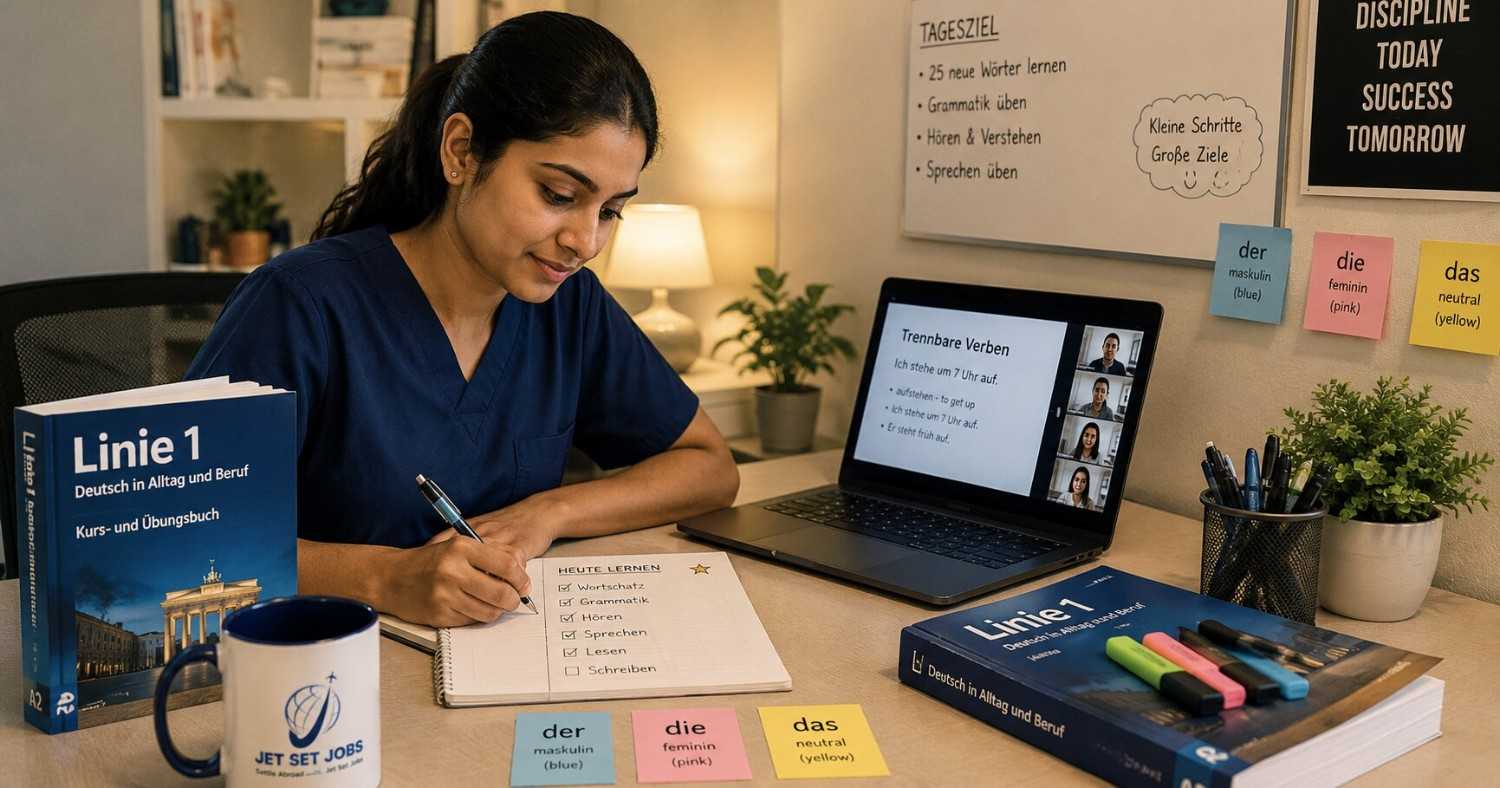
Over years of preparing Indian healthcare professionals for the German language requirement, certain mistakes come up again and again. The good news is that they are predictable - which means they are avoidable. If you know the common traps before you start, you can sidestep them and reach B2 faster, with better real-world fluency, and with far less frustration along the way.
This is the single most common and most damaging mistake. Many learners focus on grammar, vocabulary, reading, and listening - the things you can do alone and silently - while avoiding speaking, which feels uncomfortable and requires a partner. The result is a learner who can read and understand German but freezes when they have to actually speak it. Since speaking is heavily weighted in the B2 exam and is the single most important skill in a German clinical environment, this gap is serious.
Language learning rewards consistency far more than intensity. A learner who studies a little every day will dramatically outperform one who does nothing for a week then crams for six hours on Sunday. The brain consolidates language through regular, spaced exposure - not through occasional marathons. Inconsistent study also means you spend each session re-remembering what you forgot, rather than building on solid foundations.
Many Indian learners try to translate everything word-for-word from English or Hindi into German. This slows you down and produces unnatural German, because German sentence structure, word order, and idiom differ significantly from English and Indian languages. Learners stuck in 'translation mode' are always one step behind in conversation - mentally translating instead of thinking in German.
German nouns have three genders - der (masculine), die (feminine), das (neuter) - and the gender affects grammar throughout the sentence. Many learners ignore genders early, thinking they will learn them later. This is a costly mistake, because genders are hard to retrofit once you have learned hundreds of nouns without them, and incorrect genders ripple into case errors throughout your German.
Some learners treat the B2 exam as the goal and try to cram exam techniques and memorised answers to pass it - without building genuine underlying fluency. They might even pass the exam this way. But then they arrive in Germany and discover they cannot follow a clinical handover, understand a patient, or participate in a team discussion. The certificate without the fluency is worse than useless - it sets you up to struggle at exactly the moment it matters most.
Language learning has a well-known difficult middle phase - often around B1 - where the initial excitement has worn off, the material has become genuinely hard, and fluency still feels far away. This is where many learners lose motivation and either slow down dramatically or give up. It is a psychological challenge as much as a linguistic one. Those who push through this phase reach B2; those who give up here lose all the progress they made.
Watching German videos, listening to podcasts, and reading are valuable - but they are passive (input) activities. Many learners do lots of passive consumption and feel like they are learning, while doing very little active production (speaking and writing). You cannot become fluent only by consuming German; you must produce it. Passive learning builds comprehension; active production builds fluency.
Treating German as something you only do during class or study sessions limits your progress. The learners who advance fastest immerse German into their daily life - changing their phone language to German, listening to German music or podcasts during chores, watching German shows with subtitles, labelling household items with German words. This constant low-level exposure accelerates learning enormously without requiring extra dedicated study time.
| Mistake | The Fix |
|---|---|
| Neglecting speaking | Speak daily from day one, however imperfectly |
| Studying inconsistently | 30 min every day beats cramming weekly |
| Over-relying on translation | Learn to think in German; learn whole phrases |
| Ignoring noun genders | Learn every noun with its der/die/das article |
| Cramming for the exam | Build real fluency; the certificate follows |
| Giving up in the middle | Expect the plateau; push through with support |
| Passive learning only | Balance input with active speaking and writing |
| German only during study | Immerse German into daily life and environment |
📞 Book Your Free Counselling Session
Call / WhatsApp: +91 96259 66817 | +91 98100 08070
Email: support@jetsetjobs.in | www.jetsetjobs.in
500+ healthcare professionals are on their way to Germany & Austria with us.
Settle Abroad with Jet Set Jobs