🛡️ Licensed by Ministry of External Affairs · RA:
B-3413/DEL/COM/1000+/5/11419/2026
📞 +91 96259 66817
📍 15, 2nd Floor, South Patel Nagar, Delhi-110008
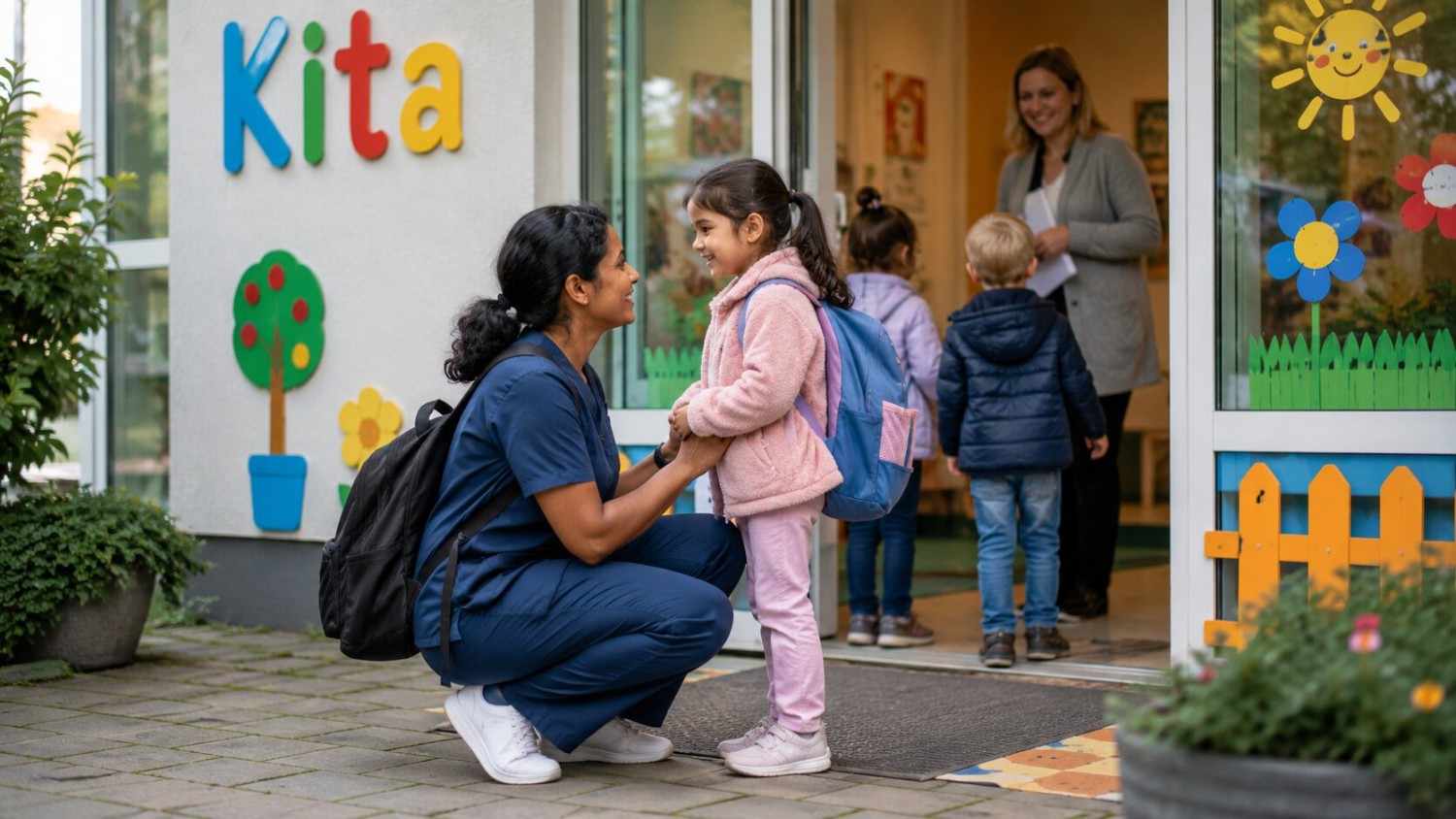
"Kita" (Kindertagesstätte) is the umbrella term for childcare, and it covers two age groups you will hear named separately: Krippe for children under three, and Kindergarten for roughly three to six. They are often in the same building. There is also the Tagesmutter / Tagesvater - a registered childminder caring for a small group in their own home, which can be a good fallback when Kita places are full.
Under German law, every child has a legal entitlement to a childcare place from their first birthday. That sounds like a guarantee, and it is a real, enforceable right. But be honest about the gap: entitlement is not the same as availability. In many cities there are long waiting lists, and families routinely register with several Kitas at once, often many months - sometimes a year or more - before they need a place.
Kita is not universally free in Germany - it depends on your federal state and often on your income:
| Type | Typical cost | Notes |
|---|---|---|
| Public Kita | Roughly €100–€400 a month full-time | Heavily state-subsidised; fees are often income-scaled |
| Some states (e.g. Berlin, Hamburg) | Effectively free | You may pay only a small meals flat rate |
| Private / bilingual Kita | Can exceed €1,000 a month | Fee-charging; sometimes shorter waiting lists |
| Tagesmutter (childminder) | Roughly €300–€600 a month (part-time) | Small group, registered with the Jugendamt |
Low-income families can also apply for support such as a Kita-Gutschein (a voucher confirming a subsidised or free place) through the Jugendamt - the youth welfare office, which is by far the most useful single contact in this whole process.
Germany pays Kindergeld (child benefit) to parents living and working there - €259 per child per month as of January 2026. You apply in writing to your local Familienkasse. It is not automatic, and nurses do forget it. Over a year, per child, that is a meaningful sum sitting unclaimed.
From around age six, school is compulsory (Schulpflicht) - and state schools are free, including for foreign children. Your child's residence status does not change their right to be educated. Children who arrive without German are usually placed in a welcome or preparation class to build the language before moving into a mainstream class. International schools exist, but they are private and expensive; the overwhelming majority of nurses' children go to the local state school, and thrive.
Here is the part parents are always surprised by. Children placed in a German Kita pick up the language through immersion at a speed no classroom can match - often becoming fluent within a year, and frequently faster than their parents. Kita is not just childcare while you work a shift; it is the single best integration tool your family has. Many nurses find their child becomes the household's translator.
📞 Book Your Free Consultation
Call / WhatsApp: +91 96259 66817
Email: support@jetsetjobs.in | www.jetsetjobs.in
500+ nurses are on their way to Germany & Austria with us. Free B2 training. Zero recruitment fees.