🛡️ Licensed by Ministry of External Affairs · RA:
B-3413/DEL/COM/1000+/5/11419/2026
📞 +91 96259 66817
📍 15, 2nd Floor, South Patel Nagar, Delhi-110008
📌 WHAT YOU'LL LEARN
What the German dual system is - and why it's the secret to Germany's skilled workforce - how your three years actually split between the workplace and the classroom, and why this model means you earn while you learn and finish job-ready.
You've heard the word ‘Ausbildung’ a hundred times by now. But to really understand what you're signing up for, you need to understand the engine underneath it: the German dual system (das duale System). It's the model that turns an ordinary Class 12 student into a qualified, in-demand professional in three years - and it's genuinely different from anything in the Indian education system. Once it clicks, the whole programme makes sense.
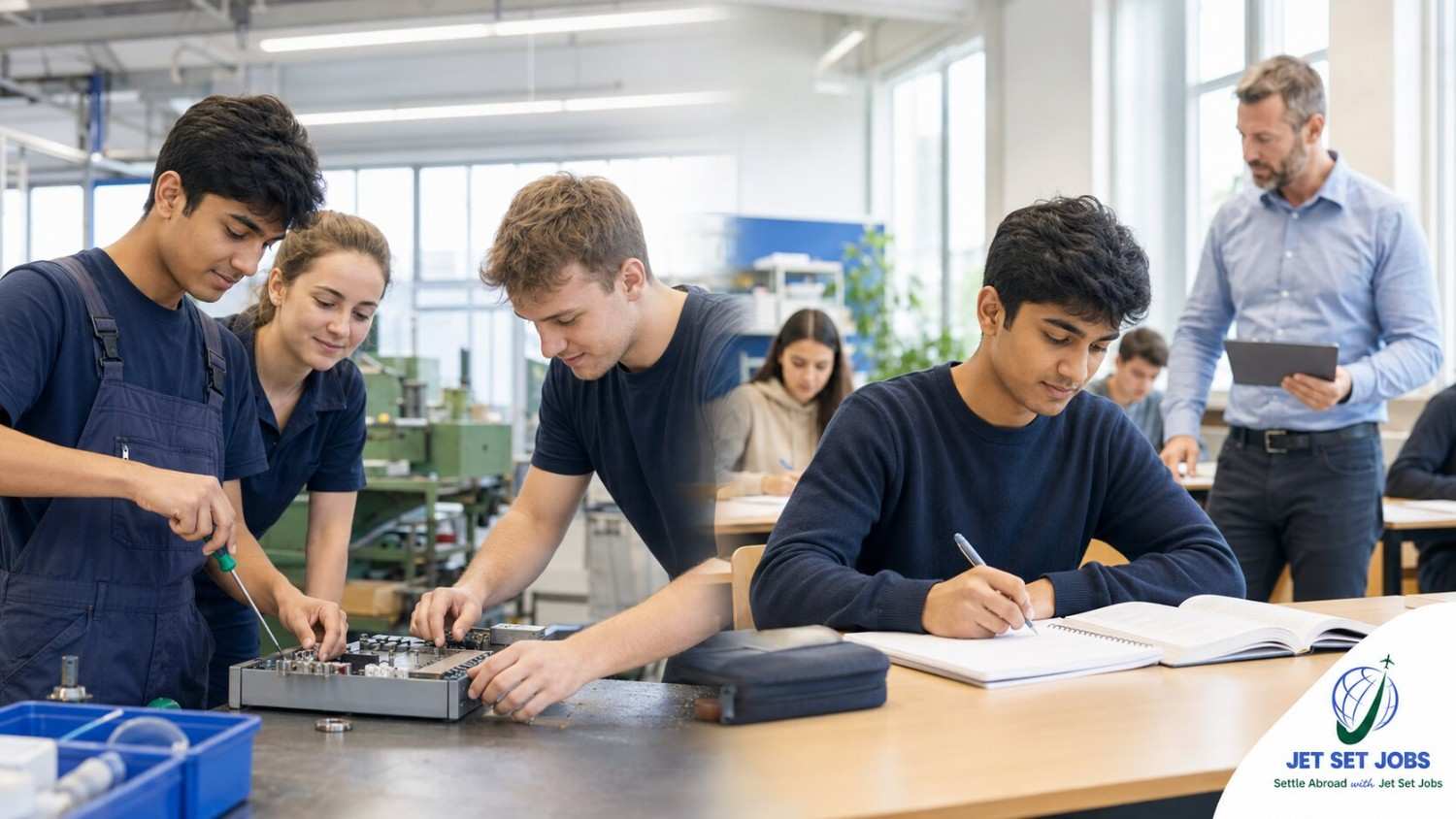
The word ‘dual’ is the key. Your training happens in two places in parallel, not one. On one side, you're an employee at a real German company, doing real work and getting paid for it. On the other, you're a student at a vocational school (the Berufsschule), learning the theory behind your trade. You move between the two throughout your three years - and both halves count equally toward your final qualification.
A typical rhythm looks like a few days a week at the company and one or two days at the Berufsschule - or the school portion delivered in blocks of several weeks. Either way, the principle is the same: you learn the hands-on skills where the work actually happens, and the underlying knowledge in the classroom, so the two constantly reinforce each other.
| The two halves | What happens there |
|---|---|
| At the company (the practical part) | You do real work alongside qualified colleagues, supervised by a certified trainer (Ausbilder). You earn your stipend here, and you build the actual hands-on skill of your trade. |
| At the Berufsschule (the theory part) | You study the technical knowledge, plus general subjects, that sit behind your trade - the ‘why’ behind the ‘how’ you're learning at work. |
Everything is coordinated by Germany's chambers (the IHK or HWK, depending on your trade), which set the standards and run the exams. At the end, you sit a final examination (the Abschlussprüfung), and passing it earns you a nationally recognised qualification - the same one a German trainee receives.
Understanding the dual system explains why Ausbildung is such an unusual opportunity for an Indian student:
This is the difference between a degree that teaches you about a job and a system that trains you in one. By the time you qualify, you've already been doing the work for three years.
In the Indian model, you typically study first and gain workplace experience later - often paying for the education and then hunting for a job. The dual system flips that: the job and the study happen together, the employer pays you, and a job is what you're being trained directly into. It's not better or worse in the abstract - but for a student who wants to earn, learn a practical skill, and build a career abroad without debt, it's a remarkably efficient path.
⚠️ THE HONEST NOTE
The dual system's strength is also its demand: it's real work and real study at the same time, in German. That's more intense than a course you simply attend. But it's exactly this intensity that makes the qualification so valuable and the job so secure at the end. You're not buying a certificate - you're being built into a professional. Go in understanding that, and the three years make complete sense.
So am I a student or an employee during Ausbildung?
Both, at the same time - that's the whole point of ‘dual.’ You're an employee at your company (earning a stipend, with employee rights) and a student at the Berufsschule (learning the theory). The two run in parallel across your three years and both count toward your qualification.
How much time is at work versus at school?
A common pattern is a few days a week at the company and one or two at the Berufsschule, or the school portion delivered in multi-week blocks. It varies by trade and region, but the split always combines hands-on work with classroom theory.
Is the final qualification actually recognised?
Yes - it's a nationally recognised German qualification, set and examined by Germany's chambers (IHK or HWK), identical to what a German trainee earns. That recognition is a big part of why it opens the door to a skilled-worker career and long-term settlement.
583+ aspirants have already started their Germany journey with Jet Set Jobs and Destination Germany.
📞 Book Your Free Consultation - Jet Set Jobs × Destination Germany
Call / WhatsApp: +91 96259 66817
Email: support@jetsetjobs.in | www.jetsetjobs.in
Ausbildung Programme Germany 2027
Eligibility: Age 18–25 | Class 12 pass | Science background preferred
Programme Fee: ₹2,50,000 + GST in 3 instalments
Free German A1–B2 training included | Stipend: €1,000–€1,300/month