🛡️ Licensed by Ministry of External Affairs · RA:
B-3413/DEL/COM/1000+/5/11419/2026
📞 +91 96259 66817
📍 15, 2nd Floor, South Patel Nagar, Delhi-110008
 JET SET JOBS
Settle Abroad with Jet Set Jobs
JET SET JOBS
Settle Abroad with Jet Set Jobs
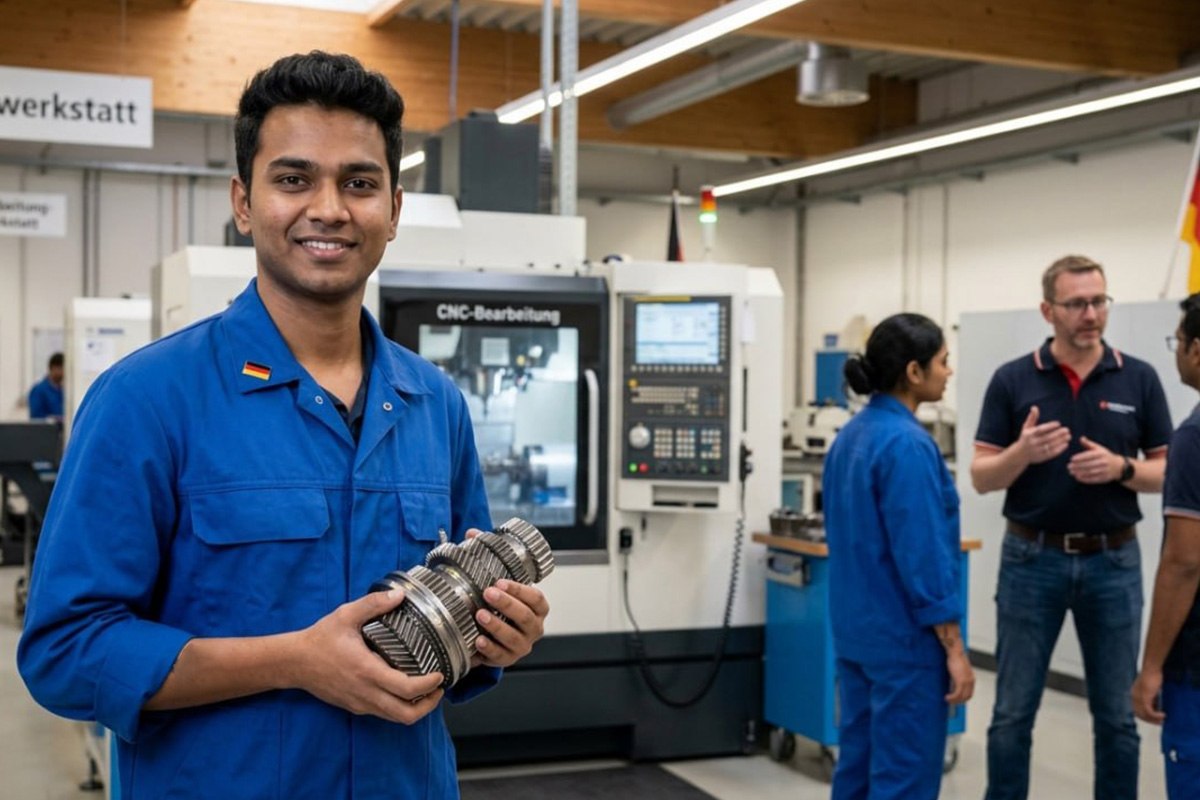
In this guide, you will learn exactly what Ausbildung is, why it is one of the best opportunities for Indians today, and how to use it to build a career – and a life – in Germany.
Ausbildung. Most Indians hearing this word for the first time have no idea what it means. Some assume it is a university course. Others think it is a work permit. It is, in fact, neither – and it is far more valuable than both.
Ausbildung is Germany’s official dual vocational training system. It is how Germany has trained its workforce for over a century. As of 2026, there are more than 78,000 unfilled Ausbildung positions across Germany, and the country is actively inviting young people from India to fill them. If you are between 18 and 25 years old, have passed Class 12 or above, and are willing to spend three years in Germany working and learning, Ausbildung may be the most important opportunity you have not yet heard of.
The word Ausbildung translates directly from German as ‘training’ or ‘education.’ In practice, it refers to a government-regulated programme where a trainee works at a real German company and attends a vocational school on alternating days. You spend roughly three days a week at your employer’s premises getting hands-on experience, and two days at school studying the theory behind your work. This combination is called the dual system – and it is the reason German vocational qualifications are respected across the entire European Union.
Ausbildung is not an internship. It is not unpaid experience. From your very first day, you are a legal employee of a German company. You sign a training contract. You receive a monthly stipend. You are covered by Germany’s social insurance system – health insurance, pension contributions, and all. You are protected by German labour law.
This is where most Indians are genuinely surprised. In Ausbildung, your German employer pays you a monthly stipend throughout your training. You do not pay them tuition. The arrangement works in the opposite direction from traditional study-abroad programmes.
| Training Year | Monthly Stipend (approx.) | In Indian Rupees (approx.) |
|---|---|---|
| Year 1 | €900 – €1,100 | ₹81,000 – ₹99,000 |
| Year 2 | €1,000 – €1,200 | ₹90,000 – ₹1,08,000 |
| Year 3 | €1,100 – €1,300 | ₹99,000 – ₹1,17,000 |
These amounts vary by sector and employer. Healthcare and IT tend to sit at the higher end. The key point is that from the moment you land in Germany, you are earning – not spending. For most Indian families, this changes the entire financial calculation of sending a child abroad.
Germany currently offers Ausbildung in over 320 recognised occupations. For Indian applicants, the most accessible and in-demand fields include healthcare and nursing, mechatronics and industrial mechanics, logistics and supply chain management, hospitality and hotel management, IT and software development, and retail and business administration. The healthcare sector is particularly notable – it has the largest number of foreign Ausbildung trainees in Germany, at over 68,000 positions, and demand is only growing as Germany’s population ages.
After completing your three years of training and passing the final examinations set by your local Chamber of Commerce (IHK) or Chamber of Crafts (HWK), you receive a nationally recognised German vocational qualification. This is not a certificate from a private institute or an online course. It is a federal government qualification, valid across Germany and recognised throughout the European Union. With this qualification in hand, you can apply for skilled worker roles across the entire EU – not just in Germany.
This is one of the most compelling aspects of the programme. After completing your Ausbildung and working in Germany for two more years in a skilled role, you become eligible to apply for a Niederlassungserlaubnis – Germany’s Permanent Residency permit. The total timeline from registration to PR eligibility is roughly five to six years. This is one of the most straightforward pathways to European permanent residency available to Indians today.
When you go to Germany on a student visa, you pay tuition fees. You may work part-time, but your income is limited and your primary status is that of a student. With Ausbildung, you arrive on a Vocational Training Visa (§16a AufenthG). You are an employee. Your employer pays you. There are no tuition fees from your side. The only cost involved is the programme fee you pay to an Indian placement agency like Jet Set Jobs – which covers your German language training from A1 level, your placement with a verified German employer, Ausbildung orientation, visa guidance, and pre-departure support.
Important: Ausbildung is a paid programme in India. The total fee for the Jet Set Jobs × Destination Germany Ausbildung Programme is ₹2,50,000 + GST, paid across three milestone-linked instalments. You only pay when confirmed milestones are reached – not all at once.
Jet Set Jobs is a New Delhi-based placement organisation working in partnership with Destination Germany – a Germany-based firm with over 300 confirmed Ausbildung placements, 180+ verified employer partners, and €7.2 million in gross salaries already earned by their candidates. Together, we manage the entire India-side journey: German language training from A1 through to B2 with 8 certified trainers, employer matching and orientation, visa support, and pre-departure preparation. Over 583 candidates have already started their Germany journey with us.
The 2027 Ausbildung intake is now open for registration. If you are aged 18 to 25, have passed Class 12 in any stream, and are ready to commit three years to building your future in Germany, this is your entry point.
Book a free demo class at our Karol Bagh centre or attend online. No commitment. No fees. Just one hour that could change your career.
Karol Bagh, New Delhi – 110008