
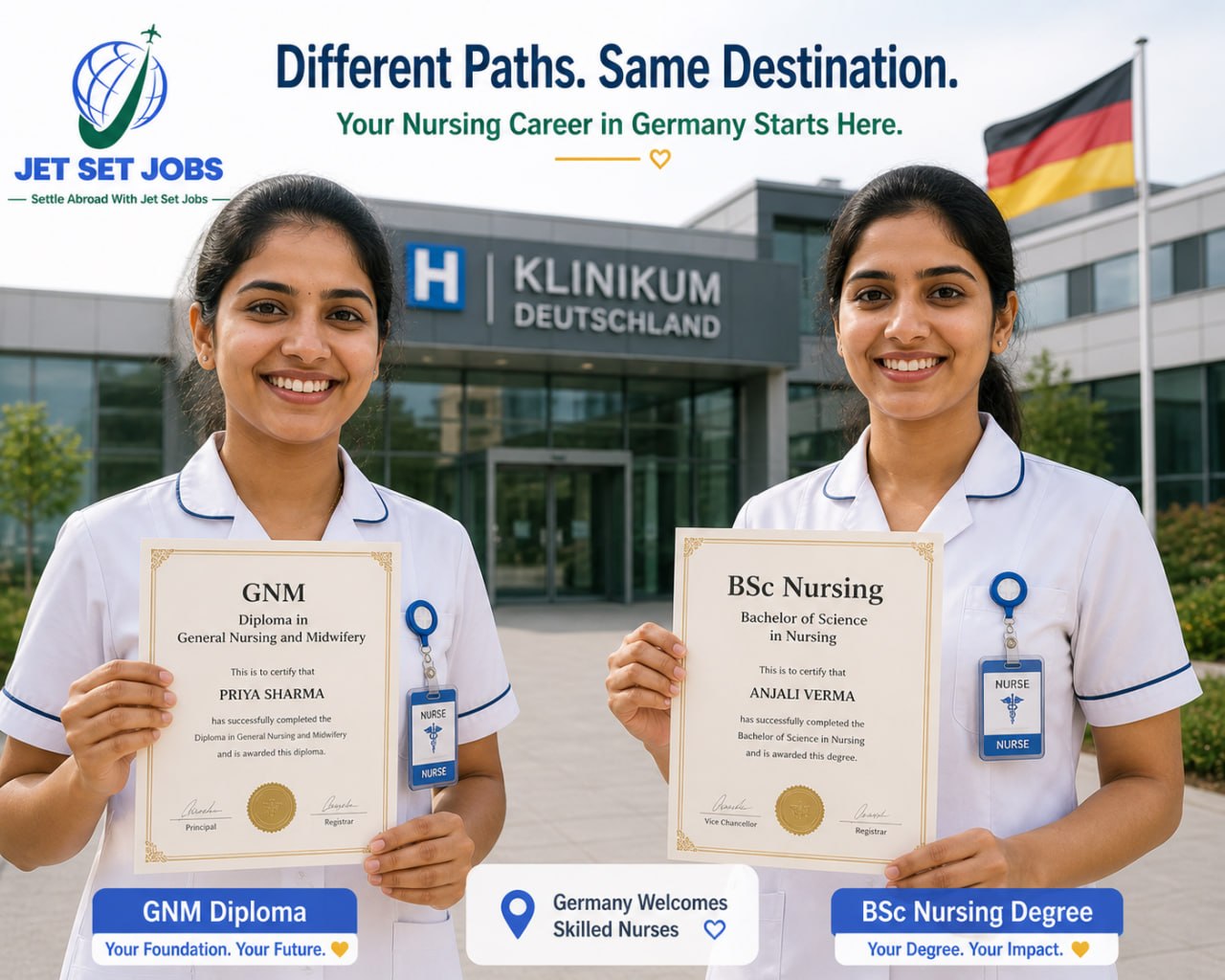
India produces two primary nursing qualifications — the General Nursing and Midwifery (GNM) diploma and the Bachelor of Science in Nursing (BSc Nursing) degree. Both are recognised by the Indian Nursing Council, both produce competent nurses, and both are accepted by German employers and recognition authorities. But they are not treated identically in the German system — and understanding the differences will help you manage your expectations and plan your Germany journey accurately.
What Germany Looks For — The Basic Standard
Germany's nursing profession is governed by the Pflegeberufegesetz (Nursing Professions Act) of 2020, which set a national standard for nursing qualifications — a 3-year training programme covering specific competencies in general nursing, paediatric nursing, and elderly care. When German authorities assess Indian nursing qualifications, they compare them against this standard.
GNM — How It Is Assessed in Germany
The GNM is a 3-year diploma programme with extensive hospital-based training — typically 1,000+ hours of clinical practice. It is the most common nursing qualification in India and the majority of Jet Set Jobs candidates hold a GNM.
In terms of duration, the GNM matches the German 3-year standard. However, the curriculum content — particularly in areas like anatomy, pharmacology depth, and evidence-based practice — sometimes differs from the German standard. As a result:
| Recognition Outcome for GNM | When It Applies | Practical Implication |
|---|---|---|
| Full recognition (Volle Anerkennung) | Possible — especially for experienced nurses with 3+ years clinical work | Less common for fresh GNM graduates; more common with experience |
| Partial recognition + adaptation period | Most common outcome for GNM holders | Adaptation period typically 6–12 months — working at full salary in Germany |
| Knowledge examination (Kenntnisprüfung) | Alternative to adaptation — option chosen by some candidates | Requires intensive preparation in Germany |
The adaptation period is not a setback — it is a structured, paid work period where the GNM nurse works in a German hospital under supervision, earning €2,800–€3,000 per month. After completing it, full recognition is granted and salary rises to the fully registered nurse level.
BSc Nursing — How It Is Assessed in Germany
The BSc Nursing is a 4-year degree programme with a stronger academic and research component alongside clinical training. It is increasingly common among younger Indian nurses and is the primary qualification for those who studied nursing after 2010.
German authorities generally view the BSc Nursing more favourably than the GNM — the 4-year duration, the academic depth, and the broader curriculum coverage tend to produce better equivalence outcomes:
| Recognition Outcome for BSc Nursing | When It Applies | Practical Implication |
|---|---|---|
| Full recognition (Volle Anerkennung) | More commonly achieved for BSc Nursing holders | Particularly with 2+ years clinical experience |
| Partial recognition + adaptation | Still possible — depends on curriculum comparison | Shorter adaptation periods compared to GNM in many cases |
| Direct employment as Pflegefachkraft | More likely for BSc holders | Some employers specifically seek BSc graduates for senior roles |
Side-by-Side Comparison — GNM vs BSc Nursing for Germany
| Factor | GNM | BSc Nursing |
|---|---|---|
| Duration | 3 years | 4 years |
| Type | Diploma | Degree |
| Recognition Outcome (typical) | Partial recognition + adaptation period (6–12 months) | Full recognition more commonly achieved |
| Time to work as registered nurse | 12–24 months after arrival (adaptation included) | 6–12 months after arrival (direct recognition likely) |
| Starting salary in Germany | €2,800–€3,200 (recognition phase) | €2,800–€3,200 (recognition phase) — same start |
| Post-recognition salary | €3,300–€3,500 | €3,300–€3,500 — same fully registered rate |
| Employer preference | Wide acceptance — majority of placements | Preferred for senior roles and some specialist positions |
| Eligibility for Jet Set Jobs | ✅ Yes | ✅ Yes |
| German language requirement | B2 — same for both | B2 — same for both |
Does Clinical Experience Change the Picture?
Yes — significantly. For GNM holders especially, clinical experience is a meaningful factor in the recognition outcome. A GNM nurse with 5+ years of ICU or OT experience brings a demonstrably stronger equivalence case to the German authority. The combination of the GNM diploma plus substantial, documented clinical experience often results in a shorter adaptation period — or in some cases, full recognition.
This is why experience letters, detailed duty records, and department-specific experience documentation matter so much in the document preparation process. Do not underestimate these — they are not formalities; they are evidence that can materially improve your recognition outcome.
Which Should You Choose — If You Are Still Studying?
If you are currently a student deciding between GNM and BSc Nursing with Germany in mind — the BSc Nursing is the stronger long-term choice. The additional year of study produces better recognition outcomes, opens more senior career pathways in Germany, and is increasingly preferred by German employer partners.
However, if you have already completed GNM — this changes nothing about your eligibility or your ability to have a successful Germany career. Hundreds of GNM nurses have gone to Germany through Jet Set Jobs, completed their adaptation period, and built excellent careers. The GNM path takes slightly longer to full registration — but it gets you there.
The One Thing That Is Equal for Both
The German language requirement is identical for GNM and BSc Nursing graduates: B2 German — TELC or Goethe — is required for both. The language training journey is the same. The visa process is the same. The salary is the same once you are fully recognised.