
Why the Offline vs Online Decision Matters More for German Than for Other Subjects
German is not a subject you can learn passively. Unlike history or general knowledge, German requires active production — speaking out loud, responding in real time, and developing an ear for how the language actually sounds when spoken at natural speed. This makes the offline vs online decision for German language training more consequential than for many other courses. The wrong choice does not just affect convenience — it can slow your progress at the levels where spoken fluency matters most.
That said, the right answer is different for every learner. A working professional on rotating shifts cannot commit to fixed classroom timings, no matter how much they prefer in-person learning. A student who lives 30 kilometres from the nearest serious institute cannot justify the daily commute across four levels. Conversely, a learner who has tried self-paced online courses before and found that accountability disappears without physical presence is making a mistake by choosing online purely because it is cheaper.
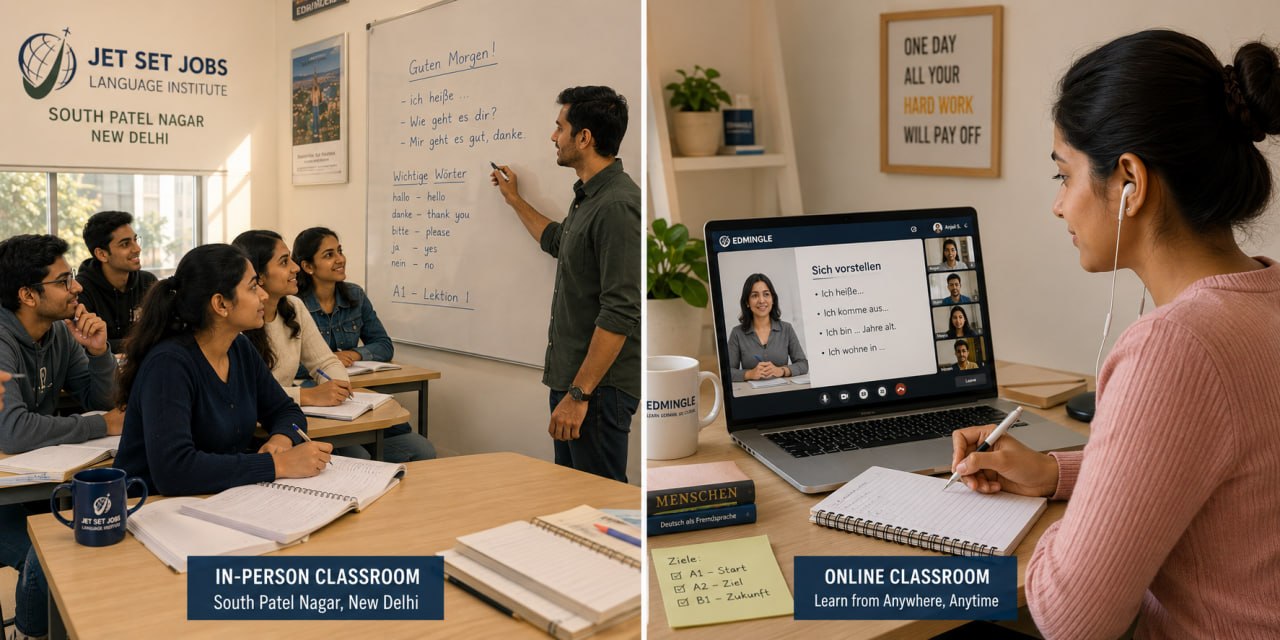
At Jet Set Jobs in South Patel Nagar, both offline classroom and online programmes use the same certified trainers, the same CEFR curriculum, and the same B2 examination preparation. The outcome — a B2 certificate — is identical. The difference is in the experience of getting there, and that experience matters because you will spend 10 to 12 months in it.
The Offline German Language Course — What It Actually Looks Like
The offline classroom programme at Jet Set Jobs runs at the South Patel Nagar centre, which is accessible from Karol Bagh, Rajendra Nagar, Moti Nagar, Kirti Nagar, Punjabi Bagh, Ramesh Nagar, and Rajender Place within 10 to 20 minutes. Classes run Monday to Friday in morning and evening batches.
Offline classes at A1 and A2 are typically taught in small groups of 8 to 12 students — small enough for the trainer to correct pronunciation in real time, monitor individual progress, and adapt the pace of the session. At B1 and B2, group sizes are kept even smaller because grammar complexity increases and individual feedback becomes more important. The B2 level is taught by a native-level or near-native instructor whose German is at C1 to C2.
The most significant advantage of the offline mode is spontaneous spoken practice. In a classroom, you hear German from both the trainer and your classmates — including their mistakes and corrections, which accelerate your own learning. You are also physically in a learning environment, which for most people creates a level of focus and accountability that is difficult to replicate at home.
The Online German Language Course — What It Actually Looks Like
The online programme at Jet Set Jobs runs as live, instructor-led sessions on the LMS — not pre-recorded videos you watch at your own pace. Classes are scheduled at fixed times with the same trainers who teach the offline batches. Sessions are interactive — the trainer can see and hear all participants, corrections happen in real time, and the speaking tasks are conducted via video, not just typed responses.
The LMS records all sessions, so students who miss a class due to a shift or travel can catch up by watching the recording before the next session. This is particularly valuable for GNM and BSc Nursing graduates who work in hospitals with rotating shift schedules. The full A1 to B2 online programme costs ₹65,000 plus GST, compared to ₹75,000 plus GST for the offline classroom programme. The ₹10,000 difference reflects the absence of physical infrastructure, not a difference in teaching quality.
Offline vs Online — Honest Side-by-Side Comparison
| Factor | Offline Classroom (Patel Nagar) | Online (LMS) |
|---|---|---|
| Location | South Patel Nagar, New Delhi — physical attendance required | Anywhere in India — attend from home or anywhere with internet |
| Trainers | Same certified JSJ trainers | Same certified JSJ trainers |
| Live interaction | In-person — highest engagement | Live video — interactive, real-time corrections |
| Speaking practice | Face-to-face with trainer and classmates | Video-based with trainer, individual and group sessions |
| Missed class | Cannot recover the session — attend the next one | Recording available — watch before next class |
| Commute required | Yes — 10–20 min from most West Delhi areas | No — attend from home |
| Schedule flexibility | Fixed morning, evening, weekend slots | Multiple live slots + recorded backup |
| Accountability | Physical presence creates routine | Requires personal discipline to maintain regularity |
| Best for A1–A2 | Either mode works equally well | Either mode works equally well |
| Best for B1–B2 | Offline — higher spoken interaction at complex levels | Online — workable with disciplined practice |
| Full programme fee | ₹75,000 + GST | ₹65,000 + GST |
| Per level fee | ₹20,000 + GST | ₹17,500 + GST |
Common Mistakes When Choosing Between Offline and Online
Choosing online because it is cheaper, not because it suits you
The ₹10,000 difference between the offline and online lump sum programmes is not the right basis for the decision. If you learn better with physical structure and face-to-face accountability — and you are within commuting distance — the ₹10,000 is easily justified by the quality of spoken practice you will get across 10 to 12 months of training.
Choosing offline without factoring in commute fatigue
A round trip to South Patel Nagar five days a week for 12 months is a genuine commitment. Students who underestimate commute fatigue often find their attendance dropping at B1 and B2 — exactly the levels where consistency matters most. If an honest assessment of your schedule suggests the commute will become unsustainable, online is the better long-term choice.
Assuming online means self-paced
The JSJ online programme is live and scheduled — not a library of videos you watch when convenient. The LMS has recordings as a backup, but the live session is the primary learning vehicle. Students who join the online programme expecting complete flexibility of timing will find that the live schedule is fixed, just as it is in the classroom.
How to Decide — Three Questions to Ask Yourself
Before choosing between offline and online, answer these three questions honestly. First: can you reliably commute to South Patel Nagar at least three times a week for the next 10 to 12 months without the commute becoming a reason to skip class? Second: do you have a home or workplace environment where you can attend a live video class without distraction? Third: have you taken online courses before, and if so, did you complete them?
If the answer to the first question is yes, consider offline. If the answer to the second and third questions are both yes, online is a genuine option. If you have a history of starting online courses and not finishing them, offline is the stronger choice regardless of convenience.
Book a Free Demo in Either Mode
The best way to experience the difference is to attend a free demo class — offline at the Patel Nagar centre or online via video call — before committing to a programme. Call or WhatsApp +91 96259 66817 or email support@jetsetjobs.in to book your slot.