🛡️ Licensed by Ministry of External Affairs · RA:
B-3413/DEL/COM/1000+/5/11419/2026
📞 +91 96259 66817
📍 15, 2nd Floor, South Patel Nagar, Delhi-110008
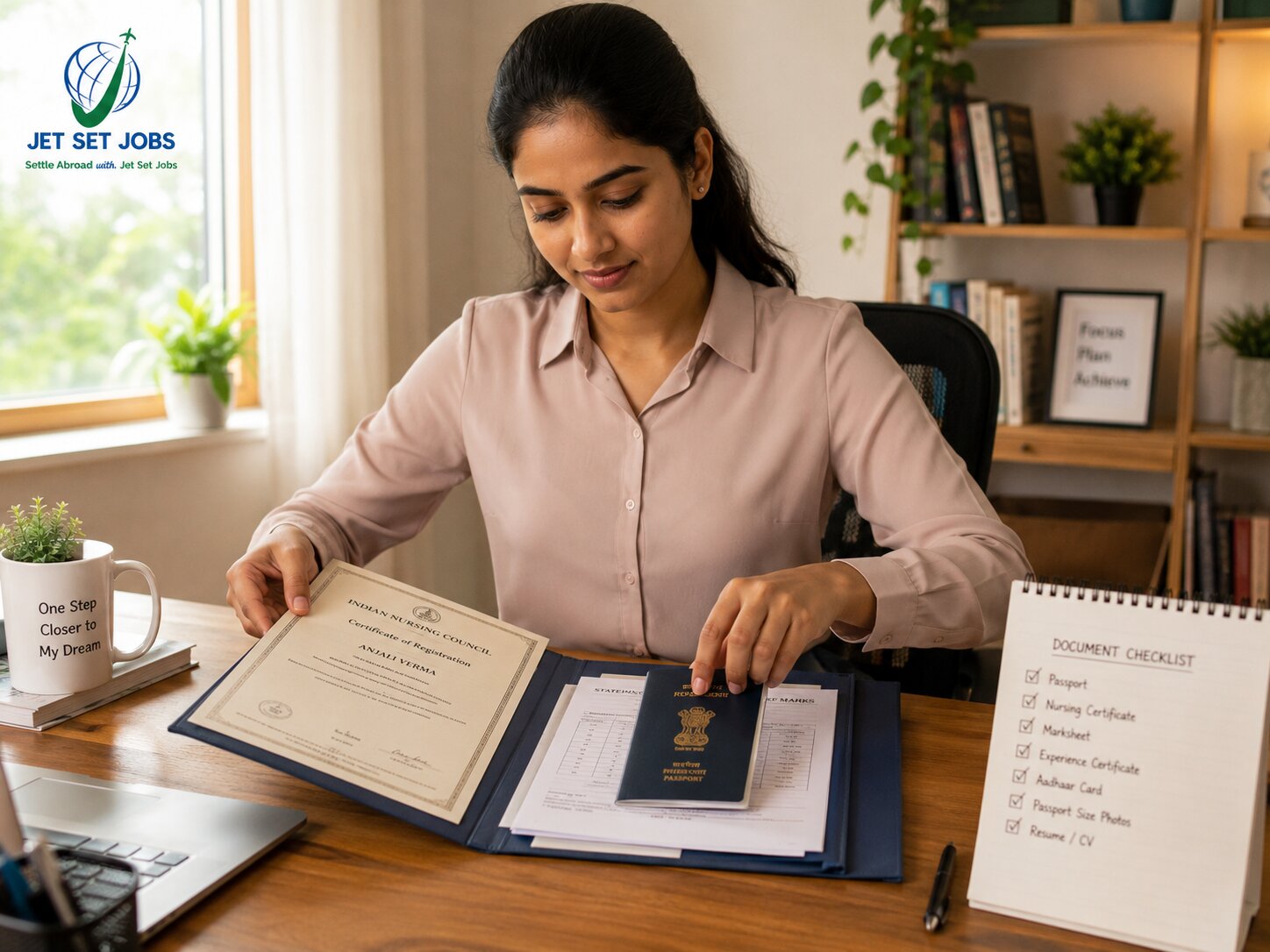
One of the most important — and most underestimated — parts of the Germany nursing journey is getting your documents right. The Berufsanerkennung process (nursing recognition in Germany) is document-intensive by design. German state authorities need to verify your training, your qualifications, your registration, and your identity before they will assess whether you can work as a nurse there. Missing a single document, submitting an untranslated certificate, or presenting a photocopy where an apostilled original is required can delay your application by months.
This blog gives you the complete picture — what documents are needed, what each one does, how to get them in order, and what to watch out for. Save this checklist and start gathering your documents as early as possible. The earlier you begin, the smoother your journey will be.
Your nursing qualification is the foundation of the entire recognition process. German authorities need to see not just that you passed, but exactly what you studied and how many hours you spent in both theory and clinical practice.
Your original GNM diploma or BSc Nursing degree certificate from the nursing institution. This must be the original or a notarised true copy — not a plain photocopy. It must eventually be submitted with an Apostille stamp and a certified German translation.
All semester or year-wise marksheets showing subjects studied and scores obtained. For GNM, this typically means three years of marksheets. For BSc Nursing, four years. German assessors use these to map your coursework against the German nursing curriculum. Keep every original marksheet — losing even one can cause significant delays.
This is one of the most overlooked documents and one of the most important. The German recognition authority uses your syllabus to compare your training content against German standards. You need an official document — usually obtained from your nursing college — that lists all subjects taught and the hours allocated to each. If your college cannot provide this, a letter from the Principal confirming the curriculum details may be accepted, but a formal syllabus document is strongly preferred.
A log of your clinical postings — which wards you worked in, for how long, and what procedures you observed or performed. For GNM candidates, this is typically the practical training register. For BSc candidates, clinical internship completion certificates from affiliated hospitals. If you no longer have these, contact your nursing college — many retain copies for several years after graduation.
This is your professional registration as a nurse in India. Every working nurse must be registered with their respective State Nursing Council. German authorities require this to confirm that you are legally recognised as a qualified nurse in India. The certificate must be current — if your registration has lapsed or needs renewal, address this before beginning the Germany application process.
Some German states require a formal letter from your State Nursing Council confirming that your registration is in good standing and that no disciplinary action has been taken against you. Contact your SNC directly to request this — processing times vary from a few days to several weeks depending on the state.
Your passport must be valid for at least 12–18 months beyond your intended travel date. If your passport is expiring soon, renew it before beginning the Germany application process — a new passport means new apostilles and translations on any documents that reference your passport number.
While not always formally required by German authorities, your Aadhaar or PAN card is often needed by document translation and apostille agencies in India to verify your identity. Keep both available throughout the process.
If you have worked as a nurse in India after graduation, an experience certificate from your employer is valuable. German authorities and employers both appreciate evidence of post-qualification clinical experience. The certificate should be on official letterhead, include your designation, dates of employment, and the type of facility.
A Police Clearance Certificate confirming that you have no criminal record. This is required for the German visa application and is sometimes requested during the Berufsanerkennung process. PCCs are typically valid for six months — time this document carefully relative to your visa application timeline.
A certificate from a registered medical practitioner confirming that you are in good health and fit to work. Some German employers request this as part of the pre-employment process. The certificate should be recent — typically issued within three months of submission.
Two additional steps are required for most documents before they can be submitted to German authorities: Apostille and certified German translation.
An Apostille is an official authentication stamp issued by the Ministry of External Affairs (MEA) of India, confirming that a document issued by an Indian authority is genuine. Typically your degree certificate, marksheets, SNC registration, and PCC will require one.
A certified German translation means your documents must be translated by a sworn translator (vereidigter Übersetzer) formally authorised to produce translations accepted by German government bodies. Do not use general translation agencies or online tools — only sworn translator certifications are accepted by German recognition authorities.
| Document | Apostille Needed? | German Translation Needed? | Where to Get It |
|---|---|---|---|
| GNM/BSc Degree Certificate | Yes | Yes | Nursing college |
| All Marksheets / Transcripts | Yes | Yes | Nursing college |
| Detailed Syllabus | No (usually) | Yes | Nursing college / Principal |
| Clinical Placement Records | No (usually) | Yes | Nursing college / hospital |
| SNC Registration Certificate | Yes | Yes | State Nursing Council |
| SNC Good Standing Letter | No | Yes | State Nursing Council |
| Valid Passport (copy) | No | No | Self |
| Experience Certificate | No | Yes | Previous employer |
| Police Clearance Certificate | Yes | Yes | Passport Seva Kendra |
| Medical Fitness Certificate | No | Yes | Registered doctor |
Starting your document collection early is one of the best things you can do for your Germany journey. Most documents take time to obtain — colleges may be slow to issue transcripts, SNC offices have processing queues, and Apostille stamping through the MEA can take 1–4 weeks depending on the state. At JSJ, our team guides every candidate through this process and connects them with trusted sworn translators and apostille services so that document delays do not hold up an otherwise ready candidate.
📞 Book Your Free Consultation
Call / WhatsApp: +91 96259 66817
Email: support@jetsetjobs.in | www.jetsetjobs.in
583+ candidates have started their Germany journey with us.
Refundable ₹75,000 deposit. Zero placement fees. MEA licensed.