🛡️ Licensed by Ministry of External Affairs · RA:
B-3413/DEL/COM/1000+/5/11419/2026
📞 +91 96259 66817
📍 15, 2nd Floor, South Patel Nagar, Delhi-110008
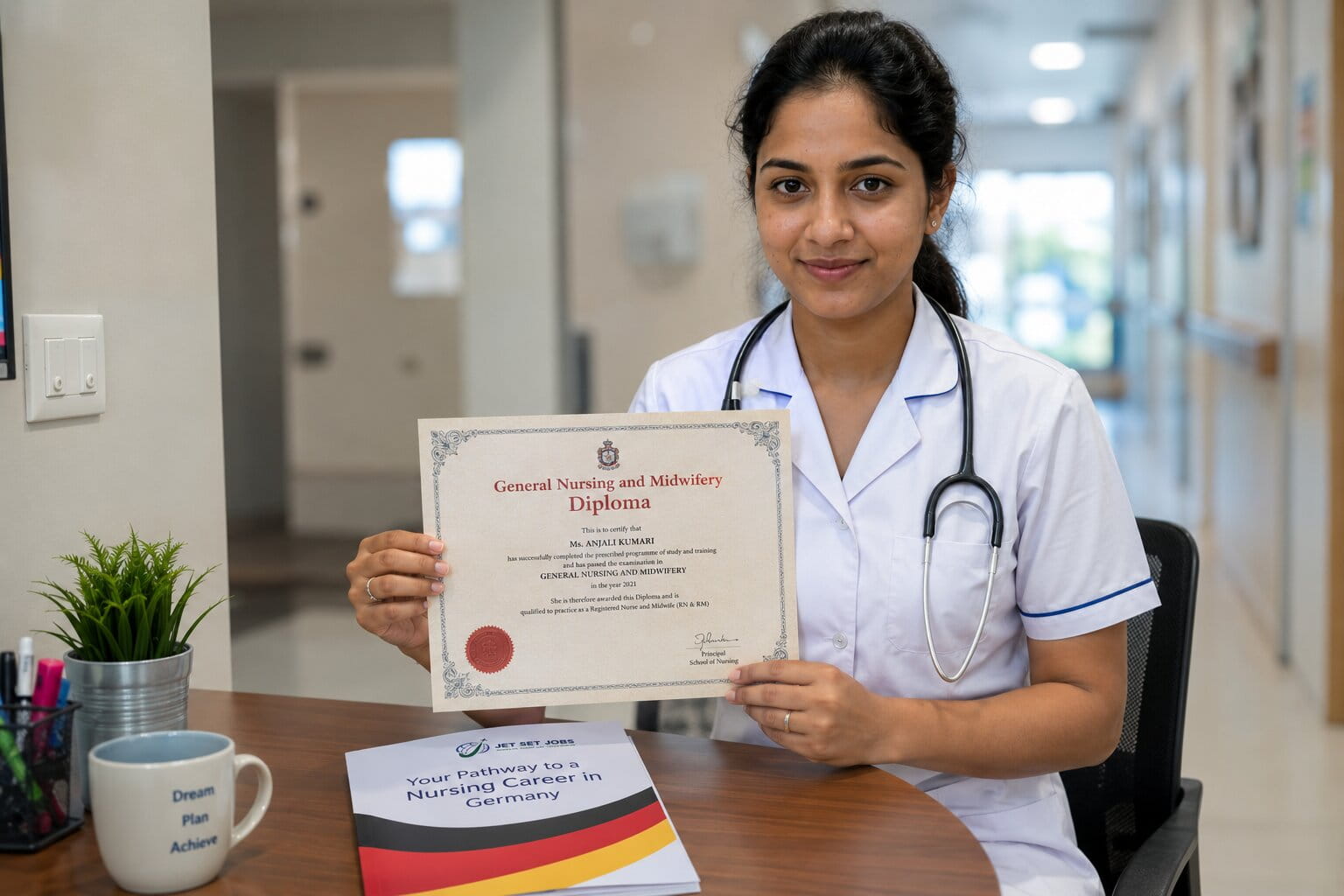
There is one question that comes up in almost every consultation Jet Set Jobs has with a GNM nurse: "Will Germany accept my diploma, or do I need a BSc degree?" It is a fair question, and the uncertainty around it stops many nurses from even taking the first step.
So let us be direct. Germany does accept GNM-qualified nurses from India. GNM and BSc Nursing are both recognised pathways to working as a registered nurse in Germany. The process is not identical for both qualifications — there are some differences in what the recognition authority expects — but GNM nurses have been successfully placed in German hospitals and care homes for years, and that includes many nurses studying at Jet Set Jobs.
What matters most is not just your qualification label. It is whether your nursing training meets the standards Germany sets for its own registered nurses. And in most cases, it does — or comes very close to it.
Germany requires every internationally trained nurse to go through a process called Berufsanerkennung — professional recognition. This is handled by a state authority (each German state has its own recognition body), and they compare your Indian nursing training to the German nursing curriculum.
The German nursing qualification (Pflegefachfrau or Pflegefachmann) is based on a 3-year training programme. Your GNM diploma is also a 3-year programme (plus 6 months of internship), which means the duration matches. The recognition authority then looks at the content — what subjects you studied, how many clinical hours you completed, and what areas were covered.
For GNM nurses, the most common outcome is partial recognition, not full recognition. This sounds more alarming than it is. Partial recognition simply means the authority found that your training matches German standards in most areas, but there are a few gaps — often in subjects like psychiatric nursing or community health, which are covered differently in Indian and German curricula.
If you receive partial recognition, you have two options to bridge the gap. The first is an Anpassungslehrgang — an adaptation course, which is essentially supervised practical training in a German hospital or care facility. This typically lasts 3 to 12 months depending on how large the identified gap is, and you are paid during this period. The second option is the Kenntnisprüfung, or knowledge test — a written and practical exam that lets you demonstrate the competencies the authority identified as gaps.
Most Indian GNM nurses complete the adaptation course route because it allows them to work, earn, and learn simultaneously. You are not sitting idle waiting for paperwork. You are inside a German hospital, getting familiar with the environment, building relationships with colleagues, and earning a salary while completing your recognition.
Once you clear the adaptation course or the knowledge test, you receive your full nursing license — the Berufserlaubnis — and from that point you work and earn as a fully recognised registered nurse in Germany.
| Factor | GNM Nurse | BSc Nursing |
|---|---|---|
| Accepted in Germany? | Yes | Yes |
| Recognition outcome (typical) | Partial recognition | Substantial / full recognition |
| Additional step needed? | Usually yes (3–6 months) | Sometimes, sometimes not |
| Salary during adaptation | €2,800–€3,200/month gross | €2,800–€3,200/month gross |
| Salary after full recognition | €3,300–€3,500/month gross | €3,300–€3,500/month gross |
| Time to full recognition | 12–18 months total | 10–15 months total |
The table above shows that while the path is slightly longer for GNM nurses, the destination is the same. Your salary, your job title, your work visa — all identical to a BSc-qualified nurse once you complete recognition. The difference is a few additional months, not a different outcome.
One concern many GNM nurses raise is whether their college or state nursing council will be recognised by Germany. The key criterion is that your college is affiliated with the Indian Nursing Council (INC) and your registration is valid with your State Nursing Council. If both of these are in place, your qualification is considered legitimate for the recognition process.
Germany uses a database called Anabin (maintained by the German government) to classify foreign qualifications. INC-recognised GNM programmes from India generally receive a positive assessment. Private or unaffiliated colleges may face additional scrutiny, which is why it is important to have your documents verified early in the process.
Whether you hold a GNM or a BSc, the German language requirement is the same: B2 level proficiency, certified by TELC or Goethe-Institut, before you can work as a nurse. This is not something specific to GNM nurses — it applies to every international nurse regardless of qualification.
B2 is the level at which you can hold professional conversations, understand medical instructions, document patient care in German, and communicate with doctors and colleagues effectively. It takes most nurses 10 to 12 months of consistent training to reach B2 from scratch, which is exactly why Jet Set Jobs provides free A1 to B2 German training as part of its programme.
Here is what a typical journey looks like for a GNM nurse working with Jet Set Jobs:
The total journey from start to finish is 18 to 24 months. This is not a shortcut — but it is a clear, structured path with a well-defined outcome at the end.
The most common misunderstanding among GNM nurses is that partial recognition means they are not qualified enough for Germany. This is simply not true. Partial recognition is the standard, expected outcome for most Indian GNM nurses — not an exception or a setback. German authorities are familiar with the Indian GNM curriculum and have a defined pathway for bridging the differences.
The second misunderstanding is that GNM nurses are paid less than BSc nurses during the process. In reality, during the adaptation phase, all internationally trained nurses — GNM or BSc — are paid at the same pre-recognition salary bracket of approximately €2,800 to €3,000 per month gross. Once full recognition is achieved, everyone moves to the same registered nurse salary scale.
📞 Book Your Free Consultation
Call / WhatsApp: +91 96259 66817
Email: support@jetsetjobs.in | www.jetsetjobs.in
500+ nurses on their way to Germany & Austria. Free B2 training. Zero recruitment fees.