🛡️ Licensed by Ministry of External Affairs · RA:
B-3413/DEL/COM/1000+/5/11419/2026
📞 +91 96259 66817
📍 15, 2nd Floor, South Patel Nagar, Delhi-110008
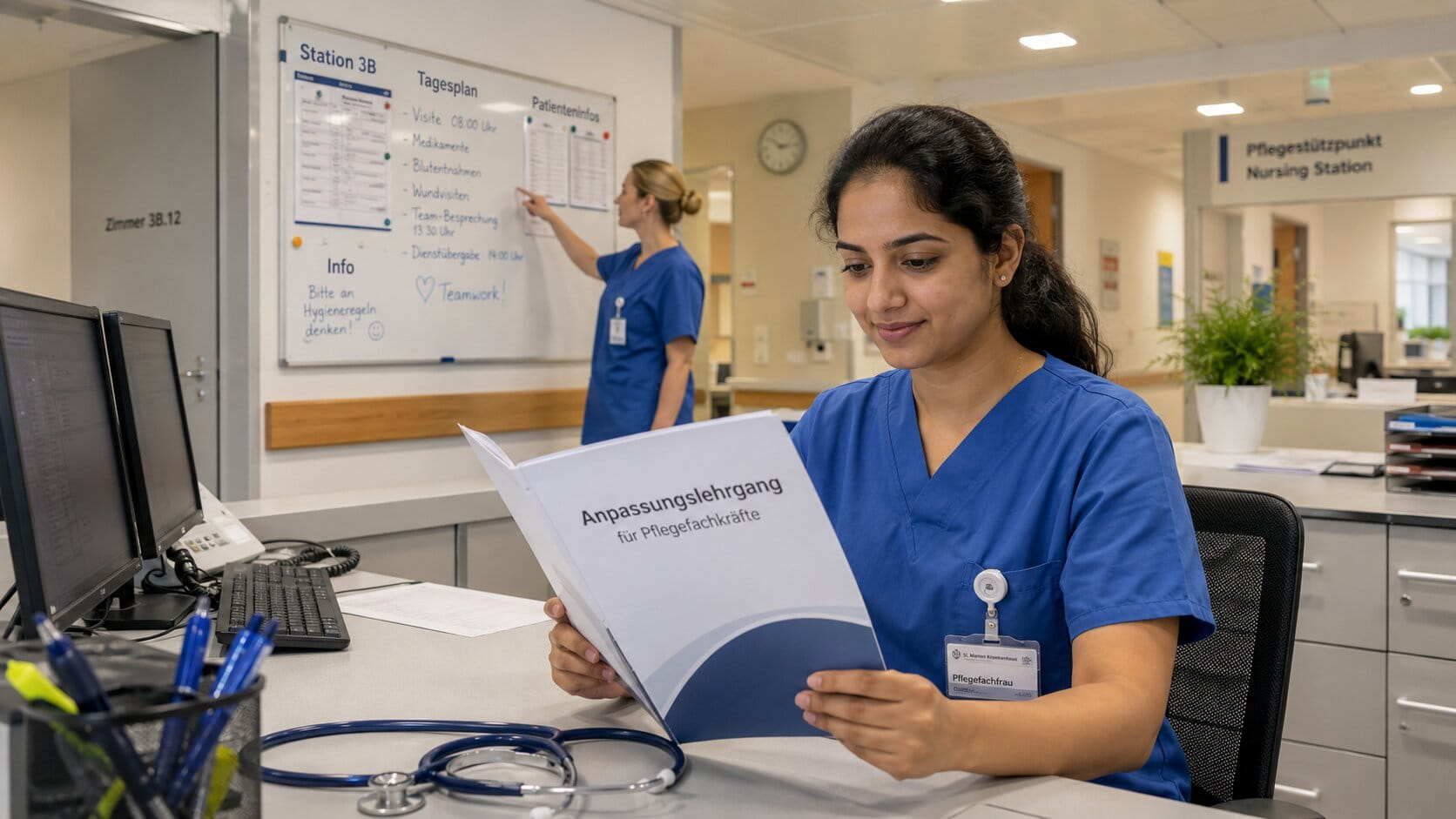
When Indian nurses hear that their nursing qualification received 'partial recognition' from the German authorities, many panic. The word partial feels like a polite way of saying 'not good enough.' But that reading is wrong — and understanding why it is wrong could be the difference between continuing your Germany journey or giving up unnecessarily.
Partial recognition — called teilweise Gleichwertigkeit in German — is the most common outcome for Indian-trained nurses applying in Germany. It is not a failure. It is not a rejection. It is the authority telling you: your nursing training meets German standards in most areas, but there are specific gaps that need to be addressed before you can receive your full nursing license.
The German system is built to accommodate international nurses. The very existence of adaptation pathways — the Anpassungslehrgang and the Kenntnisprüfung — shows that Germany expects most foreign nurses to receive partial recognition and has a structured, paid process for closing those gaps.
The German nursing curriculum (Generalistik) is a 3-year programme that covers a broad range of care areas including adult nursing, paediatric nursing, psychiatric nursing, and elderly care. Indian nursing programmes — both GNM and BSc — are strong in many of these areas but tend to have differences in how psychiatric nursing, community health, and certain documentation practices are taught.
When the recognition authority compares your Indian degree to the German standard, they are looking at subject-by-subject equivalence. If your training covered 90% of what Germany expects, you receive partial recognition. The remaining 10% is what you need to demonstrate — either through supervised practice or an exam.
| Common Gap Area | Why It Differs | How It Is Bridged |
|---|---|---|
| Psychiatric nursing | Less emphasis in Indian GNM/BSc | Covered in adaptation course |
| Elderly / palliative care | Different structure in India | Covered in adaptation course |
| German documentation norms | Different patient record systems | Learned on the job in Germany |
| Community health approach | Different delivery model | Adaptation course or exam |
The gaps are not about your clinical skills or your ability to care for patients. Indian nurses are known in Germany for their strong bedside manner, patient communication, and work ethic. The gaps are almost always about how certain care areas are structured differently between the two countries.
Once you receive partial recognition, German law gives you two ways to achieve full recognition. You do not have to go back to India. You do not have to repeat your entire nursing degree. You complete one of the following:
This is supervised practical training inside a German hospital or care facility. The duration depends on the size of the identified gap — typically 3 to 6 months for Indian nurses, though in some cases it can extend to 12 months. During the adaptation course, you are employed by the hospital, paid a salary (in the range of €2,800 to €3,000 gross per month), and guided by a designated mentor called a Praxisanleiter.
The adaptation course is the preferred route for most Indian nurses because it combines earning, learning, and workplace integration all at once. You are not in a classroom — you are inside the hospital, working alongside German colleagues, building German language fluency in a professional context, and completing your recognition simultaneously.
This is a formal examination conducted by the recognition authority. It tests the specific competencies that were identified as gaps in your assessment. The exam has a theoretical part and a practical part, and it is conducted in German. Nurses who are confident in the language and who prefer to complete the process faster sometimes choose this route.
In practice, most Indian nurses opt for the adaptation course over the knowledge test, because the language requirement for a formal German medical exam is demanding and the adaptation course gives them time to settle into the German work environment before being assessed.
It does not mean your Indian nursing degree is invalid. Your degree got you into Germany's recognition process — it was assessed, taken seriously, and found substantially equivalent. That is a positive outcome, not a negative one.
It does not mean you will be supervised forever. The adaptation course has a defined end date. Once it is complete and signed off by your supervising hospital, you apply for your full Berufserlaubnis — the nursing license. From that point, you are a fully recognised registered nurse in Germany with no further conditions.
It does not mean you will be paid less indefinitely. The pre-recognition salary bracket (€2,800–€3,000 gross) is a temporary phase. Once full recognition is issued, you move to the full TVöD-P nursing pay scale, which typically means €3,300 to €3,500 gross per month for a registered nurse.
And it does not mean only GNM nurses face this. Even BSc Nursing graduates from India sometimes receive partial recognition depending on the state, the recognition authority, and how they structured their degree. Partial recognition is not a GNM-specific issue — it is a common and expected part of the Germany nursing process for Indian nurses in general.
To make this concrete: imagine a GNM nurse from Bihar who completes her B2 German training with Jet Set Jobs over 13 months. She applies for recognition with the Regierungspräsidium Stuttgart (the recognition authority in Baden-Württemberg, one of the most common states for Indian nurse placements). Three months later she receives her decision: partial recognition, with a gap identified in psychiatric nursing and elderly care documentation.
Her hospital employer — who has already offered her a job — registers her for a 6-month adaptation course in the same hospital. She starts work. She earns €2,850 gross per month. She works with a Praxisanleiter who guides her through the German documentation system and the specific care protocols for the areas identified in her gap report. After 6 months, the adaptation course is complete. The hospital submits its assessment. The recognition authority issues her full nursing license. From month 20 of her overall journey, she is a fully recognised, fully salaried registered nurse in Germany.
This is not an unusual story. This is the standard journey for a significant number of Indian nurses who go to Germany through structured placement programmes like Jet Set Jobs.
At Jet Set Jobs, candidates are briefed on the recognition process from the very beginning — not as a surprise that arrives after B2, but as a known, expected step in the journey. Our counsellors explain what partial recognition means, what gaps typically arise for Indian nurses, and how adaptation courses work, so that candidates enter the process with clear expectations.
Because 500+ nurses are currently learning German with us and working towards placements in Germany and Austria, we also have working relationships with hospitals that have experience supporting Indian nurses through the adaptation course. This means the hospital knows the process, the Praxisanleiter knows what Indian nurses typically need to demonstrate, and the adaptation course is completed efficiently rather than dragged out unnecessarily.
📞 Book Your Free Consultation
Call / WhatsApp: +91 96259 66817
Email: support@jetsetjobs.in | www.jetsetjobs.in
500+ nurses on their way to Germany & Austria. Free B2 training. Zero recruitment fees.