🛡️ Licensed by Ministry of External Affairs · RA:
B-3413/DEL/COM/1000+/5/11419/2026
📞 +91 96259 66817
📍 15, 2nd Floor, South Patel Nagar, Delhi-110008
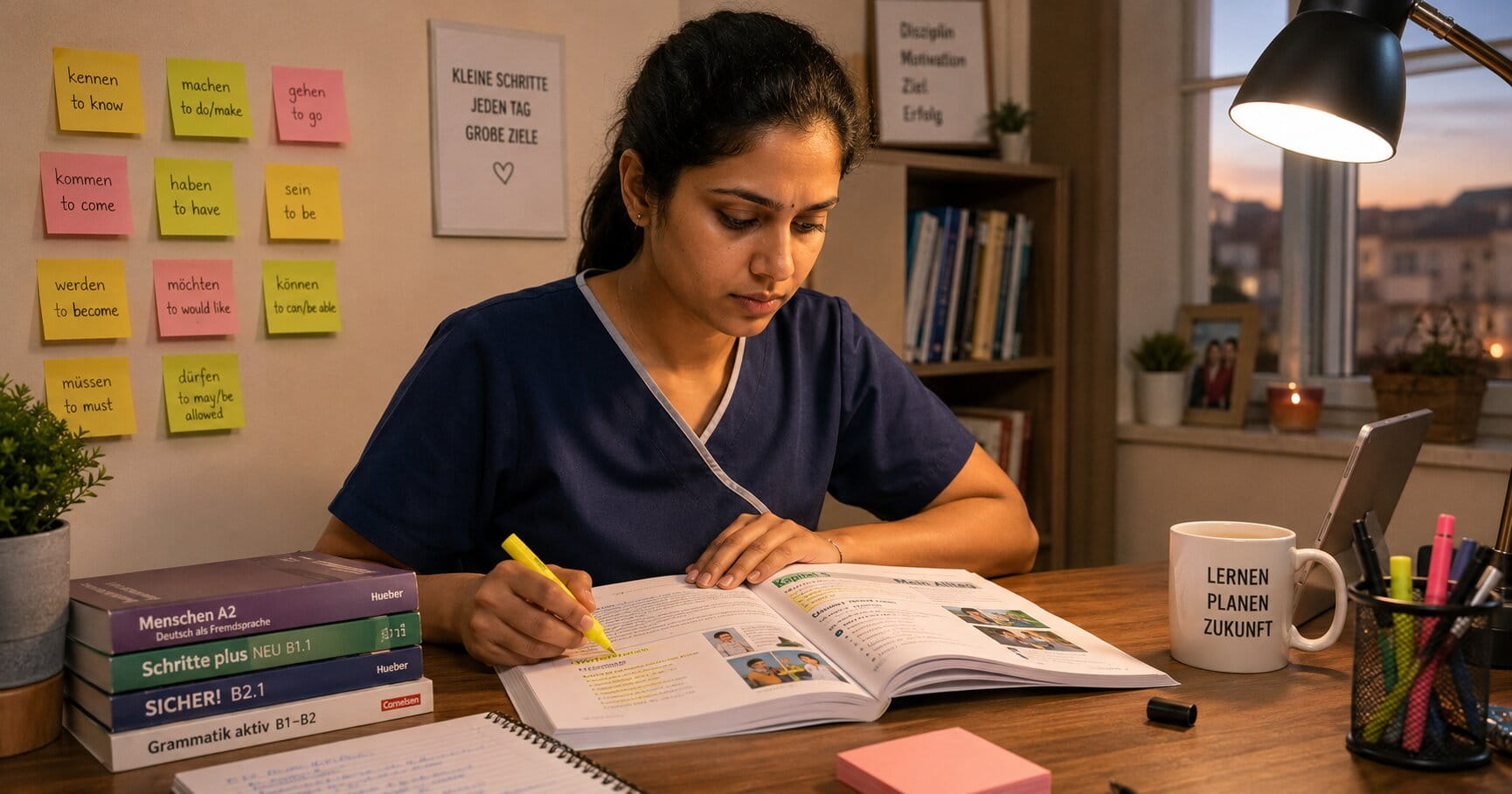
When a nurse says "German is too hard," she is rarely talking about grammar tables or pronunciation drills. She is usually saying something more personal — I am not sure I am smart enough. I am afraid of failing. I have tried to learn something new before and given up. I do not want to spend months of my life on something that may not work out.
That is a very different thing from the actual difficulty of the German language. And it deserves a very different kind of answer than "Don't worry, German is easy!" — because it is not easy. But it is also not what most people fear it will be.
This blog is for nurses who have been told German is too hard, who have heard stories about nurses failing their B2 three times, or who simply sat with a German textbook for twenty minutes and felt completely overwhelmed. You deserve the straight truth, not either reassurance or intimidation.
German assigns a gender to every noun — masculine (der), feminine (die), or neuter (das) — and these genders are not predictable from the word itself. A table (Tisch) is masculine. A door (Tür) is feminine. A girl (Mädchen) is, confusingly, neuter. Beyond gender, German has four grammatical cases (Nominativ, Akkusativ, Dativ, Genitiv) that change the form of articles and adjectives depending on the noun's role in the sentence.
For Indian nurses, this is genuinely unfamiliar territory. Hindi has gender, but no cases in the same way. Tamil and Telugu are structured very differently. This is the part of German that takes the most getting used to — and consistent practice over time is the only real solution.
German verbs often go to the end of subordinate clauses, which feels completely unnatural to an English or Hindi speaker. "I know that you are learning German" becomes in German "I know that you German are learning." This inversion trips people up constantly in speaking and writing at the B1 and B2 levels.
German has sounds that do not exist in Hindi, Tamil, Bengali, or most Indian languages — the ü, ö, ä vowels, and the guttural ch and r sounds. These require deliberate practice. However, pronunciation in German is phonetically consistent — once you learn how a letter or combination sounds, it sounds that way every single time. This is very different from English, where spelling and pronunciation have almost no reliable relationship.
Unlike English — where "though," "through," "cough," and "tough" are all pronounced differently — German is spelled exactly as it sounds. Once you learn the pronunciation rules, you can read any German word correctly even if you have never seen it before. For most Indian nurses, this is a significant advantage over English acquisition.
German and English are both Germanic languages and share a large number of cognates — words that look or sound similar. Haus (house), Wasser (water), Buch (book), Mutter (mother), Hand (hand), Finger (finger). In medical and nursing contexts, Latin and Greek roots are shared across German, English, and most European languages. Many clinical terms you already know in English — Bronchitis, Pneumonie, Kardiovaskulär, Hypertonie — are immediately recognisable in German.
The early weeks of German feel overwhelming because everything is new at once. But German grammar follows consistent rules. Once the patterns click — and for most dedicated learners they do click, usually somewhere in the A2 to B1 transition — the language becomes significantly more logical and navigable.
The A1 to B2 journey at JSJ takes 10 to 12 months with 48 weeks of structured training. This assumes consistent attendance and genuine study — not passive listening or half-hearted revision. The European Framework estimates approximately 600 to 750 hours of total learning time to reach B2 from zero.
| Level | What You Can Do | Typical Time From Zero |
|---|---|---|
| A1 | Introduce yourself, basic greetings, simple sentences | 2–3 months |
| A2 | Everyday conversations, simple transactions, routine tasks | 2–3 months |
| B1 | Understand main points, handle familiar situations, basic opinions | 2–3 months |
| B2 | Fluent professional communication, understand complex texts, document care | 3–4 months |
The B2 milestone is where nurses are eligible to apply for their Germany nursing visa. It is not the end of language learning — your German will continue to develop after you arrive — but it is the professional threshold that opens the door.
In JSJ's counselling sessions, the nurses who initially said German is too hard and then went on to clear B2 have a few things in common. They did not study in bursts — they studied every day, even if only for 30 to 45 minutes. They spoke out loud, even when they felt embarrassed. They asked their trainers questions instead of sitting quietly through confusion. And they stopped comparing their progress to other candidates in the batch.
The nurses who found German hardest were those who studied only before exams, who avoided speaking practice because of self-consciousness, or who took extended breaks and then had to re-learn what they had forgotten. These are not intelligence issues. They are study habit issues — and habits can be changed.
It is not your educational background. It is not your age. It is not whether you studied in a Hindi-medium or English-medium school. The single strongest predictor of B2 success among JSJ candidates is how many sessions they attended and how regularly they practised speaking. Nothing else comes close.
500+ nurses are currently learning German with JSJ across flexible batch timings through our online LMS platform and classroom batches. Many of them felt exactly what you may be feeling right now — that German is too hard, that they are not the kind of person who can learn a new language. Most of them are still going. Some have already cleared B2. Not because German became easy. Because they kept going anyway.
📞 Book Your Free Consultation
Call / WhatsApp: +91 96259 66817
Email: support@jetsetjobs.in | www.jetsetjobs.in
500+ nurses are on their way to Germany & Austria with us. Free B2 training. Zero recruitment fees.