🛡️ Licensed by Ministry of External Affairs · RA:
B-3413/DEL/COM/1000+/5/11419/2026
📞 +91 96259 66817
📍 15, 2nd Floor, South Patel Nagar, Delhi-110008
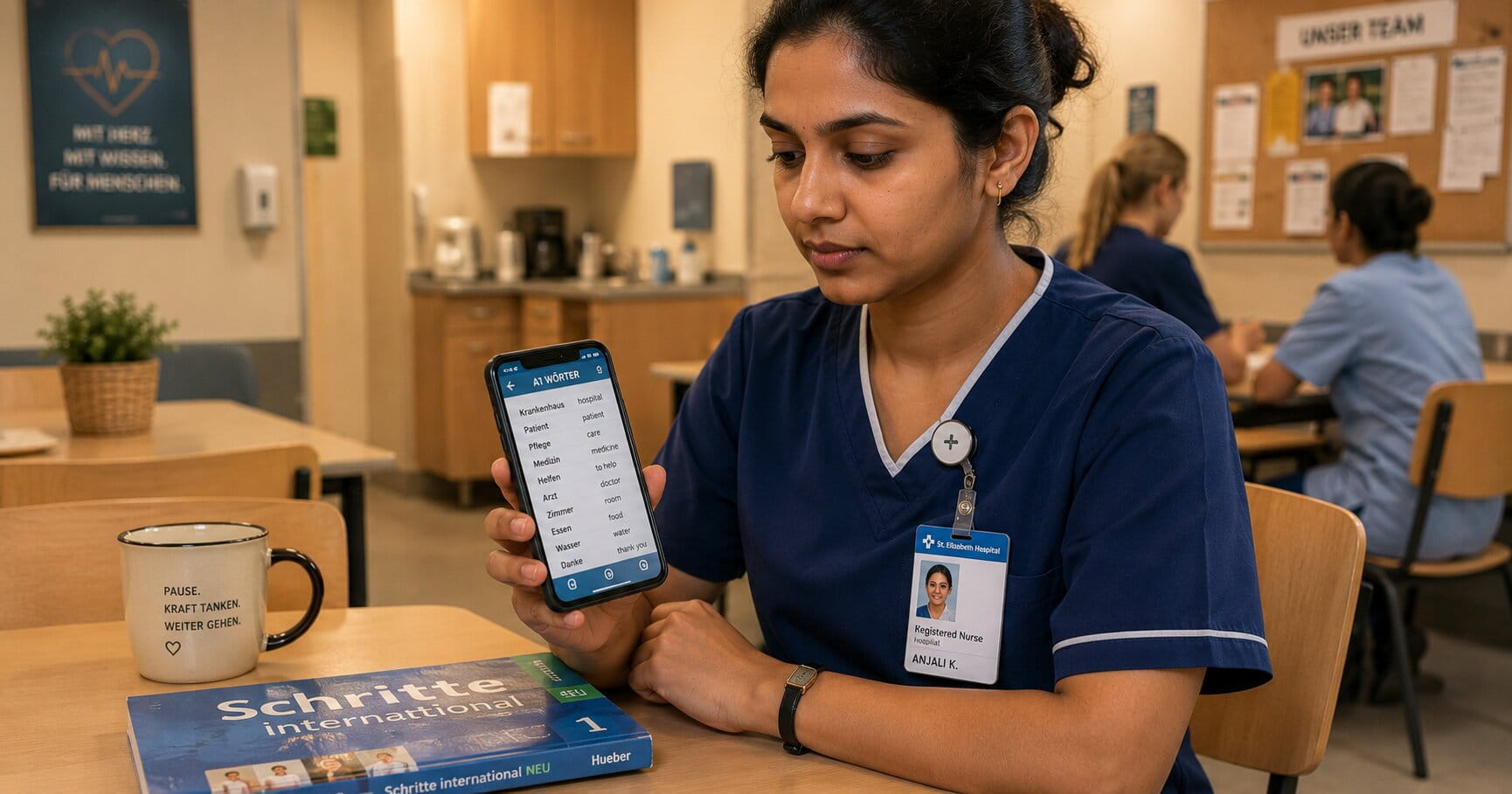
Somewhere in the network of nurses considering Germany, a story circulates: you need to quit your job to learn German properly. That you cannot do both. That the language is too demanding to study alongside 12-hour nursing shifts, night duties, and weekend work.
This belief is understandable. Learning B2 German from scratch is a significant undertaking. But it is not true that you must quit your job to do it. The question is not whether it is possible. The question is how to structure it so that it is actually manageable alongside the realities of shift work and clinical fatigue.
Let us be direct: studying German while working full time is harder than studying without a job. You will have less free time, more fatigue, and more days when the last thing you want to do after a night shift is open a grammar book. This is not a reason not to try — it is a reason to plan more carefully and set more realistic expectations.
The nurses at JSJ who have succeeded in this situation are not superhuman. They made a specific decision about how to use the time they had. Not all of it — just some of it, consistently.
Day shift nurses typically have mornings free before a shift or evenings available after. The most effective pattern JSJ trainers see: 45 to 60 minutes of active study in the morning before the shift starts, plus 20 to 30 minutes of vocabulary review or audio listening on the commute. This adds up to roughly 7 to 8 hours of study per week on working days, with longer sessions on days off. Over 10 to 12 months, this accumulates to 400 to 500 hours — sufficient for B2 with good instruction.
Rotating shift work is harder to schedule around but not impossible. The key insight: consistency beats duration. A nurse who studies 30 minutes every single day progresses faster than one who studies 3 hours once a week. Night shift nurses often find that the day before a night shift — when they are rested — is their best study window. Planning around this pattern rather than fighting it makes a real difference.
ICU and OT nurses often report the highest fatigue after shifts. For these candidates, JSJ recommends leaning heavily on audio-based learning during commutes and non-screen time. German podcasts at A1 and A2 level build listening comprehension without requiring focused visual attention. Deutsche Welle has free resources specifically designed for learners. This supplements classroom learning without adding screen fatigue on top of an already demanding job.
JSJ offers flexible batch timings across morning, afternoon, and evening slots, both online through the LMS platform and in classroom batches in New Delhi. The online format is specifically designed for nurses who cannot commit to a fixed daily presence — you can attend live sessions when available and review recorded content when shifts conflict.
The 48-week A1 to B2 curriculum is built with working nurses in mind. Lessons are structured in 90-minute sessions rather than marathon classes, vocabulary is reinforced across multiple sessions rather than taught once and expected to stick, and trainers are experienced in working with candidates who have inconsistent availability due to shift patterns.
The first is trying to study exactly as a full-time student would — 3 to 4 hours every evening — and burning out within six weeks when that pace proves unsustainable alongside shift work. The solution is to start with less than you think you need and build gradually. Thirty minutes daily is a foundation. An hour daily is strong.
The second mistake is taking unplanned breaks. A two-week gap in German study is enough to make A2-level vocabulary feel unfamiliar again. The difference between candidates who complete B2 and those who drop out is not that the completers had perfect schedules. It is that they restarted within days of a disruption rather than waiting until the "right time" to pick up again. There is no right time. There is only now.
For the vast majority of JSJ candidates, no. Candidates who work while studying take longer to reach B2 than those who study full-time, but they reach the same destination. Working candidates typically take 12 months where full-time students take 10. That two-month difference costs nothing in terms of outcome — and it preserves income, routine, and financial security during the journey.
📞 Book Your Free Consultation
Call / WhatsApp: +91 96259 66817
Email: support@jetsetjobs.in | www.jetsetjobs.in
500+ nurses are on their way to Germany & Austria with us. Free B2 training. Zero recruitment fees.