🛡️ Licensed by Ministry of External Affairs · RA:
B-3413/DEL/COM/1000+/5/11419/2026
📞 +91 96259 66817
📍 15, 2nd Floor, South Patel Nagar, Delhi-110008
The Berufsanerkennung process assesses your Indian nursing qualification against the German standard. In the vast majority of cases for Indian nurses, this assessment does not result in immediate full recognition. Instead, the German state authority identifies gaps between your Indian training and the German nursing standard — and asks you to close those gaps before you can be fully licensed.
There are two ways to close those gaps. Understanding which route applies to you — and what it involves — is essential planning for your Germany journey.
German nursing education is governed by the Pflegeberufegesetz (Nursing Professions Act) of 2020, which introduced a unified, generalised nursing qualification covering elderly care, adult care, and paediatric nursing. Indian nursing qualifications — both GNM and BSc Nursing — were developed under a different curriculum framework, and while they are rigorous and clinically strong, they do not map perfectly onto the German standard in every area.
The state authority reviews your degree certificates, transcripts, and clinical training records against their checklist. Where they find areas that were not covered — or not covered in sufficient depth — they document a "substantial difference" (wesentlicher Unterschied). The size and nature of these gaps determines which compensation measure is required.
You work. You earn. You get supervised. You receive full recognition at the end.
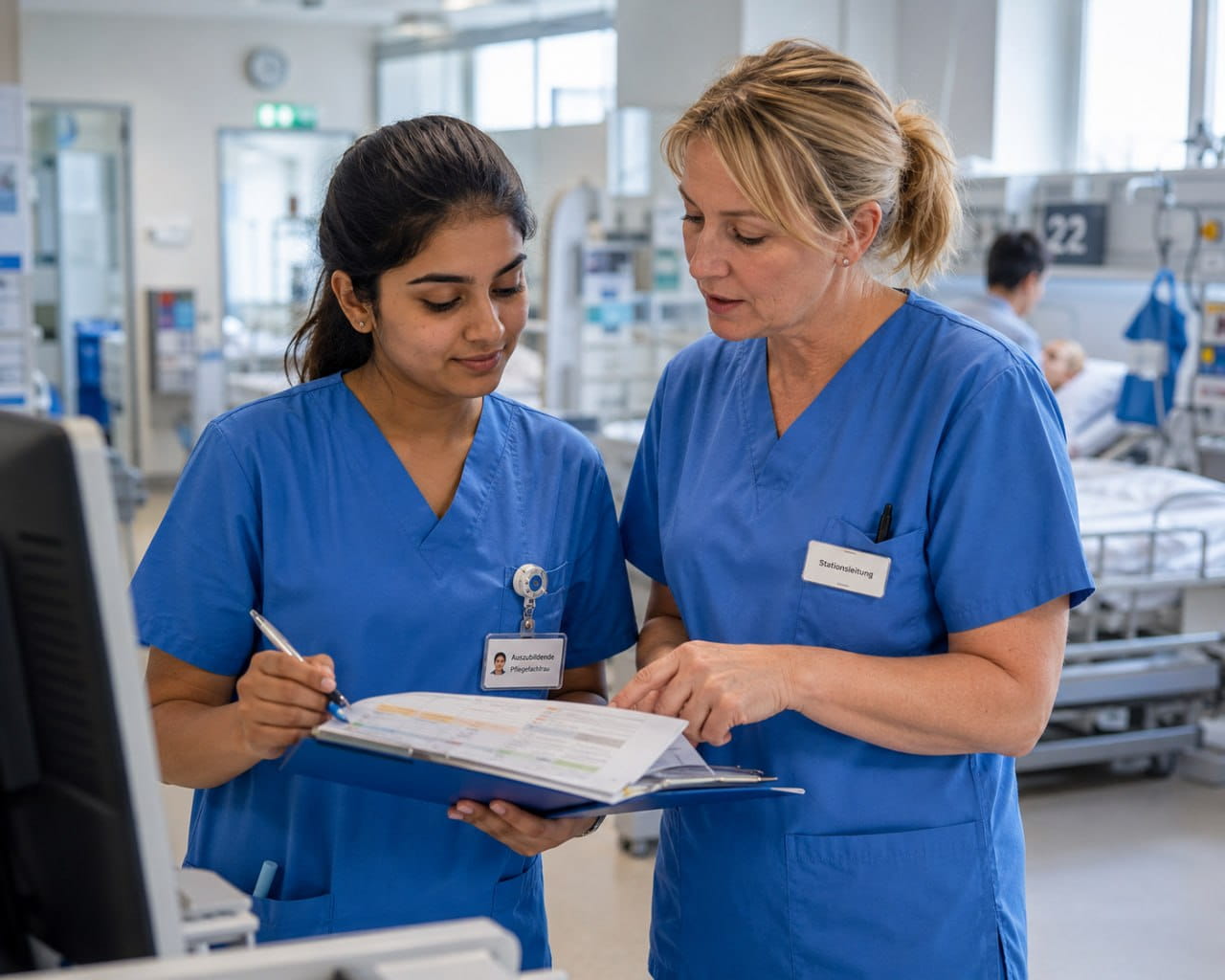
The Anpassungslehrgang — adaptation period or supervised work placement — is by far the most common outcome for Indian nurses. It is a period of supervised clinical work in a German hospital or care home during which you demonstrate, in practice, that you meet the German nursing standard.
| Factor | Details | Key Point |
|---|---|---|
| Duration | 6–18 months (most Indian nurses: 6–12 months) | Supervised practice in a German hospital or care home |
| Employment status | Fully employed — paid nurse | Earning full salary from Day 1 |
| Supervision | Assigned German Praxisanleiter (practice educator) | Structured feedback and assessment throughout |
| Cost | None — you are employed | Your employer bears the supervisory costs |
| Outcome | Full Berufsanerkennung on completion | Fully licensed Pflegefachkraft |
| Failure risk | Very low — it is a supported work period, not a pass/fail exam | Rare — the process is designed to support success |
A formal pass/fail clinical examination — conducted entirely in German.
The Kenntnisprüfung — literally "knowledge examination" — is an alternative to the Anpassungslehrgang. It is an examination, not a work period. Candidates who choose or are assigned the Kenntnisprüfung must pass a formal practical and theoretical assessment before receiving full recognition.
The Kenntnisprüfung is a practical nursing examination — not a written multiple-choice test. It typically involves:
The examination is administered by the state authority or a designated examination body and is conducted entirely in German. You must have B2-level German to have any realistic chance of passing, as the oral and documentation components are fully in German.
Most Indian nurses are not offered a free choice between the two. The state authority makes the determination based on the gaps identified in your qualification assessment. However, in some states the candidate may request the Kenntnisprüfung as an alternative to the adaptation period — useful if you want a defined endpoint rather than an open-ended work supervision period.
| Factor | Kenntnisprüfung | Anpassungslehrgang |
|---|---|---|
| Nature | Formal examination — pass/fail | Supervised work period — completion based |
| Format | Practical skills + oral questions + documentation | Clinical work at a German facility under supervision |
| Duration | One examination day (typically 4–8 hours) | 6–18 months of employment |
| When it happens | After arriving in Germany — at state authority centre | After arriving in Germany — at employer facility from Day 1 |
| Salary during this period | Not employed — no salary during preparation | Fully employed — earning €2,800–€3,000/month throughout |
| Pass rate | Variable — lower than adaptation completion rates | Very high — supervised and supported process |
| Who typically takes it | Very specific gaps; candidate requests it | Most Indian nurses — GNM and BSc graduates |
The state authority makes the initial determination. In practice, the vast majority of Indian nurses — particularly GNM graduates and BSc graduates without strong documentation of paediatric or elderly care — are assigned the Anpassungslehrgang. This is because the adaptation period is the state's preferred route when gaps are moderate and the candidate has genuine clinical experience.
The Kenntnisprüfung is more commonly assigned when the gaps are very specific and limited, when the candidate has a particularly strong academic background, or when the candidate requests it in writing as an alternative.
📞 Book Your Free Consultation
Call / WhatsApp: +91 96259 66817 | support@jetsetjobs.in | www.jetsetjobs.in
583+ candidates have started their Germany journey with us. Refundable ₹75,000 deposit. Zero placement fees. MEA licensed.