🛡️ Licensed by Ministry of External Affairs · RA:
B-3413/DEL/COM/1000+/5/11419/2026
📞 +91 96259 66817
📍 15, 2nd Floor, South Patel Nagar, Delhi-110008
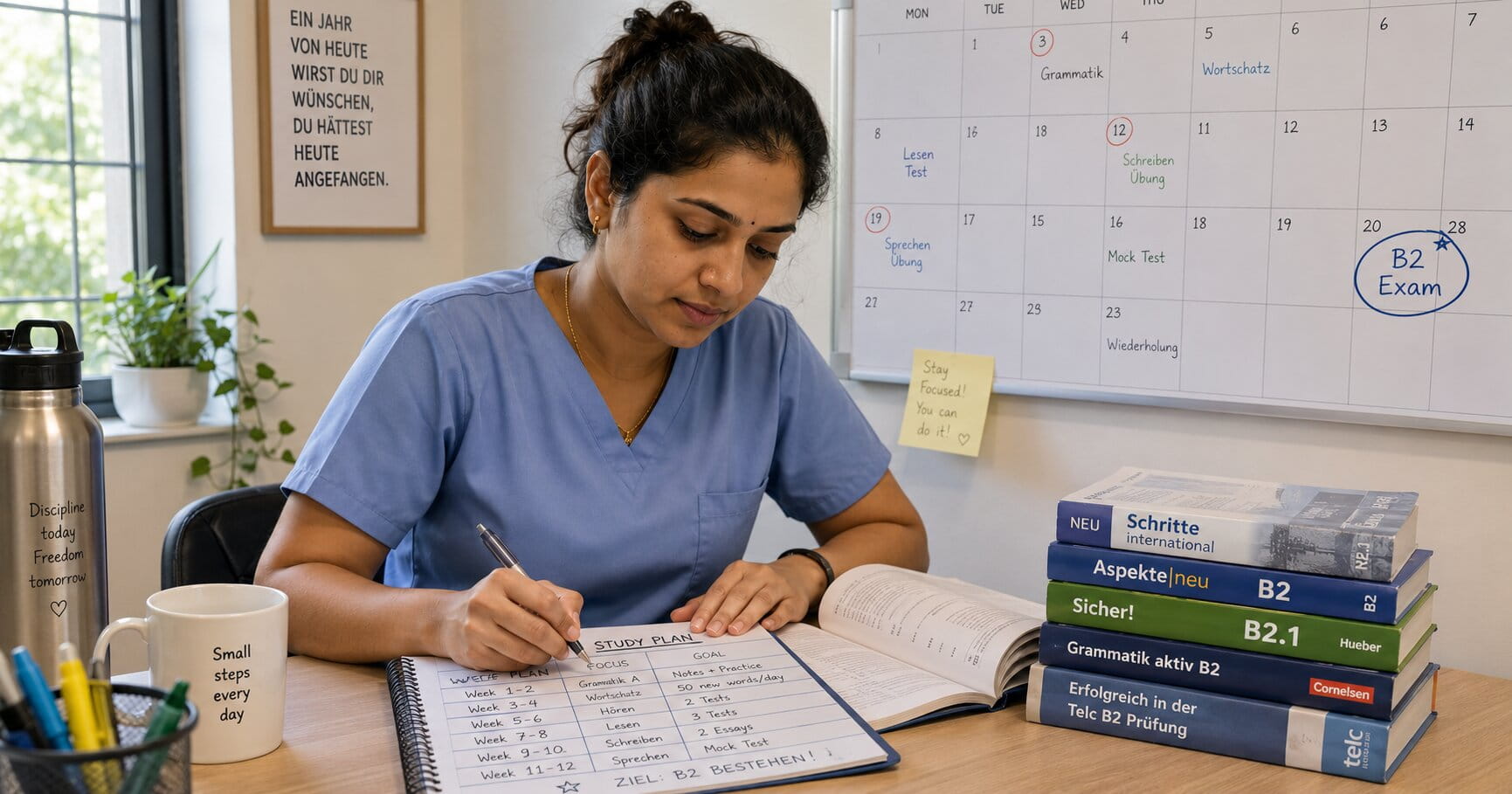
"How long will this take?" is one of the first things nurses ask in JSJ consultations — and it is also one of the most misanswered questions in the Germany nursing space. Agencies that want quick enrolments say six months. Agencies that are cautious say eighteen. Neither of these is reliably accurate for the average Indian nurse starting from zero.
The timeline matters because it affects everything else: when you can expect to take the B2 exam, when your visa application can begin, when you might realistically arrive in Germany, and how long you need to sustain the financial and personal commitment of the preparation phase.
The Common European Framework of Reference for Languages (CEFR) — the international standard that defines A1 through C2 — estimates that reaching B2 from zero requires approximately 600 to 750 hours of learning. This figure is based on controlled studies of adult language learners in structured programmes, and it is the most reliable benchmark available.
At a study pace of 15 hours per week — which includes classroom time, homework, self-study, and speaking practice — 600 hours translates to roughly 40 weeks, or about 10 months. At 10 hours per week — the realistic pace for a working nurse — it translates to 60 weeks, or roughly 14 to 15 months. These are not JSJ estimates. They are the numbers behind every serious language training programme in the world.
JSJ's German language training runs across 48 weeks of structured instruction, covering A1 through B2 including examination preparation. The total journey from starting training to clearing the B2 exam is 10 to 12 months for most JSJ candidates who attend consistently and study regularly alongside sessions.
| Phase | Content | Duration |
|---|---|---|
| A1 | Introductions, basic sentences, numbers, simple daily vocabulary | 10–12 weeks |
| A2 | Daily conversations, simple transactions, expressing needs | 10–12 weeks |
| B1 | Expressing opinions, handling familiar situations, longer conversations | 10–12 weeks |
| B2 + Exam Prep | Professional communication, complex texts, exam techniques, mock tests | 14–16 weeks |
| Total training | A1 to B2 including exam preparation | 48 weeks |
Nurses with strong English consistently progress faster through German than those with limited English. This is because German and English share significant vocabulary, and because the cognitive habits of reading and writing in a non-native language are already established. Nurses from states where English-medium education is the norm (Kerala, Tamil Nadu, Karnataka, Goa) often reach B2 in 10 months. Nurses from states with limited English exposure sometimes take 12 to 14 months — not because German is harder for them, but because they are building two sets of language skills simultaneously.
This is the single most controllable variable. Candidates who attend 85% or more of scheduled sessions reach B2 within the expected 10 to 12 month window. Candidates who attend 60 to 70% of sessions take 14 to 18 months. Candidates who take extended breaks of four weeks or more frequently need to repeat sections of the A2 or B1 curriculum, adding months to the journey.
B2 is assessed on listening, reading, writing, and speaking. Most Indian nurses find the grammar and reading components manageable. The speaking component — conducting a structured conversation with an examiner in German — is where unprepared candidates fail. Nurses who only speak German during class sessions are consistently less prepared for the oral exam than those who actively seek additional speaking practice: language exchange partners, speaking practice apps, conversations with batchmates outside class time, or recording themselves and listening back.
Nurses who have previously learned a language through structured study tend to reach B2 faster. The skills are transferable: note-taking habits, vocabulary memorisation techniques, comfort with grammar instruction, tolerance for the awkwardness of early-stage speaking. If you have no prior language learning experience, this is not a barrier — it just means the early months may feel slower than for others in your batch.
| Timeline Claim | Who Says It | What It Actually Means |
|---|---|---|
| 6 months to B2 | Some agencies and coaching centres | Optimistic. Possible only for highly motivated full-time learners with prior language experience. Not realistic for most working nurses. |
| 10–12 months to B2 | JSJ's programme | Realistic for consistent, attending candidates. Based on 48 structured weeks plus exam preparation. |
| 12–14 months to B2 | Realistic for working nurses on shifts | Accurate for shift nurses who study 60–90 min/day with some missed sessions. Still achievable with the right structure. |
| 18+ months to B2 | Extended cases | Happens when candidates take breaks, have low attendance, or start and stop the programme. Not inevitable — avoidable with consistency. |
Yes — within limits. The three most effective ways to reduce the time to B2 are: increase daily study time beyond what the programme requires (even 30 extra minutes of vocabulary review makes a measurable difference over months), prioritise speaking practice aggressively, and avoid breaks of more than a few days without any German exposure at all.
What does not reliably speed things up: using translation apps instead of learning vocabulary properly, rushing through levels without consolidating, or trying to skip A1 and A2 content because they feel too basic. The foundation levels are where the grammar patterns are established that B2 builds on. Weak A2 is consistently the underlying cause of B1 and B2 struggles.
Clearing B2 is not the end of the journey — it is the beginning of the next phase. After B2, the employer matching and document preparation process begins. This typically takes 3 to 6 months: apostille of documents, translation of certificates, application to the German state recognition authority, job interview, and visa application. Adding this to the training phase, the total timeline from starting German training to arriving in Germany is typically 15 to 20 months.
500+ nurses are currently at various stages of this journey with JSJ — some just starting A1, some in B1, some preparing for their B2 exam, some already in Germany. The nurses who are in Germany today were at A1 fifteen to twenty months ago. The question is where you will be in fifteen to twenty months — still thinking about it, or already there.
📞 Book Your Free Consultation
Call / WhatsApp: +91 96259 66817
Email: support@jetsetjobs.in | www.jetsetjobs.in
500+ nurses are on their way to Germany & Austria with us. Free B2 training. Zero recruitment fees.