🛡️ Licensed by Ministry of External Affairs · RA:
B-3413/DEL/COM/1000+/5/11419/2026
📞 +91 96259 66817
📍 15, 2nd Floor, South Patel Nagar, Delhi-110008
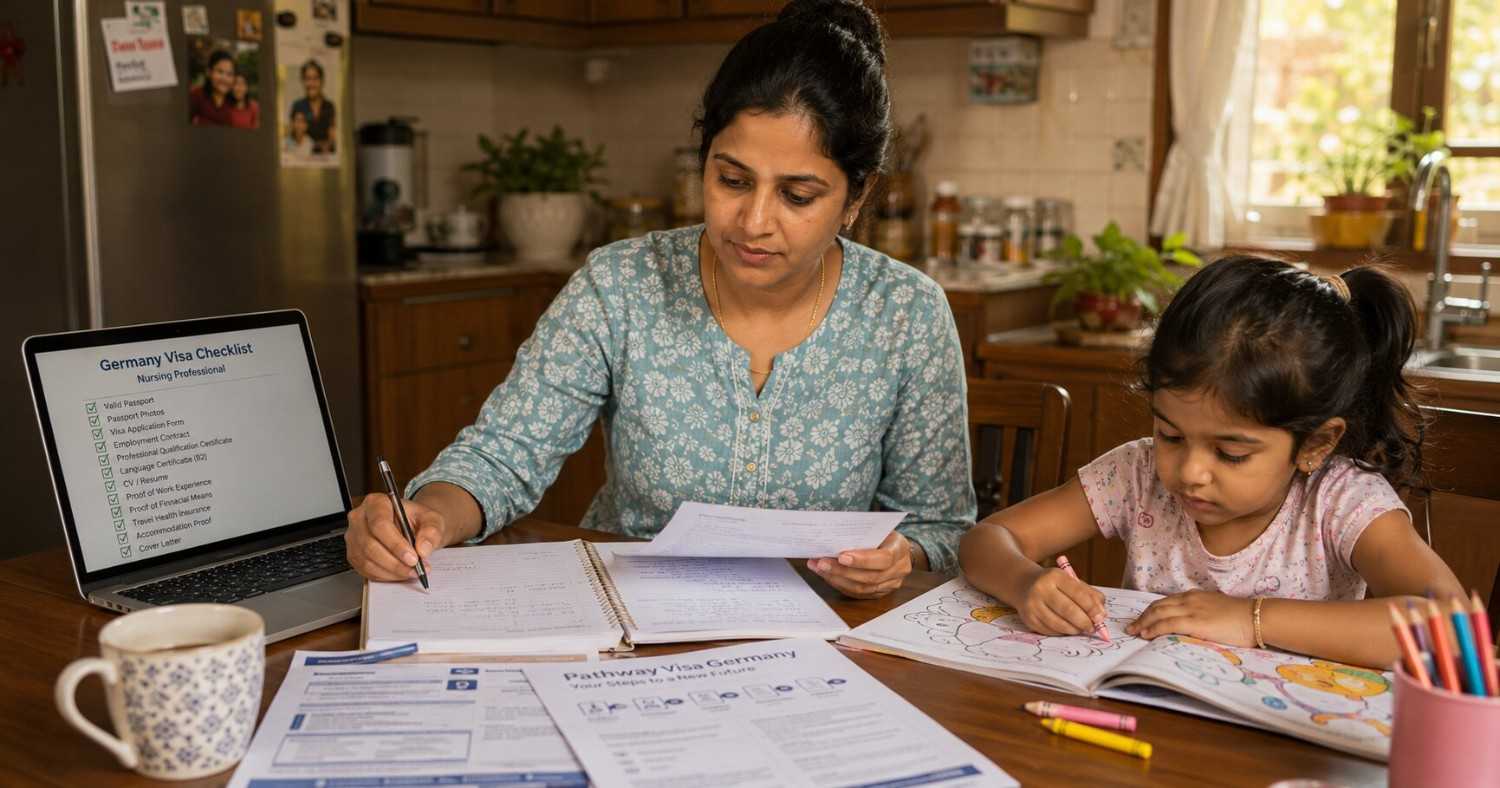
No — in the vast majority of cases, your child cannot travel with you on your first trip to Germany. Your initial journey is on a recognition visa that is issued to you as an individual healthcare worker. This visa does not include dependent travel rights from day one.
However, Germany's family reunification law — Familiennachzug — gives your child (and your spouse) the legal right to join you in Germany once you are established. This is not a special permission or a favour from your employer. It is a legal right. The process has a defined timeline, defined requirements, and a defined outcome. It is slower than most nurses would like, but it is certain.
Understanding this path clearly — rather than discovering it after you arrive — is what lets you plan the separation period sensibly and manage it without being blindsided.
When you travel to Germany on a §16d Recognition Visa, you are arriving as an individual worker whose professional qualification is still being formally assessed. The visa is issued on the basis that you have a job offer, B2-level German, and the intention to complete the recognition process. It is a work visa, not a family visa.
German immigration law permits family members to join a worker in Germany through the Familiennachzug process — but this process requires the primary worker to first establish several conditions: a valid residence permit (not just a visa), adequate stable income, and adequate housing for the entire family. None of these conditions can typically be confirmed before the nurse arrives, which is why family travel from day one is not the standard pathway.
| Phase | What Happens | Approximate Timing |
|---|---|---|
| Nurse arrives in Germany | Begins work on §16d visa, completes Anmeldung (address registration) | Month 1 |
| Settlement period | Nurse secures stable accommodation — own flat or employer flat large enough for family | Months 2–5 |
| Residence permit issued | Nurse applies for and receives Aufenthaltserlaubnis (residence permit) based on employment | Months 3–6 |
| Family visa application | Spouse and child apply at German consulate in India. Documents submitted including nurse's permit, proof of housing, income. | Months 6–9 |
| Visa processing | German consulate in India processes application. Waiting time currently 3–6 months. | Months 9–15 |
| Family arrives | Spouse and child travel to Germany. Child enrolled in school. | Months 12–18 |
The total separation period is typically 12 to 18 months from the nurse's departure to family reunification. Nurses who begin the housing and paperwork process immediately upon arrival — rather than waiting — consistently achieve reunification at the lower end of this range.
For a child's family reunification visa, the following documents are required from the Indian side:
The apostille process for Indian documents can take 4 to 8 weeks depending on the state. Starting this process before the nurse departs for Germany significantly compresses the reunification timeline.
Children of Indian nurses in Germany are entitled to attend German state schools free of charge from the day they arrive — this is a legal right under German law, not dependent on citizenship or residency status. Most primary schools and secondary schools in cities with established international communities have experience with non-German-speaking children joining mid-year.
The DaZ (Deutsch als Zweitsprache — German as a Second Language) programme provides dedicated support for children from non-German-speaking families. Children under 12 typically achieve functional German fluency within 6 to 12 months of attending school. The younger the child, the faster this happens — children under six who attend Kita (childcare) in Germany often become fluent within months.
Teenagers face a harder transition, particularly for children aged 14 to 17 who are close to completing secondary school in India. For this age group, the timing of the move requires careful planning — this is a personal decision that depends on the child's academic situation and should be discussed in detail with JSJ's counselling team.
For nurses with young children, the separation period is the hardest part of the Germany journey — harder than the language training, harder than the recognition process. It is also the most commonly underplanned part.
The nurses who manage it best are those who made explicit, practical arrangements for the child's care before departing. Not "my mother will help" — but "my mother will move in with my husband from the day I leave, and my sister will cover school pickup on Tuesdays and Thursdays." Specific plans, with named people and named responsibilities, function significantly better than general agreements.
Daily video calls are the norm for JSJ nurses with children. Many nurses establish a fixed call time — 8 PM India time, every evening — so that the child has a reliable, daily window with their parent. Consistency matters more than duration. A ten-minute daily video call provides more stability for a young child than an hour-long call every few days.
In some cases, yes — but it requires specific conditions to be met faster than average. Nurses who secure their own flat within the first 2 to 3 months, whose residence permit is processed quickly, and whose consulate appointment is available early, can sometimes achieve reunification in 9 to 10 months. This is the best-case scenario, not the standard, but it is worth knowing it exists.
JSJ's placement coordination team works actively to match nurses with employers who provide fast housing support — because faster housing means faster family reunification. If you have a child and family reunification timeline is a priority, make this clear from your first consultation. It affects the employer matching process.
500+ nurses are on their way to Germany and Austria with us. A significant number of them have children — some under five, some in primary school, some teenagers. Every one of them went through the same separation period. Every one of them came out the other side with their family in Germany, their child in school, and a life that looks nothing like what they left behind in India — in the best possible way.
📞 Book Your Free Consultation
Call / WhatsApp: +91 96259 66817
Email: support@jetsetjobs.in | www.jetsetjobs.in
500+ nurses are on their way to Germany & Austria with us. Free B2 training. Zero recruitment fees.