🛡️ Licensed by Ministry of External Affairs · RA:
B-3413/DEL/COM/1000+/5/11419/2026
📞 +91 96259 66817
📍 15, 2nd Floor, South Patel Nagar, Delhi-110008
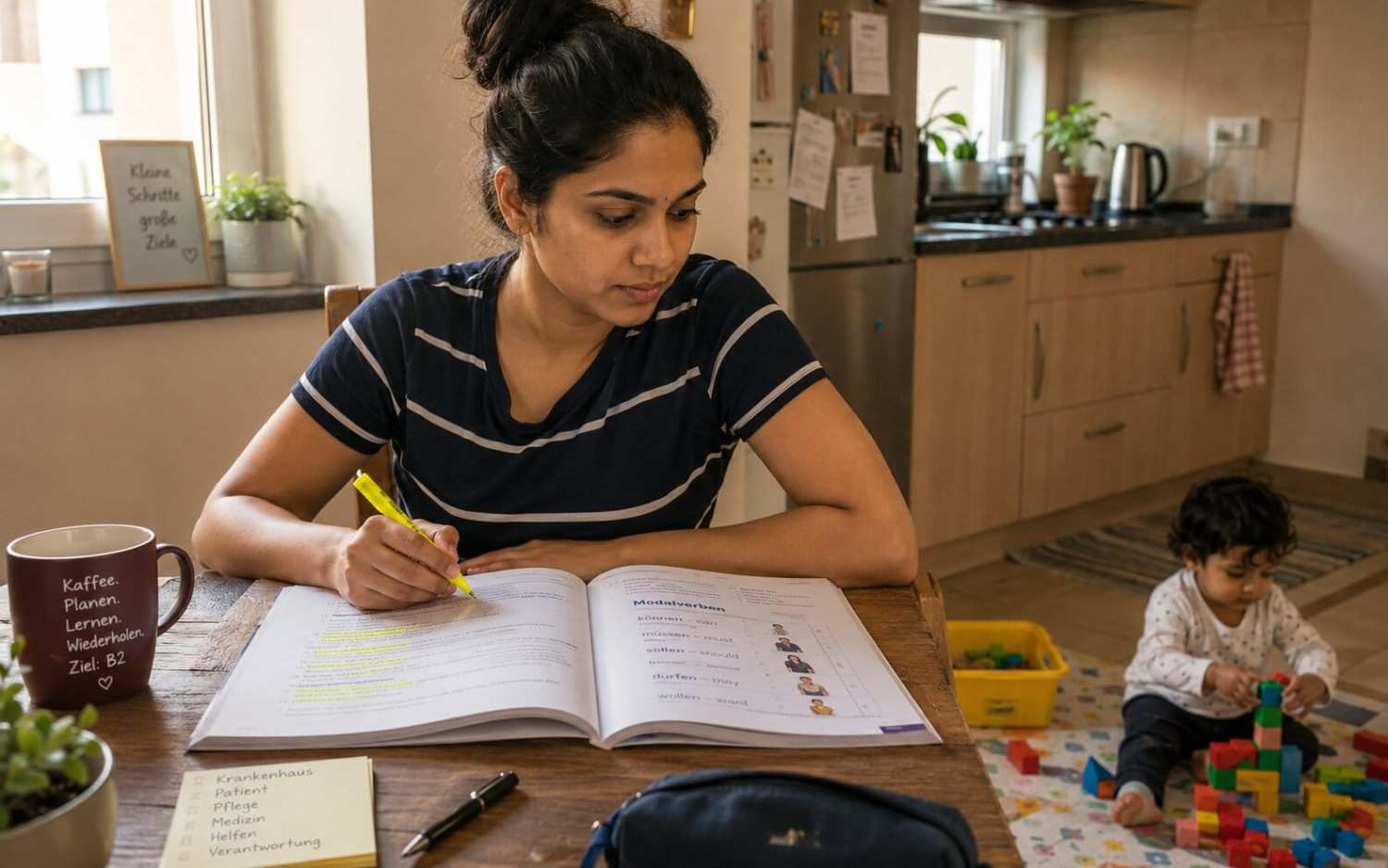
When a nurse says she cannot learn German because of her kids, she is not making a claim about language acquisition. She is making a statement about exhaustion, guilt, and an already full life. She is saying: I am already stretched. I am already giving everything I have. Adding something this significant feels impossible.
That feeling is completely valid. It also does not mean the thing is actually impossible. Many nurses in JSJ's programme have small children — some have infants. The ones who have progressed are not doing so because they found extra hours in the day. They are doing so because they changed how they used the hours they already had.
The most common pattern JSJ counsellors see in nurses with young children: they decide to "start properly" when the baby is six months old, then when the baby is one, then when the baby starts walking, then when the baby starts school. The perfect time to learn German — when life is settled and time is abundant — does not arrive. Children grow into new demands as they grow out of old ones.
The nurses who make progress are those who start now, with imperfect conditions, and adjust the study structure as those conditions change. Starting with 20 minutes a day is not ideal. It is vastly better than starting nothing and waiting for ideal.
| Time Window | Duration | What Works Best |
|---|---|---|
| Before the child wakes | 20–40 min | New vocabulary, grammar points requiring focus |
| During child's nap | 30–60 min | Live class attendance, reading comprehension |
| After child sleeps at night | 30–45 min | Revision, writing practice, listening |
| Commute to/from work | 15–20 min | German audio, vocabulary apps, podcast listening |
| Feed or hold time | 15–20 min | Passive audio — podcasts, German children's songs |
None of these windows requires a child-free house for three hours. They require consistent small commitments, stitched together across the day. Individually, each window feels insufficient. Together, they add up to 90 to 150 minutes of daily exposure — which, over 12 months, is enough to reach B2 with good instruction.
Nurses studying German alongside young children have one advantage that childless candidates do not: constant access to German children's media. German children's songs (Kinderlieder), cartoons with simple vocabulary (Peppa Wutz in German, Sandmännchen, Die Sendung mit der Maus), and children's picture books are some of the most effective tools for building A1 and A2 vocabulary. The language is clear, the repetition is high, and the content is forgiving of inattention.
Several JSJ candidates have specifically mentioned learning German alongside their toddlers — playing German songs during playtime, narrating simple daily activities in German to the child, pointing at objects and saying the German word aloud. This is not a substitute for structured study, but as a supplement it is genuinely effective and adds zero time to the day.
Many Indian nurses with children feel guilty about studying — time spent on German is time not spent with the child, not spent on household work, not spent on the hundred other things waiting. This guilt is real and it deserves to be named.
Here is the reframe that several JSJ candidates have found useful: studying German is not time taken away from your child. It is time invested in your child's future. The nurse who reaches Germany creates a life where her child grows up with European education, healthcare, safety, and opportunity. The Germany journey is, at its core, an act of parental sacrifice and planning — not self-indulgence.
The nurses with young children who make the most consistent progress in JSJ's programme are almost always those who have asked for specific, bounded help from their spouse, mother, or in-law. Not "I need help" — which is too vague to act on. But "I need 45 minutes from 9 to 9:45 PM when you take the baby and I study in another room." A specific time, a specific duration, a specific handoff.
This conversation is harder to have than it sounds, particularly in joint family settings where language learning for Germany may not be fully understood or supported. But it is worth having. The nurses who complete B2 are the ones whose family eventually understood what they were building — not because the family immediately agreed, but because the nurse kept showing up and kept explaining.
JSJ offers both morning and evening batch options through the online LMS platform, specifically because many candidates cannot commit to a single fixed daily slot. Live sessions can be attended when nap times or family support allow, and recorded content is available when they do not. The curriculum is designed to accommodate the reality that a nurse with a young child will not have perfect attendance — and to ensure that imperfect attendance still leads to B2.
500+ nurses are currently learning German with us. A meaningful number of them have children under five. They are not doing it perfectly. They are doing it consistently enough. That is the standard. Not perfection — consistency.
📞 Book Your Free Consultation
Call / WhatsApp: +91 96259 66817
Email: support@jetsetjobs.in | www.jetsetjobs.in
500+ nurses are on their way to Germany & Austria with us. Free B2 training. Zero recruitment fees.