🛡️ Licensed by Ministry of External Affairs · RA:
B-3413/DEL/COM/1000+/5/11419/2026
📞 +91 96259 66817
📍 15, 2nd Floor, South Patel Nagar, Delhi-110008
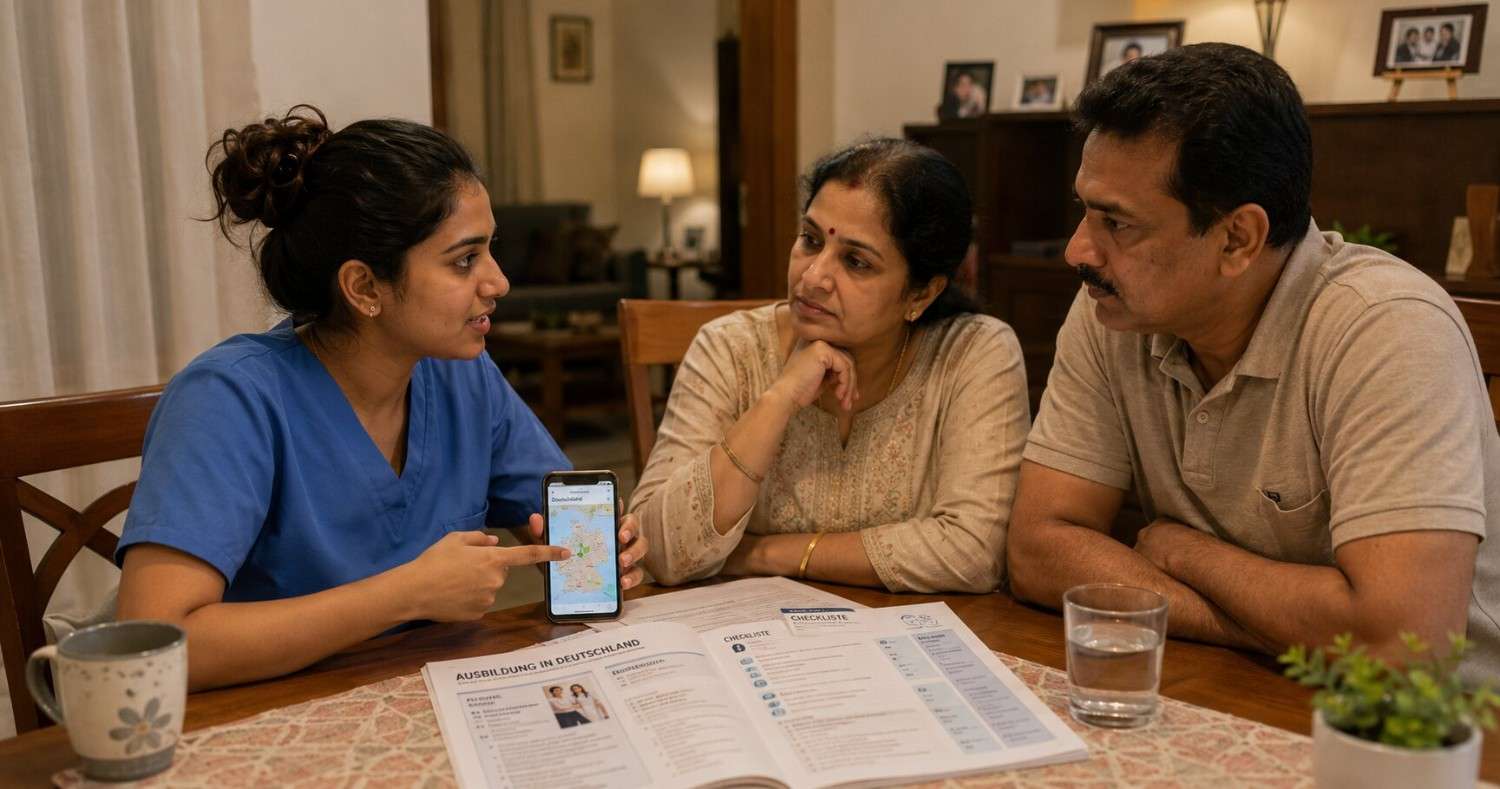
In JSJ's counselling records, family resistance — primarily from parents — is the second most common reason nurses do not enrol, right after language fear. It affects nurses across every state, every age group, and every family background. It is not a problem unique to conservative families or small towns. Nurses from metro cities with educated parents face it too, just in different forms.
The resistance usually takes one of three shapes. The first is safety-based: parents are genuinely afraid for their daughter's physical safety in a foreign country where she has no family support. The second is cultural: a daughter living alone in Europe feels wrong to parents whose reference points are shaped by a very different set of social norms. The third is practical: parents depend on the nurse's presence at home — for childcare, elderly care, or financial reasons — and cannot imagine managing without her.
Each of these requires a different response. The mistake most nurses make is giving financial arguments to parents whose concern is safety, or safety arguments to parents whose concern is cultural. Addressing the real concern — not the concern you wish they had — is what moves these conversations forward.
Parents who are worried about their daughter's physical safety in Germany are not being irrational. They have likely read or heard things about crime, racism, or the vulnerability of young women living alone abroad. The most effective response to safety concerns is specific, factual information — not reassurance. Reassurance sounds dismissive. Specific facts land differently.
Offer to show your parents the JSJ website, the MEA registration, and the contracts that German employers provide. Physical documentation in their hands does more than words alone.
For some families, the objection is not really about safety — it is about what it means for a daughter to live alone in a foreign country. This is a deeper concern, and it does not respond well to statistics or safety data.
What works better with culturally rooted resistance is reframing — changing the context in which the decision is being seen. Instead of "I want to go abroad and live alone," the more productive framing is: "I am doing this for our family. I will be more financially secure. I will be able to support you better. I am going for a fixed period to build something — not leaving permanently."
Time also matters here. Parents who say no today sometimes say yes in three months, not because the facts changed but because the idea became familiar. Nurses who drop the subject after one refusal miss this. Nurses who keep the conversation alive — sharing articles, showing messages from nurses already in Germany, bringing it up gently and consistently — often find that resistance softens over time.
In joint families, the opinion of a key elder — a grandparent, an uncle, a respected family friend — can shift the household conversation more than anything the nurse herself can say. Identifying who holds influence in your family and bringing them information first is sometimes the more effective approach.
In some households, the nurse's presence is genuinely load-bearing. She manages childcare for her siblings' children. She is the primary carer for an elderly parent. She contributes a significant portion of household income. Her parents are not being unreasonable when they say the family cannot manage without her — they may be accurately describing a real situation.
This conversation requires a plan, not an argument. What specific arrangements would need to be in place before departure? Who would take over the childcare? How would the financial gap be managed in the first 10 to 12 months before she starts earning in Germany? Can a sibling step into a support role? Is there a relative who could move in temporarily?
Nurses who approach this practically — "Let us plan this together, not argue about whether it is possible" — find far more traction than those who simply push back against the objection. The goal is to make the family feel that the departure has been thought through with them, not decided without them.
Do not issue ultimatums. Telling your parents "I am going whether you agree or not" damages the relationship and leaves you without family support during one of the most demanding periods of your life. The nurses who arrive in Germany having fought their families into reluctant acceptance are significantly less supported emotionally than those who arrived with family understanding behind them.
Do not make promises you cannot keep. Saying "I will be back in one year" when you are planning to stay for five is a short-term solution that creates a larger long-term problem. Be honest about what the Germany journey involves — the language training, the recognition process, the realistic timeline — so your family's expectations are aligned with reality.
Do not try to resolve everything in one conversation. These are significant life decisions being processed by people who love you and are afraid of losing you. They deserve patience, not pressure.
JSJ counsellors regularly speak directly with parents of nurses who are interested in the programme. If your parents have specific questions — about the employer, the city, the accommodation, the legal protections, the contract — JSJ can address them directly. In some cases, parents have visited the JSJ office in South Patel Nagar, New Delhi to see the operation and meet the team before giving their agreement. This is welcomed, not just permitted.
JSJ can also connect families with other JSJ families whose nurses are already in Germany. Speaking with someone who has been through the same fear — and come out the other side with their daughter calling from a German city, earning well, safe and settled — is the most effective reassurance that exists.
500+ nurses are currently learning German with us. Behind each of those nurses is a family who made a decision. Some of them made it easily. Many of them made it slowly, through exactly the kind of patient, repeated, honest conversations this blog describes.
📞 Book Your Free Consultation
Call / WhatsApp: +91 96259 66817
Email: support@jetsetjobs.in | www.jetsetjobs.in
500+ nurses are on their way to Germany & Austria with us. Free B2 training. Zero recruitment fees.