🛡️ Licensed by Ministry of External Affairs · RA:
B-3413/DEL/COM/1000+/5/11419/2026
📞 +91 96259 66817
📍 15, 2nd Floor, South Patel Nagar, Delhi-110008
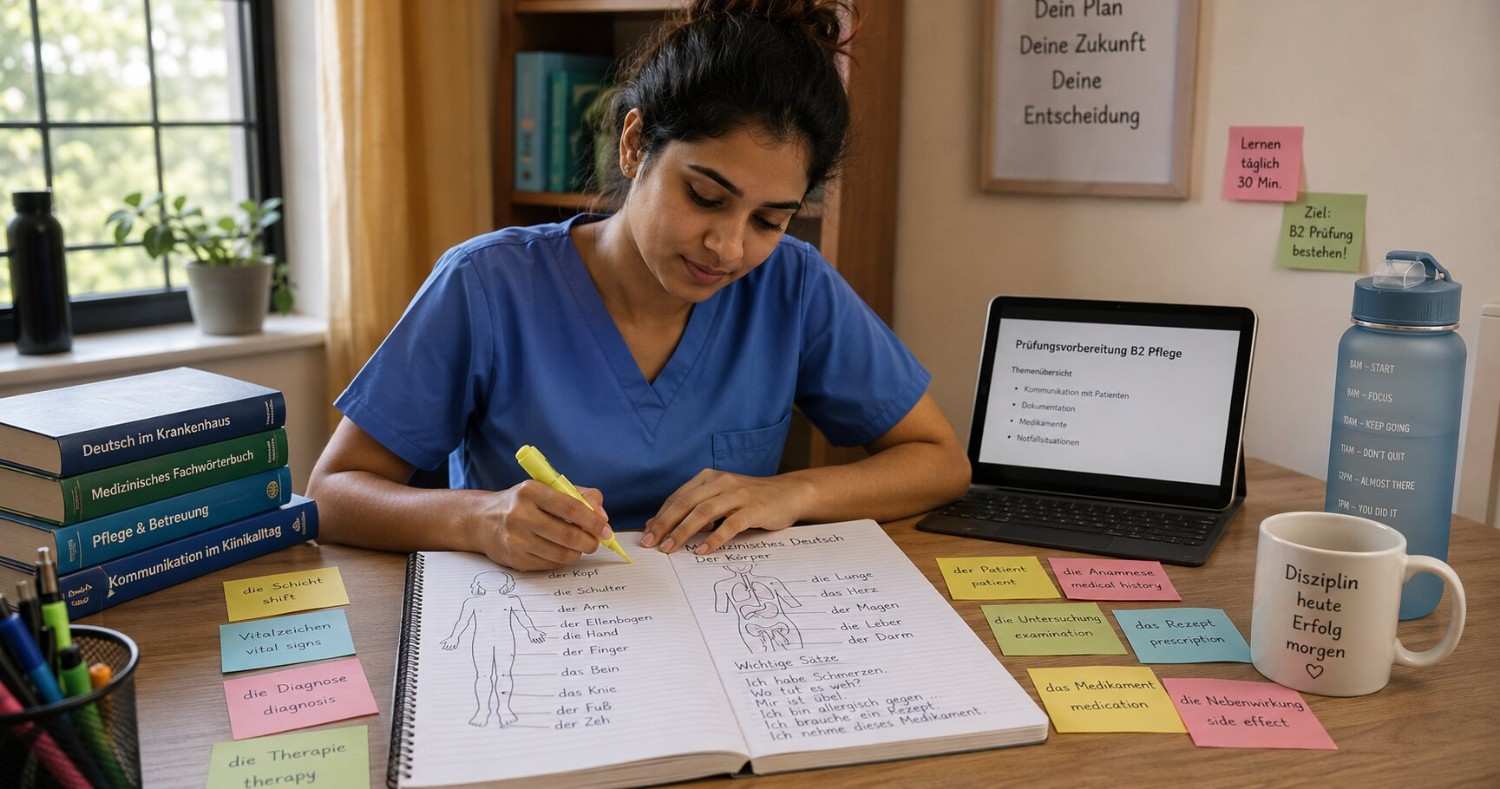
The B2 exam tests general German — conversations about travel, expressing opinions, understanding news articles, writing formal letters. These skills are necessary and they are tested for a reason. But the German you will actually use in a hospital or care home in Germany is different from the German tested in the B2 exam.
On your first shift in Germany, you will take a patient's history, document vital signs, hand over a patient to the next shift, and communicate with a doctor about a patient's medication. None of these tasks is covered in the standard B2 curriculum. They require a specific layer of clinical vocabulary on top of your general B2 foundation.
The nurses who feel most confident in their first weeks in Germany are those who began building medical German vocabulary before they left India — not after they arrived.
German medical terminology largely shares roots with English medical terms — both come from Latin and Greek. Many terms are immediately recognisable once you see them.
| German Term | English | Used In |
|---|---|---|
| das Herz | heart | Cardiovascular care, vitals |
| die Lunge | lung | Respiratory assessment |
| die Niere | kidney | Fluid balance, renal monitoring |
| die Leber | liver | Lab values, medication metabolism |
| der Magen | stomach | Nutrition, NG tube care |
| das Gehirn | brain | Neurological assessment |
| die Wirbelsäule | spine | Positioning, mobility care |
| der Blutdruck | blood pressure | Vitals documentation — used every shift |
| der Puls | pulse | Vitals — daily use |
| die Körpertemperatur | body temperature | Vitals — daily use |
When you take a patient's history (Anamnese), you need to understand what the patient is describing. These are the most commonly reported symptoms in ward and care home settings:
| German Term | English |
|---|---|
| die Schmerzen (plural) | pain |
| der Schwindel | dizziness |
| die Übelkeit | nausea |
| das Erbrechen | vomiting |
| die Atemnot | shortness of breath / difficulty breathing |
| die Schwäche | weakness |
| der Husten | cough |
| das Fieber | fever |
| die Bewusstlosigkeit | loss of consciousness |
| die Verstopfung | constipation |
| der Durchfall | diarrhoea |
| die Schlaflosigkeit | insomnia |
A critical phrase for patient history taking: "Seit wann haben Sie diese Beschwerden?" — "How long have you had these symptoms?" And: "Können Sie den Schmerz auf einer Skala von 1 bis 10 bewerten?" — "Can you rate the pain on a scale of 1 to 10?"
These are the terms that appear in every shift handover and patient care plan. Knowing them before you arrive means you can read documentation from day one:
| German Term | English |
|---|---|
| die Pflegedokumentation | nursing documentation / patient care records |
| die Übergabe | shift handover |
| die Vitalzeichen | vital signs |
| die Wundversorgung | wound care |
| die Medikamentengabe | medication administration |
| der Verbandswechsel | dressing change |
| die Mobilisation | mobilisation / getting patient moving |
| die Lagerung | patient positioning |
| die Flüssigkeitsbilanz | fluid balance |
| die Körperpflege | personal hygiene / bathing care |
| die Dekubitusprophylaxe | pressure ulcer prevention |
| die Sturzprophylaxe | fall prevention |
You do not need to memorise every medication name — most drug names are internationally standardised. What you do need to know are the categories, routes, and frequency terms that appear in medication orders:
The shift handover (Übergabe or Pflegeübergabe) is where Indian nurses feel most exposed in their first weeks in Germany. You must present each patient's status to the incoming team — concisely, accurately, in German. The structure is predictable once you know it: patient name and room number, diagnosis and current status, vital signs, any significant changes, medications administered, pending tasks, and family notes.
Key phrases for handover practice:
As candidates in JSJ's programme progress through B1 and into B2, trainers begin introducing clinical vocabulary, patient communication scenarios, and handover practice. Candidates who take initiative — keeping a separate medical German vocabulary notebook, watching German medical documentaries, practising handover phrases with batchmates — consistently report feeling more prepared when they arrive.
500+ nurses are currently learning German with us. The ones who are already building clinical vocabulary alongside their B2 preparation are giving themselves a measurable advantage. Start the medical vocabulary list now — you do not need to wait until you clear B2.
📞 Book Your Free Consultation
Call / WhatsApp: +91 96259 66817
Email: support@jetsetjobs.in | www.jetsetjobs.in
500+ nurses are on their way to Germany & Austria with us. Free B2 training. Zero recruitment fees.