🛡️ Licensed by Ministry of External Affairs · RA:
B-3413/DEL/COM/1000+/5/11419/2026
📞 +91 96259 66817
📍 15, 2nd Floor, South Patel Nagar, Delhi-110008
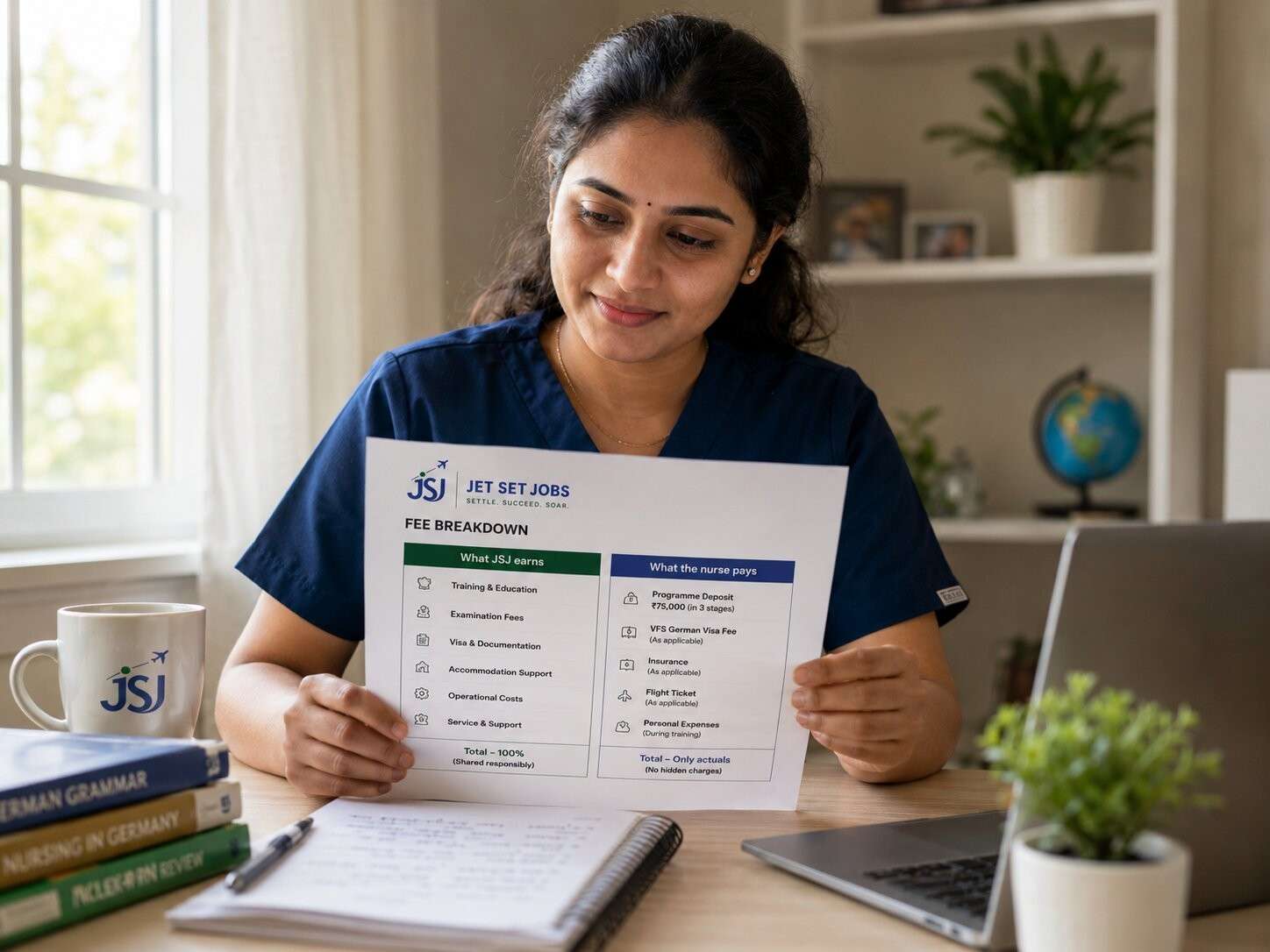
When a nurse asks "why do you charge zero recruitment fees?", she is usually asking something more pointed: what is your actual incentive here? If I am not paying you for placement, what are you getting out of this? Why would you invest in my language training, my employer matching, and my visa support without earning from me directly?
This is a completely reasonable question. In fact, it is the most important question a nurse can ask an overseas placement agency — because the answer tells you everything about whether the agency's interests are aligned with hers.
JSJ earns revenue from two sources:
When a JSJ-trained, B2-certified Indian nurse is successfully placed in a German or Austrian hospital or care home, that employer pays JSJ a placement fee. This fee is paid by the employer — not by the nurse. It is a standard international recruitment fee, equivalent to what any professional headhunter or recruitment agency charges for placing a skilled worker. The nurse pays nothing.
JSJ charges a refundable programme deposit of ₹75,000 from candidates. This deposit covers the real cost of the 48-week A1 to B2 training programme — trainer salaries, LMS platform access, study materials, and exam preparation. It is not a revenue item. It is cost recovery for a service delivered. The deposit is refundable if the nurse does not travel — meaning JSJ does not profit from candidates who do not reach Germany.
The employer-pays model is the global standard for legitimate international recruitment. Every reputable international staffing firm charges placement fees to employers, not to workers. German hospitals and care homes need nurses. Indian nurses exist and are being trained in large numbers. The barrier between supply and demand is language and documentation — which is exactly what JSJ addresses. The German employer pays for the service of having that barrier removed on their behalf.
When an agency charges fees from the candidate instead, it has inverted this logic. The nurse is paying for the service of being placed — but the nurse is not the one with the urgent need. The German employer is. Charging the wrong side places the financial risk on the person who can least afford it.
This is the core reason why the zero-fee-from-candidates model protects nurses better than any alternative:
If JSJ charged ₹1.5 lakh from a nurse as a placement fee, JSJ's revenue would not depend on whether she reached Germany — only on whether she paid. This creates an incentive to collect from as many candidates as possible, regardless of their actual suitability or likelihood of successful placement.
Because JSJ earns only from employer placement fees, and only when a placement is successful, JSJ's incentive is to invest in quality at every stage: rigorous candidate selection, genuine language training to B2, proper employer matching, and real placement support. A nurse who fails B2 and does not travel is a loss for JSJ. Only a nurse who arrives, adapts, and stays is a successful outcome. This is why JSJ uses in-house C1-certified trainers, builds mock exams into the curriculum, and invests in post-arrival support.
Zero recruitment fees does not mean the Germany journey costs nothing. It means JSJ does not earn from the nurse. The costs that still exist — the B2 exam fee, apostille and translation, the visa fee, the flight, the settlement fund — are real and total approximately ₹1.5 to ₹2 lakh across 12 to 18 months.
| Cost | Who Receives It | Approximate Amount |
|---|---|---|
| Programme deposit (refundable) | JSJ — cost recovery for training | ₹75,000 |
| B2 exam fee | TELC / Goethe — not JSJ | ₹12,000–₹18,000 |
| Apostille and translation | Government authority and translator — not JSJ | ₹15,000–₹25,000 |
| Visa application fee | German consulate — not JSJ | ~₹9,500 |
| Flight and settlement | Airline and personal expenses — not JSJ | ₹1,00,000–₹1,50,000 |
| Placement fee (employer) | Paid by German employer to JSJ — not by nurse | Not disclosed to candidate |
We explain this model in detail because we believe nurses who understand it make better decisions. A nurse who knows JSJ earns from employer placement fees understands that JSJ's interest is in placing her — not in collecting from her. The model is what it says it is. The employer pays. The nurse trains, completes B2, gets placed, and builds a career in Germany. JSJ earns from the employer's placement fee and reputation-builds through nurses who succeed.
500+ nurses are on their way to Germany and Austria with us. Zero of them paid a recruitment fee. Every one of them paid a refundable programme deposit that covered their 48-week training. This is the model. It works. It will continue to work as long as JSJ continues to place nurses — which is the only outcome that sustains it.
📞 Book Your Free Consultation
Call / WhatsApp: +91 96259 66817
Email: support@jetsetjobs.in | www.jetsetjobs.in
500+ nurses are on their way to Germany & Austria with us. Free B2 training. Zero recruitment fees.