🛡️ Licensed by Ministry of External Affairs · RA:
B-3413/DEL/COM/1000+/5/11419/2026
📞 +91 96259 66817
📍 15, 2nd Floor, South Patel Nagar, Delhi-110008
📌 What You'll Learn
This blog explains the real difference between doing an Ausbildung in Germany and trying to get a direct job. If you or your family are wondering which path is realistic, legal, and long-lasting — this is the blog to read.
When Indian students think about going to Germany, they often imagine two scenarios. First: getting some training, learning German, and then landing a full-time job. Second: going straight to Germany, finding a job, and building a life from Day 1. Both sound reasonable. But in practice, they are very different in terms of visa, eligibility, process, and long-term outcome.
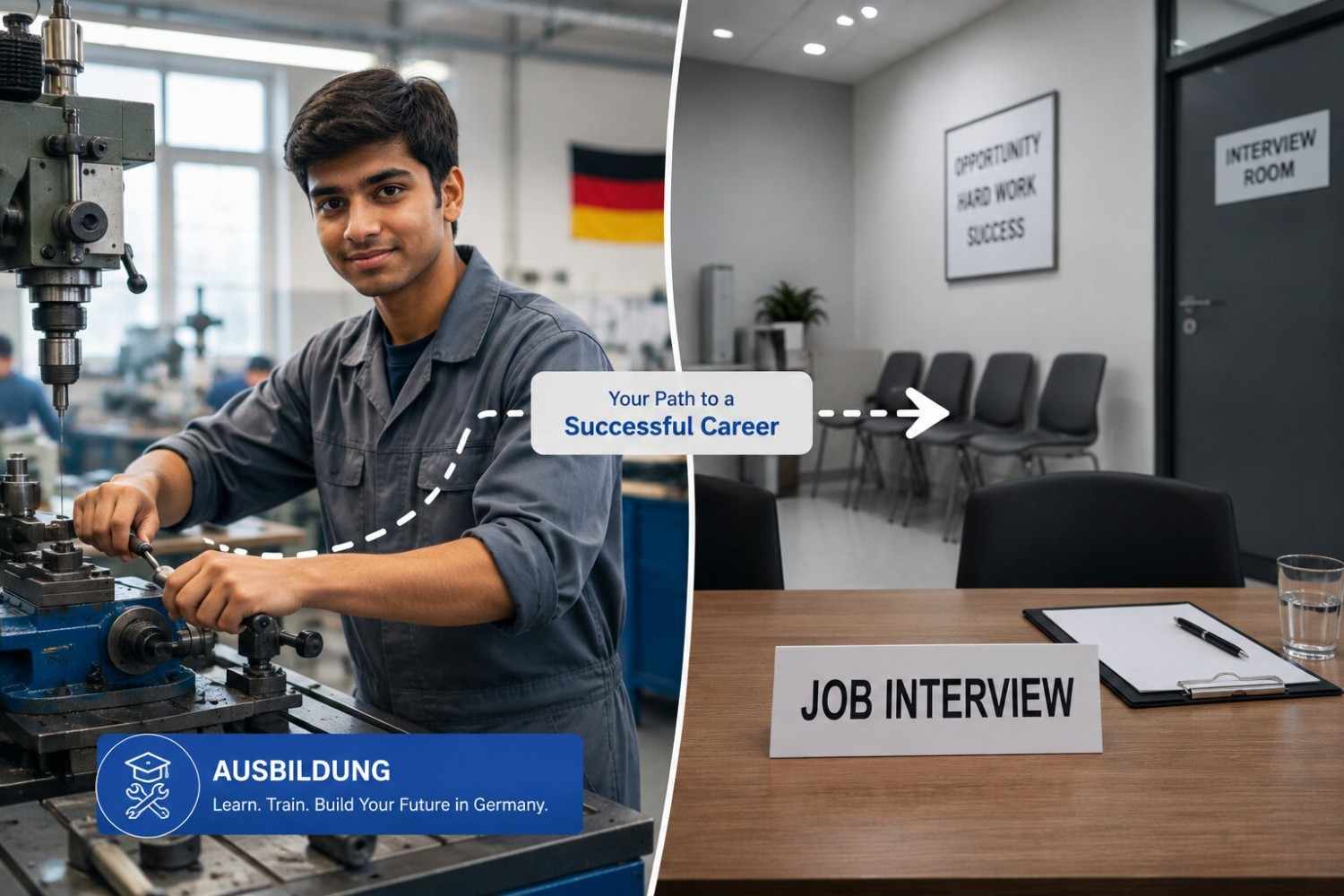
The Ausbildung route is a structured, government-recognised vocational training programme. You come to Germany, train for three years in a specific sector, earn a stipend every month, and graduate with a German qualification that is valid across the European Union. The direct job route — officially called the Fachkräfteeinwanderung or Skilled Worker Immigration — requires you to already hold a recognised qualification, secure a job offer, and then apply for a work visa.
The key word is "already." If you are a Class 12 graduate aged 18–20 with no German qualification, you are almost certainly not yet eligible for a direct job visa. That is where Ausbildung becomes not just an option, but the correct path.
Germany has opened its skilled worker visa significantly in recent years due to the Fachkräftemangel — the country's well-documented shortage of skilled workers. However, the visa still has strict requirements. You must hold a degree or vocational qualification that is recognised in Germany. Your qualification must match the job you are applying for. And most employers expect at least conversational German — usually B1 to B2 — for most practical job roles.
For IT or tech roles, some English-language positions exist, but they are highly competitive and mostly accessible to experienced professionals with university degrees. For healthcare, caregiving, logistics, mechatronics, and hospitality — the sectors where Indian candidates are most competitive — German language proficiency is non-negotiable.
Add to that the challenge of finding an employer willing to sponsor your visa without already knowing your work ethic, and the direct job route becomes much harder than it sounds on YouTube or in WhatsApp groups.
| Factor | Ausbildung (Vocational Training) | Direct Job (Fachkräfte Visa) |
|---|---|---|
| Who is eligible | Class 12 pass, age 18–25, no prior German degree needed | Recognised degree or vocational qualification required |
| German language | Learn A1 to B2 before departure — training included | B1–B2 typically required before you even apply |
| Stipend / Salary | €1,000–€1,300/month from Day 1 | €2,500–€3,600+/month — but only if you get hired |
| Visa type | Ausbildung visa — structured, well-established route | Work / Skilled Worker visa — competitive, employer-led |
| Employer support | Employer is your training partner and responsible for you | Employer hires you — you are responsible for yourself |
| Qualification outcome | Recognised German Berufsabschluss (vocational certificate) | No new qualification gained |
| PR pathway | ~4 years to Niederlassungserlaubnis (Permanent Residency) | Possible but dependent on job continuation and contract |
| Risk level | Low — structured programme, stipend guaranteed | High — no job offer = no visa, no income, no entry |
The Ausbildung route does something the direct job route cannot: it qualifies you while you work. By the time you complete your three-year training, you hold a German Berufsabschluss — a vocational qualification issued by the German Chamber of Commerce or a relevant authority. This certificate is legally recognised across all 27 EU member states. It is the same qualification a German student would receive after the same programme.
With this certificate, your second step — getting a full-time job as a Fachkraft — becomes far easier. You already speak German at B2 or higher. You have three years of German work experience. You know the culture, the workplace norms, the employer expectations. Many Ausbildung graduates receive a permanent job offer from the very employer who trained them. This is called Übernahme — the transition from trainee to full employee — and it is common in Germany.
So the right way to think about Ausbildung is not as a compromise. It is the entry road that leads directly to the career you want.
One objection candidates sometimes raise is: some agents offer direct job placement for a smaller or deferred fee. This deserves an honest answer.
Direct job placement agents typically charge lower upfront fees because they are not providing language training, employer matching, visa support, or a guaranteed programme. They are often selling a job offer letter — and the quality of that letter, the employer's reputation, and the visa outcome vary enormously. Many candidates who have gone this route have faced rejected visas, fraudulent employers, or arrived in Germany to find conditions very different from what was promised.
The JSJ Ausbildung programme includes A1 to B2 language training (10–12 months), employer matching through Destination Germany GmbH, visa guidance, and a real, signed Ausbildungsvertrag (training contract). The fee of ₹2,50,000 + GST covers all of this. It is non-refundable — and it is also transparent. There are no hidden charges.
💡 Key Reminder
The stipend you earn in Germany — €1,000 to €1,300 per month — starts from Day 1 of your Ausbildung. Over three years, this adds up to approximately €36,000 to €46,800 in total earnings. Your investment pays back within your first year abroad.
Here is the honest breakdown. If you are 18 to 25, have a Class 12 qualification (Science preferred), and want a structured, safe, and long-term route to working and settling in Germany — Ausbildung is for you. If you are already a qualified engineer, IT professional, or hold a German-recognised degree and have a confirmed job offer — the direct Fachkräfte visa may be applicable. Most Indian students reading this blog are in the first category.
If someone is telling a 19-year-old Class 12 student that they can get a direct job in Germany next month, ask for the visa documentation and the verified employer letter. The numbers rarely add up.
Jet Set Jobs, in partnership with Destination Germany GmbH, has helped 583+ candidates start their Germany journey through the Ausbildung route. The programme runs on a clear structure: registration, language training from A1 to B2, employer matching, visa application, and departure. Every step is guided. Every fee is declared upfront. There are no shortcuts — but there is a proven path.
If you are serious about Germany, start with Ausbildung. Build the qualification. Earn while you learn. And arrive in Germany not as someone looking for work, but as someone with a contract, a stipend, and a future.
📞 Book Your Free Consultation — Jet Set Jobs × Destination Germany
Call / WhatsApp: +91 96259 66817
Email: support@jetsetjobs.in | www.jetsetjobs.in
Ausbildung Programme Germany 2027
Eligibility: Age 18–25 | Class 12 pass | Science background preferred
Programme Fee: ₹2,50,000 + GST in 3 instalments
Free German A1–B2 training included | Stipend: €1,000–€1,300/month