🛡️ Licensed by Ministry of External Affairs · RA:
B-3413/DEL/COM/1000+/5/11419/2026
📞 +91 96259 66817
📍 15, 2nd Floor, South Patel Nagar, Delhi-110008
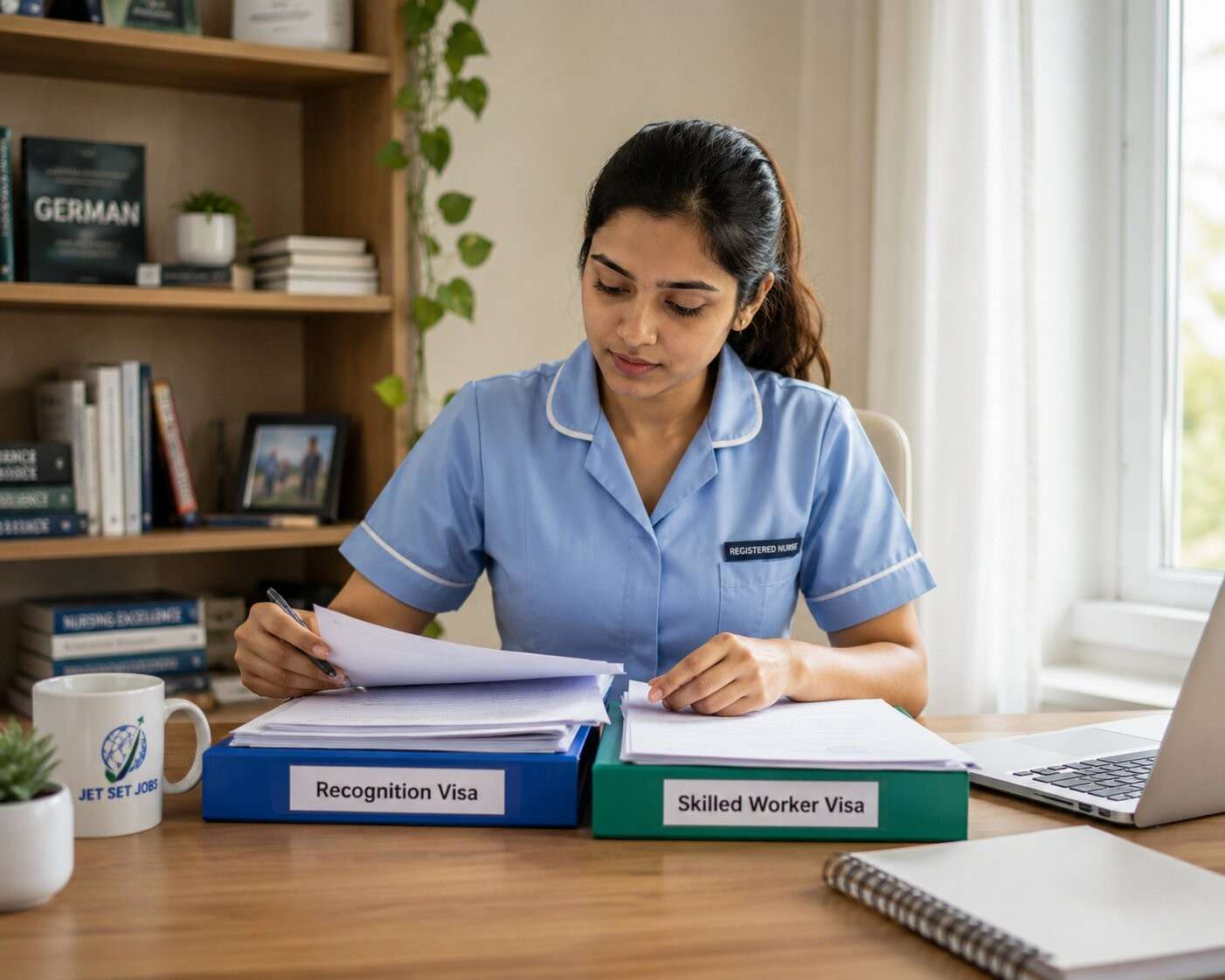
One of the most common questions Indian nurses ask before starting their Germany journey is: what type of visa do I need? The answer depends on where you are in your recognition process and what kind of job offer you have. Germany offers two main visa routes for internationally qualified nurses — and understanding the difference can save you months of confusion and delay.
Both visas are legitimate, both lead to the same destination (working as a nurse in Germany), and both are processed through the German consulate in India. But they are different in purpose, eligibility conditions, and the documents they require. Let's break this down clearly.
Section 16d of the German Residence Act is the visa designed specifically for internationally qualified healthcare professionals — including nurses — who have not yet completed the German recognition process (Berufsanerkennung) for their qualification. This is the most common visa route for Indian nurses going to Germany through structured placement programmes like Jet Set Jobs.
The Section 16d visa allows you to enter Germany to complete your recognition process on German soil. It is tied to a job offer from a German hospital or care facility that is willing to employ you during the recognition phase. Your employer in Germany becomes a key part of this process — they sponsor your stay and support you through the 'adaptation period' (Anpassungsqualifizierung) if required.
The adaptation period is a supervised work phase where you work as a nurse under observation, and a recognised nursing assessor evaluates whether your skills meet German standards. Once the state nursing authority (Landesprüfungsamt) is satisfied, your qualification is fully recognised and you receive your German nursing licence (Berufserlaubnis or Approbation).
The Fachkräftevisum, or Skilled Worker Visa, is for internationally qualified professionals whose foreign qualification has already been officially recognised as equivalent to a German qualification before arrival. In the context of nursing, this means you have already received full Berufsanerkennung — your Indian nursing degree has been assessed and accepted as equivalent to the German Pflegefachmann/Pflegefachfrau qualification.
In practice, very few Indian nurses go to Germany on a Fachkräftevisum as their first visa. Full recognition from abroad takes longer and involves more steps, including submitting translated and apostilled documents to a German recognition authority. It is more commonly used by nurses who have already worked in Germany on a Section 16d visa and completed their recognition, then briefly returned to India and are applying to return to their employer.
The Fachkräftevisum is also used by professionals in other sectors — engineers, IT workers, teachers. For nurses specifically, the recognition-linked Section 16d route is far more common and more practical when applying from India.
| Feature | Section 16d (Recognition Visa) | Fachkräftevisum (Skilled Worker Visa) |
|---|---|---|
| Who is it for? | Nurses whose qualification is not yet recognised in Germany | Nurses with full German recognition already completed |
| When to use it | Applying from India before Berufsanerkennung is done | Applying after recognition is complete (often from India after return) |
| Job offer needed? | Yes — confirmed COL from German employer required | Yes — confirmed employment contract required |
| Recognition status | Recognition happens after you arrive in Germany | Recognition must be complete before you apply |
| Most common for Indian nurses? | Yes — this is the standard route | Less common for first-time applicants from India |
| Duration | Initially up to 2 years; renewable | Initially up to 4 years or duration of contract |
| Family reunification? | Possible after certain period | Yes, once settled and income conditions met |
At Jet Set Jobs, the standard route for all our nurses is the Section 16d Recognition Visa. Here is why: when you complete your A1 to B2 German language training with us and reach B2 level, we connect you with verified German hospitals who issue a Contract of Labour (COL). This COL is the key document that unlocks your Section 16d visa application.
The process is designed so that your recognition happens after you arrive in Germany — not before. This is a deliberate design in German immigration policy to make it practical for internationally trained nurses to enter the system. Germany needs nurses urgently, and the Section 16d route allows hospitals to bring nurses in and train them to German standards while they work.
The 500+ nurses currently learning German with Jet Set Jobs are all on the Section 16d pathway. Five of our nurses have already received contract offers from German hospitals — and their visa applications will proceed through this exact route.
Technically, yes — but the pre-requisite is that your Indian nursing qualification has already been fully recognised by a German state authority before you apply. This process, done from India, typically takes 6 to 12 months on its own and requires extensive documentation. Most Indian nurses — especially those just starting out — would find this route slower and more bureaucratic than the Section 16d route.
There are some scenarios where the Fachkräftevisum makes more sense: if you have already gone through recognition in Germany, returned to India, and want to re-enter to resume working, the Fachkräftevisum may be more appropriate than re-applying under Section 16d. Your placement advisor at Jet Set Jobs will guide you on which visa category applies to your specific situation.
Some nurses ask about a third option — the language visa under Section 16f, which allows entry to Germany specifically to attend a language course. At Jet Set Jobs, we do NOT use this route. Our A1 to B2 language training (10–12 months, 48 weeks of structured training) happens fully in India. By the time you are ready to go to Germany, you already have B2 certification. There is no need to travel to Germany just for language training.
The Section 16f route is more applicable to people who need to reach a specific language level in Germany itself — often for Ausbildung or academic programmes. For our nursing pathway, the Section 16d route after B2 certification is faster, cleaner, and well-established.
| Your Situation | Recommended Visa Route |
|---|---|
| Indian nurse, no German recognition yet, have a job offer / COL | Section 16d – Recognition Visa |
| Indian nurse, full German recognition already done, have a job offer | Fachkräftevisum |
| Indian nurse, completed language training, no COL yet | Wait for COL — then Section 16d |
| Indian nurse already in Germany on 16d, completed recognition, returning to India temporarily | Fachkräftevisum on return |
Choosing the right visa is not complicated once you understand where you are in the process. For almost every Indian nurse starting fresh from India — with language training done and a hospital contract in hand — the Section 16d Recognition Visa is the correct and standard route. It is designed exactly for your situation.
Jet Set Jobs handles the entire process — from matching you with the right German hospital partner to guiding your visa documentation. You do not need to figure this out alone.
📞 Book Your Free Consultation
Call / WhatsApp: +91 96259 66817
Email: support@jetsetjobs.in | www.jetsetjobs.in
500+ nurses are on their way to Germany & Austria with us. Free B2 training. Zero recruitment fees.