🛡️ Licensed by Ministry of External Affairs · RA:
B-3413/DEL/COM/1000+/5/11419/2026
📞 +91 96259 66817
📍 15, 2nd Floor, South Patel Nagar, Delhi-110008
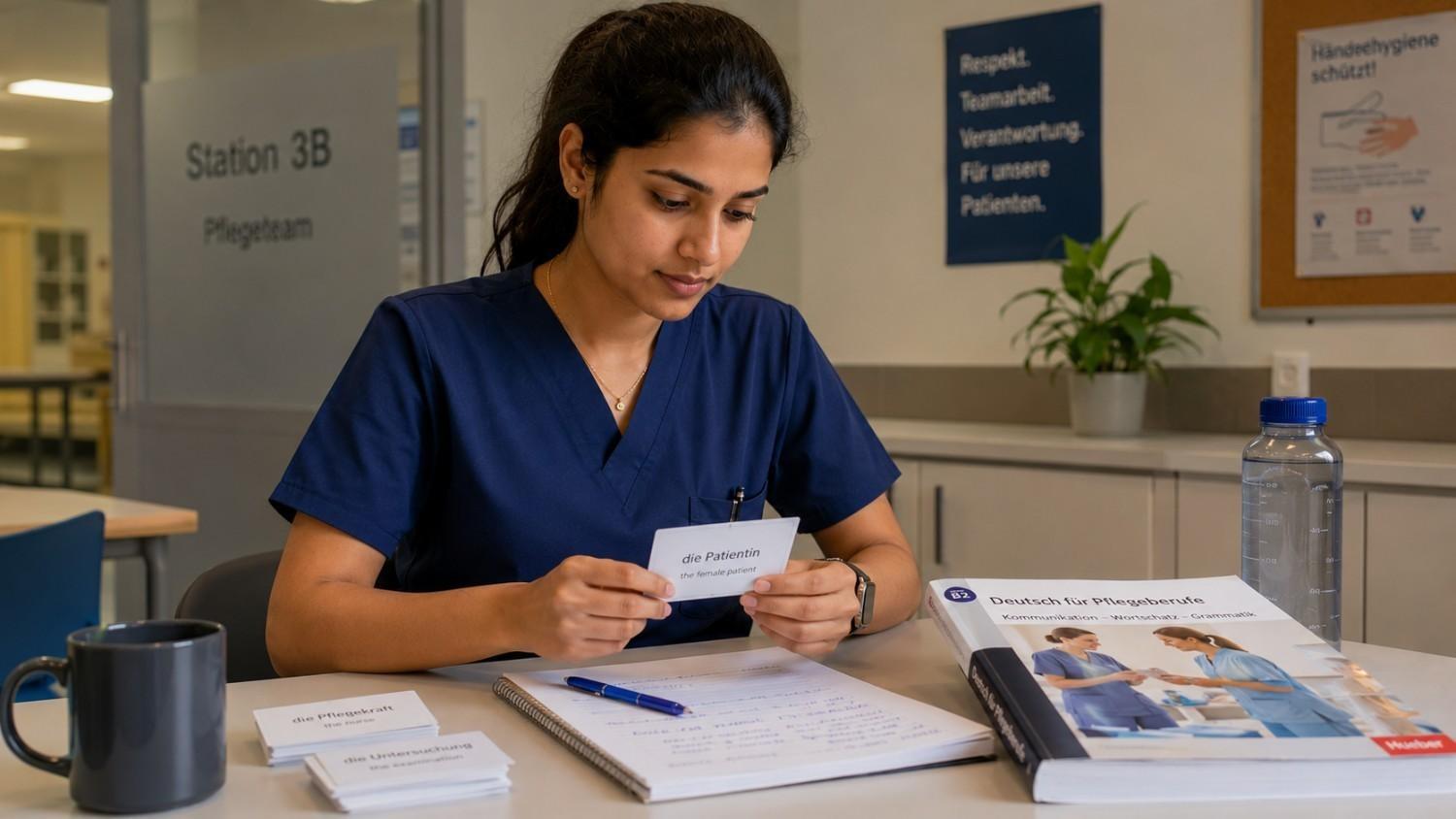
When Indian nurses begin researching the Germany nursing process, they quickly come across a term that sounds intimidating: Fachsprachprüfung, or FSP. Many assume it is yet another exam they must pass before leaving India. Others confuse it with their B2 language certificate. The reality is more nuanced — and understanding where the FSP fits in your journey is important for proper planning.
This blog covers everything: what the FSP is, what it tests, whether you will need to take it, when it happens, and how Jet Set Jobs prepares its nurses for this stage.
The Fachsprachprüfung — literally translated as 'professional language examination' — is a specialised German language test designed specifically for internationally qualified healthcare professionals seeking full recognition of their medical qualification in Germany. It is not a general language exam. It tests your ability to communicate in German within a clinical and professional medical context.
The FSP assesses three core competencies: your ability to document a patient case in written German (Dokumentation), your ability to discuss a patient case with a supervising doctor or colleague (professional consultation), and your ability to conduct a structured patient consultation in German (Patientengespräch). In a nursing context, it evaluates whether you can communicate clearly and professionally with patients, doctors, and colleagues in a German hospital setting.
Critically, the FSP is not the same as your B2 certificate. Your B2 (TELC or Goethe) tests general German proficiency. The FSP specifically tests medical and clinical German communication — vocabulary, documentation style, patient interaction, and professional conduct in a healthcare environment.
The FSP is conducted by the Ärztekammer (Medical Association) or Pflegekammer (Nursing Council) of the German federal state where your employer is located. Each state has its own examination body — for example, the Landesärztekammer Bayern in Bavaria, or the equivalent authority in Thuringia, North Rhine-Westphalia, or whatever state your German hospital is in.
This is important: the FSP is a German examination, conducted in Germany, by a German state authority. It is not taken in India. You take it after you have arrived in Germany on your Section 16d visa and begun working.
Not always — but in most cases, yes. Whether you need to take the FSP depends on the German state where you are employed and the decision of the state recognition authority (Landesprüfungsamt) that reviews your qualification.
| Scenario | FSP Requirement |
|---|---|
| Recognition authority finds your qualification substantially equivalent | FSP may be waived or replaced with a shorter assessment |
| Recognition authority finds qualification gaps (most common for Indian nurses) | FSP is required as part of the adaptation period assessment |
| You are placed in a state that uses FSP as standard for all internationally qualified nurses | FSP is mandatory regardless of qualification assessment |
| Full Approbation application (highest recognition level) | FSP is almost always required |
In practice, the large majority of Indian nurses going through the Section 16d pathway will be required to take the FSP at some point during their adaptation period in Germany. It is safest to plan for it and be prepared — if it turns out you do not need it, that is a bonus.
The FSP typically happens during your adaptation period (Anpassungsqualifizierung) in Germany — the supervised work phase that follows your arrival. You will have been working at your German hospital for some months, using the language daily, building familiarity with medical German vocabulary and documentation. By the time the FSP is scheduled, you should have significant practical exposure to the clinical German environment.
The timing varies by state. Some states schedule the FSP within the first 6 months of your adaptation period. Others wait until closer to the recognition assessment. Your German employer and the state recognition authority will guide you on when to register and appear for the exam.
You are given a clinical scenario and asked to conduct a simulated patient consultation in German. This tests your ability to take a patient history, explain a procedure or medication, respond to patient concerns, and communicate clearly and compassionately in a medical context. Duration: typically 20–25 minutes.
You are asked to write a patient summary, handover note, or medical documentation in German based on a clinical scenario. This tests your ability to use correct medical German terminology, document accurately, and write in the formal German used in hospital records. Duration: typically 45–60 minutes.
You participate in a simulated professional discussion — for example, handover to a colleague, consultation with a senior nurse or doctor about a patient, or a team briefing. This tests your professional communication style, use of medical terminology, and ability to present clinical information clearly to peers. Duration: typically 15–20 minutes.
| FSP Component | What It Tests | Duration |
|---|---|---|
| Patient Consultation | Medical German conversation, patient communication skills | 20–25 min |
| Case Documentation | Written medical German, documentation accuracy and terminology | 45–60 min |
| Professional Discussion | Clinical handover, peer communication, terminology in context | 15–20 min |
Because the FSP happens after you arrive in Germany and have been working for some months, your daily work environment is itself the best preparation. Every patient interaction, every documentation task, every handover in German builds your FSP readiness naturally.
However, targeted preparation makes a significant difference. Here is what works:
At Jet Set Jobs, our A1 to B2 training (10–12 months, 48 weeks) includes healthcare German vocabulary as part of the B2 curriculum. While this does not replace in-Germany FSP preparation, it ensures you arrive with a strong foundation in medical German that makes FSP preparation significantly easier.
The FSP can be retaken. The number of permitted attempts and the waiting period between attempts varies by state — typically you can retake after a few months. Your German employer and the state authority will advise you on the process. Do not be discouraged by a first attempt that does not go well — the FSP is a demanding exam and many internationally qualified nurses need more than one attempt.
| Factor | B2 Language Certificate | Fachsprachprüfung (FSP) |
|---|---|---|
| What it tests | General German proficiency | Medical/clinical German communication |
| Where it is taken | In India (TELC or Goethe exam centre) | In Germany (state Ärztekammer or Pflegekammer) |
| When it is taken | Before departure — required for visa application | After arrival — during adaptation period |
| Who sets the exam | TELC GmbH or Goethe Institut | German state medical/nursing association |
| Required for visa? | Yes — mandatory before COL and visa application | No — not a visa requirement |
| Required for full recognition? | Yes — submitted as part of recognition documents | Yes — required for Berufserlaubnis / Approbation in most states |
At Jet Set Jobs, we brief every nurse on the FSP as part of our pre-departure preparation. We ensure you understand what it is, when it will happen, and how to approach it. Our healthcare German vocabulary training at B2 level gives you the foundation — and once you are in Germany, your employer and the state authority will provide the formal preparation support.
You are not walking into any of this alone. 500+ nurses are currently in training with us, and our team is with you from A1 all the way through to Approbation.
📞 Book Your Free Consultation
Call / WhatsApp: +91 96259 66817
Email: support@jetsetjobs.in | www.jetsetjobs.in
500+ nurses are on their way to Germany & Austria with us. Free B2 training. Zero recruitment fees.