🛡️ Licensed by Ministry of External Affairs · RA:
B-3413/DEL/COM/1000+/5/11419/2026
📞 +91 96259 66817
📍 15, 2nd Floor, South Patel Nagar, Delhi-110008
📌 What You'll Learn
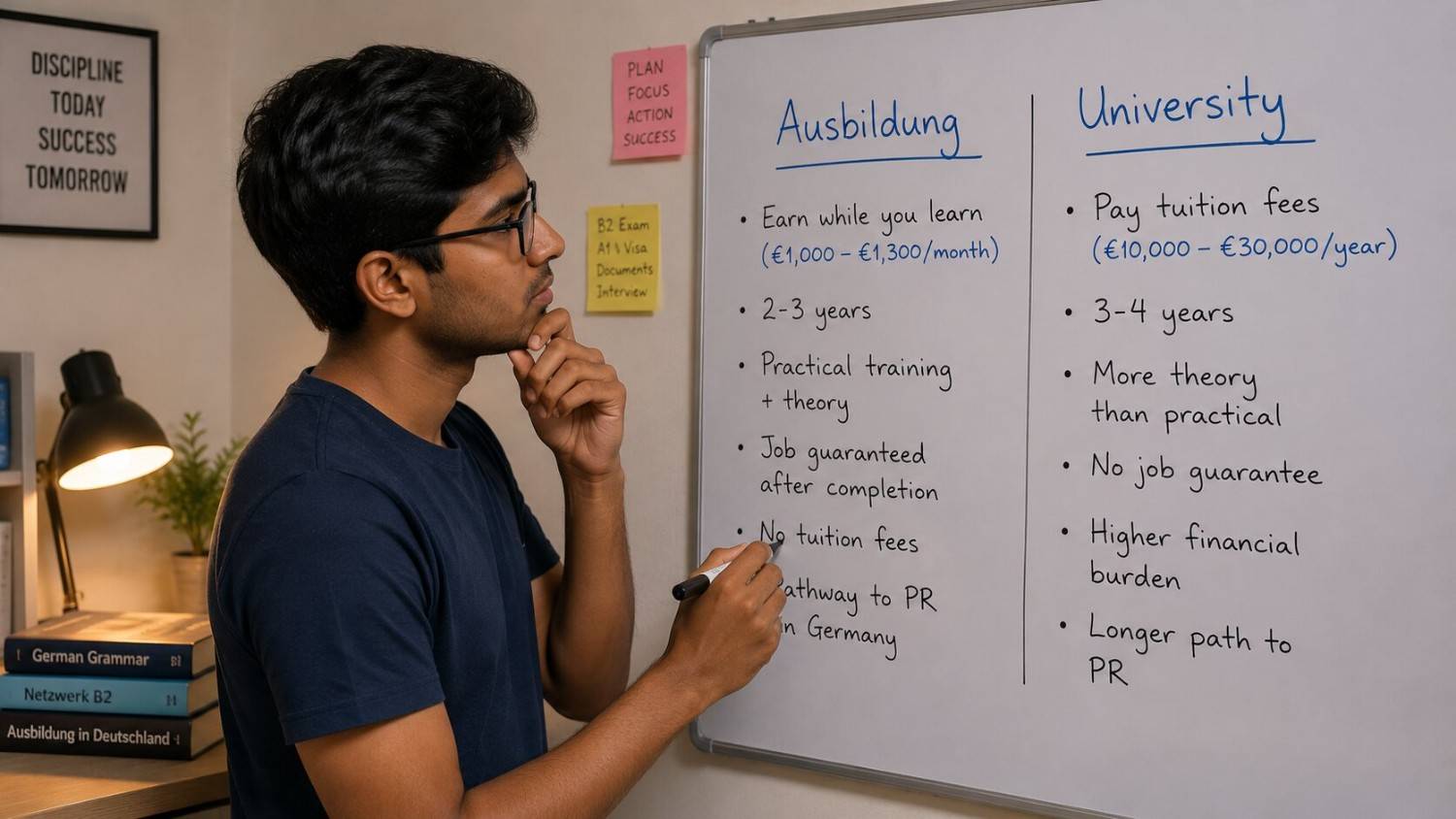
Germany offers Indian students two legitimate pathways: Ausbildung (vocational training) and university study. Both lead to a German qualification. Both offer long-term PR possibilities. But the eligibility requirements, costs, visa types, income timelines, and candidate profiles are fundamentally different. This blog compares them honestly so you can choose the right one for your situation.
When Indian families research going to Germany, they often encounter both options in the same breath: "You can study in Germany - tuition is mostly free!" and "You can do Ausbildung - you earn from Day 1!" Both statements are broadly true. But the two pathways are built for different profiles, have different requirements, and lead to meaningfully different lives in the short and medium term.
The goal of this blog is not to declare a winner. Both routes are legitimate. The question is which profile fits you - and which route you are actually eligible for, can afford, and can realistically complete.
| Factor | Ausbildung (Vocational Training) | University Study in Germany |
|---|---|---|
| What you study | A specific vocational occupation - practical, employer-led, sector-specific. | An academic degree programme - theoretical and research-oriented. |
| Duration | 3 years | 3 years (Bachelor) to 5 years (Master) |
| Visa type | National Visa for Ausbildung (Berufsausbildung). Specific, well-established route. | Student visa (Studentenvisum). Different requirements and restrictions. |
| German language | B2 (TELC or Goethe-Institut) required before visa application. | B2–C1 for German-taught programmes. English programmes exist but are limited and competitive. |
| Tuition fees | Zero - covered by the employer. Berufsschule is state-funded. | Public universities: €200–400/semester (administrative). Private universities: full fees. |
| Income during programme | €1,000–€1,300/month stipend from Day 1. Paid by employer. | No stipend. Part-time work capped at 120 full working days/year. |
| Pre-departure cost from India | ~₹3.5–3.75 lakh total (programme fee + visa + flight). | Block account: ~₹10 lakh+ deposited before visa. Plus ongoing living costs. |
| Qualification earned | German Berufsabschluss - EU-recognised vocational qualification across all 27 member states. | German Bachelor's/Master's degree - internationally recognised academic qualification. |
| Post-qualification salary | Fachkraft: €2,500–€3,600/month depending on sector. | Graduate: €2,800–€5,000+/month depending on field and employer. |
| PR pathway | Niederlassungserlaubnis available after ~4 years of qualifying employment post-Ausbildung. | PR possible after 2 years of qualifying employment post-graduation (faster route). |
| Who it suits | Class 12 graduates (18–25) who want to earn while training, prefer practical work, and have limited block account capital available. | Candidates with strong academic records, financial capacity for block account, targeting degree-requiring careers. |
One of the most significant practical differences is the block account (Sperrkonto) requirement for the student visa. To obtain a German student visa, Indian students must deposit approximately €11,208 (2024 requirement) into a German blocked bank account before the visa is issued. This is released in monthly instalments of ~€934 to cover living costs.
For most Indian families, this means a pre-departure deposit of approximately ₹10 lakh or more - in addition to any private university tuition, flights, and top-up living costs. Many families underestimate this when they hear "German universities are free."
The Ausbildung route has no block account requirement. Your employer pays your stipend from Day 1. Total pre-departure investment for the JSJ programme is approximately ₹3.5 to ₹3.75 lakh - a significantly lower financial barrier.
Both pathways require German language proficiency - often surprising to candidates who assume English-taught German university programmes make language learning optional. For German-taught university programmes (the majority of public university places), B2 to C1 German is required. For English-taught programmes, IELTS or TOEFL is required and competition for seats is high.
For Ausbildung, B2 German is required - identical to most university routes. The JSJ programme includes A1 to B2 language training in the programme fee, taking 10 to 12 months. University applicants typically need to arrange and fund their own language training independently.
📌 The Bottom Line
For a Class 12 graduate aged 18–22 from a middle-class Indian family without ₹10+ lakh immediately available - motivated by earning, practical training, and a fast route to German employment - Ausbildung is the more accessible and financially sensible first step. For a candidate with strong academics, family financial capacity, and a specific degree-requiring career target, university is the right choice. Both are Germany. Both work. The right choice depends entirely on who you are and what you actually have.
📞 Book Your Free Consultation - Jet Set Jobs × Destination Germany
Call / WhatsApp: +91 96259 66817
Email: support@jetsetjobs.in | www.jetsetjobs.in
Ausbildung Programme Germany 2027
Eligibility: Age 18–25 | Class 12 pass | Science background preferred
Programme Fee: ₹2,50,000 + GST in 3 instalments
Free German A1–B2 training included | Stipend: €1,000–€1,300/month from Day 1