🛡️ Licensed by Ministry of External Affairs · RA:
B-3413/DEL/COM/1000+/5/11419/2026
📞 +91 96259 66817
📍 15, 2nd Floor, South Patel Nagar, Delhi-110008
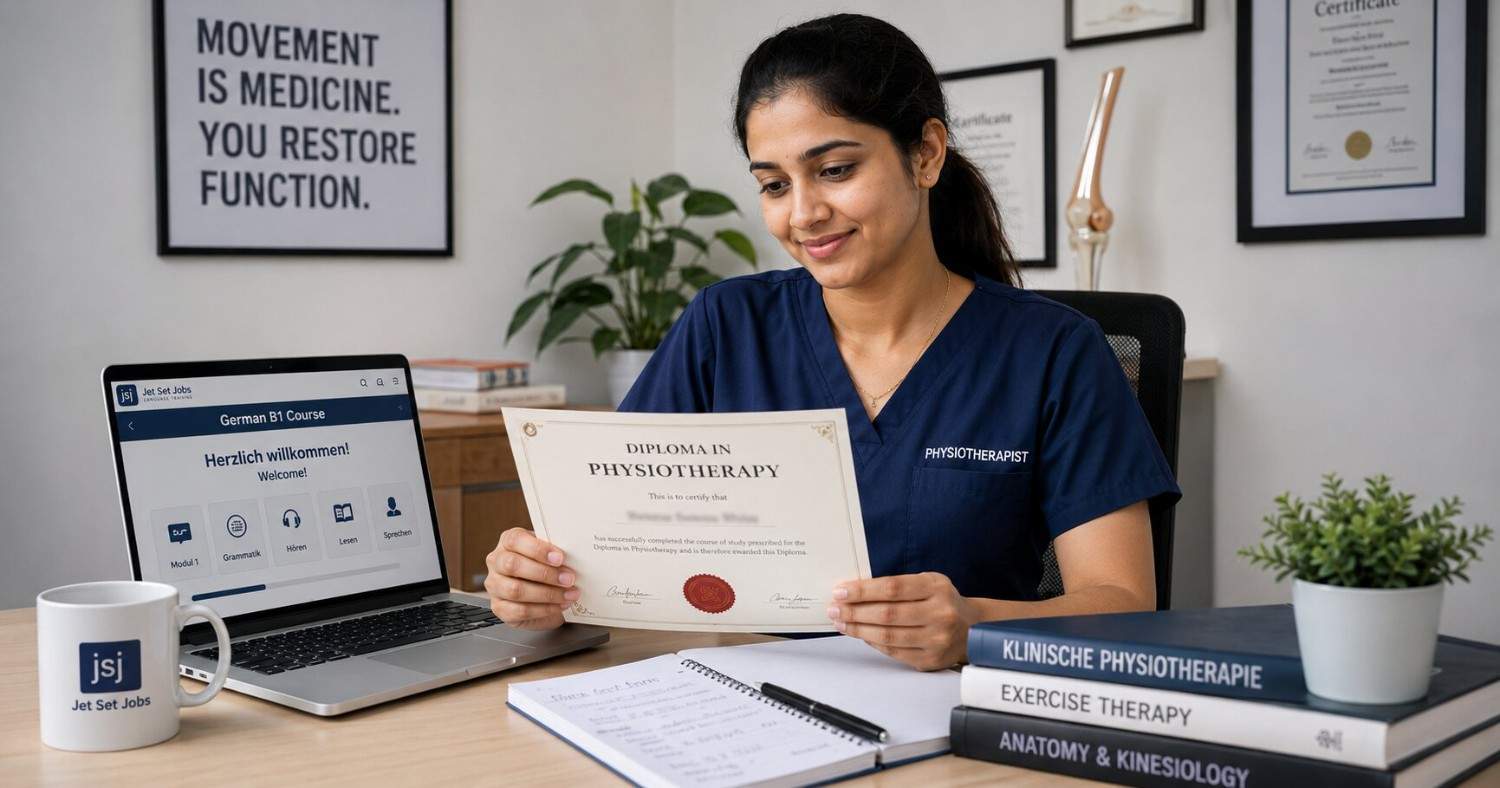
Many physiotherapists in India completed a Diploma in Physiotherapy (DPT) - a two-year programme typically offered through paramedical boards - rather than a four-and-a-half-year BPT degree. If this is you, you may have already been told by someone that Germany is not possible for diploma holders. That is not entirely accurate.
The reality is more nuanced. Diploma holders are not automatically excluded from Germany. But the recognition process is assessed differently, and being prepared for that assessment - with the right documentation and realistic expectations - is what determines whether the pathway works for you.
When a German state authority assesses an Indian qualification, they compare its duration, curriculum content, and clinical training hours against the German Physiotherapeut standard - a three-year full-time programme with a structured clinical curriculum.
| Factor | BPT (Bachelor of Physiotherapy) | Diploma in Physiotherapy (DPT) |
|---|---|---|
| Duration | 4.5 years including internship | 2 years (some states 2.5 years) |
| Academic level | Degree - university level | Diploma - paramedical board level |
| Curriculum breadth | Comprehensive across all PT specialisations | Foundational - may have narrower coverage |
| Clinical hours | Substantial - internship in teaching hospital | Variable - depends on institution |
| Recognition pathway | Berufsanerkennung - standard route | Berufsanerkennung - adaptation period or Kenntnisprüfung more likely |
A shorter programme with narrower curriculum coverage is more likely to result in identified gaps during German recognition assessment. This does not mean rejection - it means a structured adaptation period targeting those gaps.
| Possible Gap Identified | What the Authority May Require |
|---|---|
| Shorter overall training duration | Extended adaptation period - typically 6 to 18 months supervised practice |
| Narrower curriculum coverage | Adaptation period with rotations targeting specific clinical areas |
| Fewer documented clinical hours | Additional supervised clinical practice within the adaptation period |
| Lower academic qualification level | Kenntnisprüfung (knowledge exam) in identified subjects - as an alternative to adaptation period |
Importantly - none of these outcomes mean you cannot work in Germany. They mean your path to full recognition takes a defined additional step after arrival. You are still employed, still earning, and still progressing toward full Berufsanerkennung throughout.
Yes - significantly. A diploma holder with five or more years of active clinical experience in a hospital or rehabilitation setting is in a meaningfully stronger position than a diploma holder with minimal clinical exposure since graduation. Clinical experience provides additional documentation that partially offsets the shorter academic duration - experience letters, employer certificates, and supervisor references build a picture of practical competence that the authority considers alongside academic qualifications.
| Document | Why It Matters for Diploma Holders |
|---|---|
| Diploma certificate | Must be apostilled and translated - the name and issuing body matter |
| Paramedical board / university affiliation proof | Confirms the issuing body is officially recognised |
| Mark sheets / academic transcripts | Shows curriculum subjects covered - critical for gap assessment |
| Clinical training records from institution | Internship / practical training documentation - as detailed as possible |
| Professional registration certificate | State PT council or IAP registration - must be active |
| Experience letters from all employers | Each employer, duration, role, and clinical areas worked in |
| Patient caseload documentation if available | Letters from supervisors confirming clinical volume and complexity |
Not necessarily. German employers - particularly in rehabilitation centres and care homes in smaller German cities - have experience with international candidates at various qualification levels and understand that the adaptation period is part of the process. The honest picture is that BPT holders have a smoother path through recognition, and employers will generally prefer BPT applicants when both are available. But diploma holders with strong clinical experience and genuine B2 German are considered, and many have successfully completed the Germany pathway through structured adaptation periods.
Some diploma holders in India have pursued lateral entry into BPT programmes through bridge courses offered by certain universities. If you have already done this, your recognition position improves significantly. If you are considering whether to upgrade before applying to JSJ - this is a conversation for a counselling session. The answer depends on your age, your current clinical experience, how much additional time upgrading would take, and whether that time cost is worth it given your overall timeline.
📞 Book Your Free Counselling Session
Call / WhatsApp: +91 96259 66817 | +91 98100 08070
Email: support@jetsetjobs.in | www.jetsetjobs.in
500+ healthcare professionals are on their way to Germany & Austria with us.
Settle Abroad with Jet Set Jobs