🛡️ Licensed by Ministry of External Affairs · RA:
B-3413/DEL/COM/1000+/5/11419/2026
📞 +91 96259 66817
📍 15, 2nd Floor, South Patel Nagar, Delhi-110008
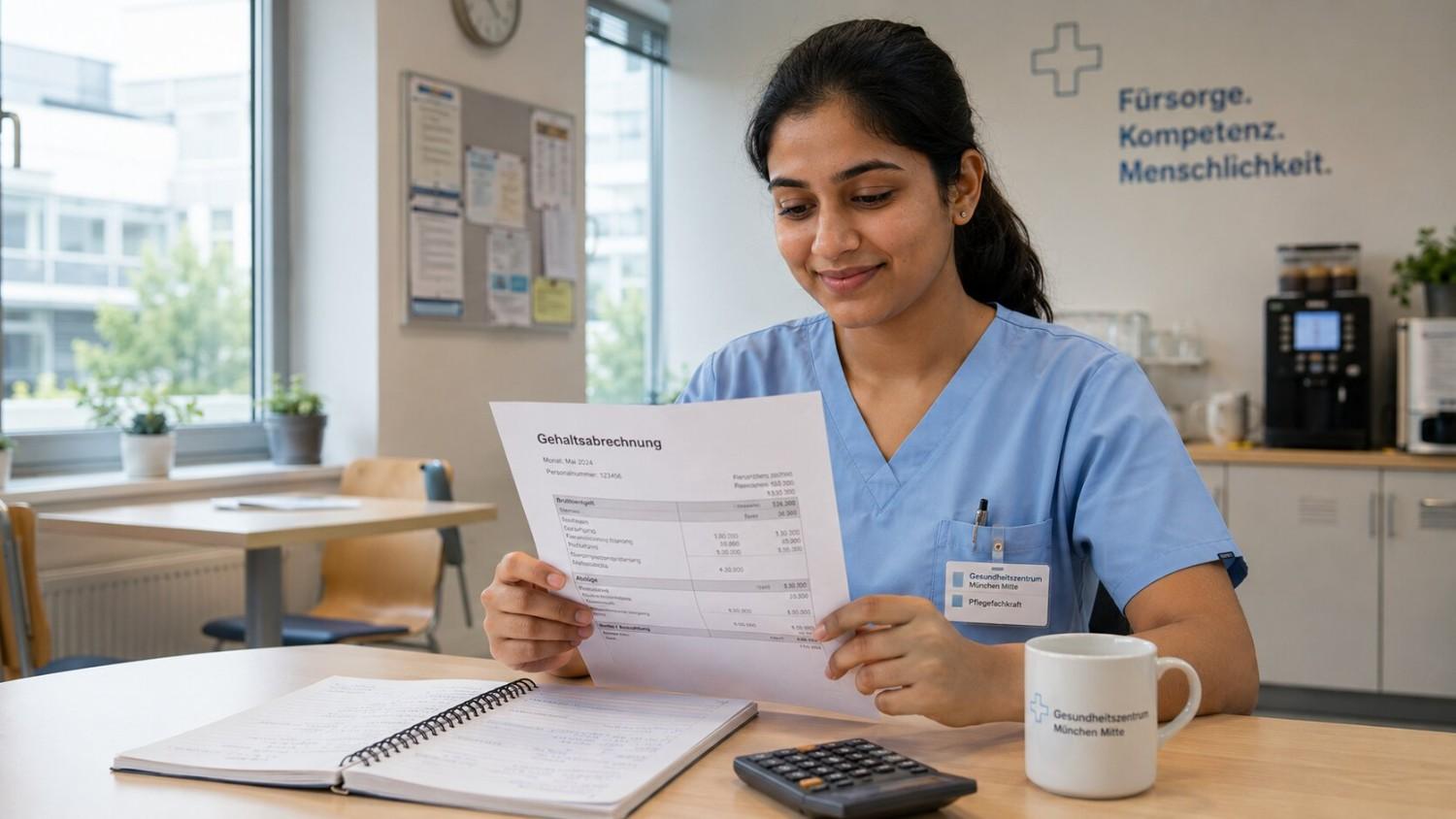
When most Indian nurses see a German job offer, they look straight at the gross monthly figure — usually somewhere around €2,800–€3,000 during the recognition phase and €3,300–€3,500 once full Approbation is granted. That number matters. But in Germany, especially in hospitals that follow a collective wage agreement like TVöD, your real annual earnings are higher than twelve times that figure.
That is because German hospitals add a layer of bonuses and supplements (called Zuschläge and Zulagen) on top of base pay. Some come automatically. Some depend on the shifts you work. Understanding them helps you read your offer properly and plan your savings honestly — without over-estimating or under-estimating what lands in your account.
Jahressonderzahlung — often called the Weihnachtsgeld or Christmas bonus — is an extra payment most public-sector hospitals pay once a year, usually with the November salary. It is calculated as a percentage of your monthly pay, and for nursing pay groups it commonly sits in the region of around 75–90% of one month's salary, depending on your pay group and agreement.
In simple terms: many nurses receive close to an extra month's salary at the end of the year. For a nurse earning roughly €3,000 gross, that can mean an additional payment in the rough range of €2,200–€2,700 gross arriving in winter. The exact percentage is set by the collective agreement your hospital follows, so always check what applies to your employer.
German law and collective agreements reward unsocial hours. If you work nights, Sundays or public holidays, you earn a supplement on top of your normal hourly rate. As a nurse working rotating shifts, these add up across the year. Typical supplement ranges under common hospital agreements look like this:
| Type of shift / hour | Typical supplement | What it means |
|---|---|---|
| Night shift (Nachtzuschlag) | around +20–25% | Extra on top of your hourly rate for night-time hours |
| Sunday work (Sonntagszuschlag) | around +25% | Paid when you are rostered on a Sunday |
| Public holiday (Feiertagszuschlag) | around +35% (higher on key holidays) | Paid for working on official German public holidays |
| Saturday (in some agreements) | small per-hour supplement | Applies in certain hospitals for afternoon/evening Saturday hours |
If you work beyond your contracted hours, that time is not lost. In Germany overtime (Überstunden) is generally either paid with an overtime supplement or banked as time off that you take later. Many nurses prefer banking the hours so they can take longer breaks or visit family in India. How overtime is handled — paid vs. time-in-lieu, and the supplement rate — is set out in your contract and the hospital's agreement, so it is a fair question to ask in your interview.
Nurses who work in rotating shift systems usually receive a separate monthly allowance — a Wechselschichtzulage or Schichtzulage — simply for working a changing roster. Depending on whether you are on a full rotating-shift pattern or a partial one, this is commonly a fixed monthly amount (often roughly in the range of €40–€110 per month). It is small compared to the Christmas bonus, but it is steady money every month for work you are already doing.
Money is not the only thing German hospitals offer. Several benefits protect your time, health and future:
Put together, the picture looks like this: a base salary, plus shift supplements that vary with your roster, plus a monthly shift allowance, plus a near-month's Christmas bonus once a year, plus protected leave and a pension. Your net take-home during the recognition phase realistically lands in the region of €1,750–€1,950 per month, and that is before the seasonal Christmas payment and any extra night/Sunday/holiday hours you pick up.
📞 Book Your Free Consultation
Call / WhatsApp: +91 96259 66817
Email: support@jetsetjobs.in | www.jetsetjobs.in
500+ nurses are on their way to Germany & Austria with us. Free B2 training. Zero recruitment fees.