🛡️ Licensed by Ministry of External Affairs · RA:
B-3413/DEL/COM/1000+/5/11419/2026
📞 +91 96259 66817
📍 15, 2nd Floor, South Patel Nagar, Delhi-110008
📌 WHAT YOU'LL LEARN
A degree from a typical Indian private university can cost ₹8–20 lakh and still end with no guaranteed job. This blog compares that path, honestly, against a paid Ausbildung in Germany — the real costs, the real outcomes, and who each route actually suits.
For most Indian families, the default after Class 12 is simple: get a seat in a private college, pay the fees, and hope a job follows. It feels safe because everyone does it. But “everyone does it” is not the same as “it works.” Let's look at what that default path actually costs — and what you get for it.
One thing up front, in fairness: this is not about the top private colleges. Institutions like BITS, VIT or Thapar are genuinely strong, and if you can get into one and afford it, that's a real option. This blog is about the other 4,000-plus private universities — the ones the large majority of students actually attend.
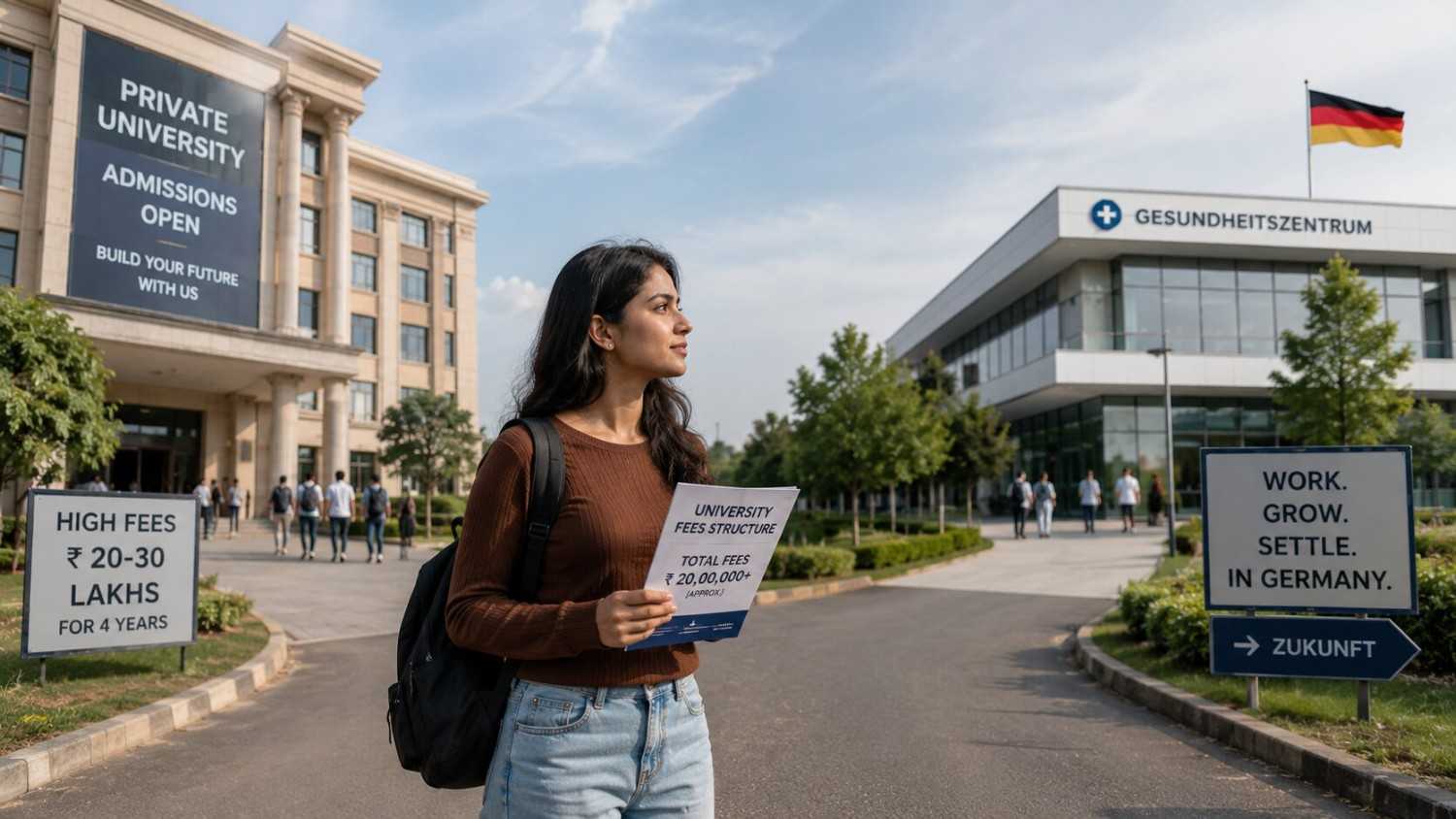
At most private engineering and management colleges in 2026, annual fees run roughly ₹2–5.5 lakh, which works out to around ₹8–20 lakh+ for a full degree once you add hostel, mess and living costs. Premium private institutes climb well past ₹25–30 lakh.
That money is spent whether or not a job appears at the end. There is no stipend, no earning while you study — it is a pure outflow for three to four years.
Private colleges love the phrase “100% placement”. Read the fine print and it usually means something much smaller. Even industry analysts note that the claim typically counts only students who opted in for placements, sometimes counts unpaid internship stipends as “placements,” and quietly excludes everyone who didn't get an offer.
At the genuinely strong private colleges, realistic placement rates sit around 70–85%. At the average tier-2 or tier-3 private university, the figure is far lower, and the packages that do land are often ₹3–4 lakh per year — barely above a fresher's living costs. The headline “₹50 lakh highest package” goes to one or two students; the median is what you should actually plan your life around.
⚠️ HOW TO READ PLACEMENT CLAIMS HONESTLY
Ignore the “highest package.” Look instead at the median CTC and the number of unique recruiters. Those two numbers tell you what a typical graduate — not the topper — can realistically expect.
Now compare that with Germany's Ausbildung route. Instead of paying a college for three to four years, you sign a training contract with a German employer. There is no tuition for the vocational training, and the employer pays you a monthly stipend of €1,000–€1,300 from your very first day. At the end of three years, you hold a German qualification recognised across all 27 EU states — and most trainees are kept on as a Fachkraft by the same employer who trained them.
Your main cost is the JSJ programme fee of ₹2,50,000 + GST, paid in three instalments, which covers your full A1–B2 German training. That's a fraction of a private degree — and unlike that degree, it comes with income and a clear job pathway built in.
| Factor | Typical private university (India) | Germany Ausbildung (JSJ) |
|---|---|---|
| What you pay | ₹8–20 lakh+ over the degree | ₹2,50,000 + GST (no tuition for the training) |
| Earn while studying | Nothing | €1,000–€1,300/month stipend from Day 1 |
| Job at the end | Not guaranteed; placement stats often inflated | Strong path to a Fachkraft job, often with your training employer |
| Qualification value | Recognised in India | German qualification recognised across 27 EU states |
| The catch | High cost, uncertain ROI | Must learn German to B2 (10–12 months) |
Ausbildung isn't a magic shortcut, and we won't pretend it is. It asks for something a local degree doesn't: you must learn German to B2 level, which takes most students 10–12 months of real, consistent effort before they fly. If you're not willing to put in that work, a German programme will be hard. But notice the trade — that effort replaces a ₹15-lakh fee and a hope-for-the-best placement with a paid contract and a recognised European qualification.
To be fair: if you've earned a seat at a top-ranked private institute with strong, verifiable placements, or your heart is set on a specific Indian profession (law, medicine, civil services prep, a family business), a domestic degree can make complete sense. The comparison here is for the much larger group of students heading into an average private college mainly because it was the path of least resistance. For them, the Ausbildung maths is simply hard to beat.
📞 Book Your Free Consultation — Jet Set Jobs × Destination Germany
Call / WhatsApp: +91 96259 66817
Email: support@jetsetjobs.in | www.jetsetjobs.in
Ausbildung Programme Germany 2027
Eligibility: Age 18–25 | Class 12 pass | Science background preferred
Programme Fee: ₹2,50,000 + GST in 3 instalments
Free German A1–B2 training included | Stipend: €1,000–€1,300/month