🛡️ Licensed by Ministry of External Affairs · RA:
B-3413/DEL/COM/1000+/5/11419/2026
📞 +91 96259 66817
📍 15, 2nd Floor, South Patel Nagar, Delhi-110008
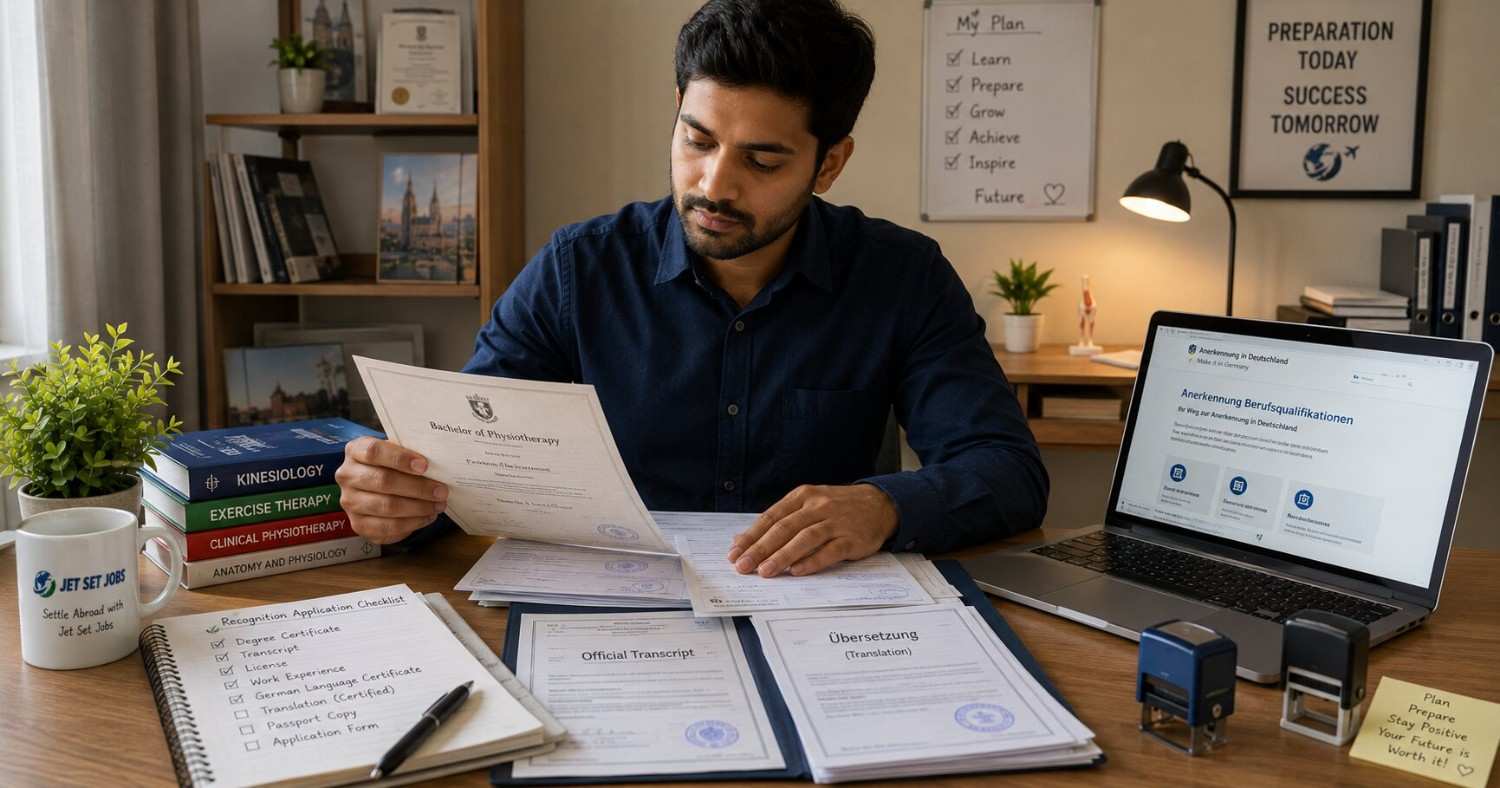
Of all the German words you will encounter on the Germany pathway, none matters more than Anerkennung - recognition. It is the official process that converts your Indian physiotherapy qualification into the legal right to work as a physiotherapist in Germany. Understanding it clearly removes much of the anxiety around 'will my degree be accepted?', and this blog explains it from start to finish.
We covered recognition briefly in our earlier process blog. Here, we go deep - because for high-intent candidates actually moving through the pathway, the details of Anerkennung are exactly what you need to understand.
Physiotherapy is a 'regulated profession' (reglementierter Beruf) in Germany. This means that, unlike some professions where you can simply apply for jobs, you legally cannot use the professional title 'Physiotherapeut' or practise as one until a German authority has granted you permission. That permission is the state permit to use the professional title (Erlaubnis zur Führung der Berufsbezeichnung).
This rule exists to protect patients and maintain professional standards - Germany wants to ensure that anyone treating patients as a physiotherapist meets the same standard as a German-trained one. For you, it means recognition is not optional or a formality to skip: it is the legal gateway to practising. The good news is that it is a well-defined, navigable process with a high success rate for properly prepared Indian physiotherapists.
The core of Anerkennung is an equivalence assessment (Gleichwertigkeitsprüfung). The recognition authority takes your Indian physiotherapy training and compares it, point by point, against the German reference qualification - the standard a German-trained physiotherapist meets. They are looking at:
The outcome of this comparison determines your path. If your qualification is assessed as fully equivalent, recognition is granted. If significant differences are identified, you receive a deficit notice (Defizitbescheid) and complete a compensatory measure - a topic so important it has its own blog in this series. Either way, the process leads to recognition for properly prepared candidates.
| Step | What Happens |
|---|---|
| 1. Determine the authority | Recognition is handled at the level of the German federal state (Bundesland) where you intend to work. The right authority depends on your destination state. |
| 2. Prepare documents | Assemble and prepare your qualification documents - degree, transcripts, training curriculum, work experience - with apostille and certified German translation. |
| 3. Submit the application | Lodge your recognition application with the competent authority, including all required documents and the B2 language certificate. |
| 4. Equivalence assessment | The authority compares your qualification to the German reference qualification to check for equivalence. |
| 5. Decision | Either full recognition, OR a deficit notice (Defizitbescheid) specifying differences to be compensated. |
| 6. Compensatory measure (if needed) | If a deficit notice is issued, complete an adaptation course (Anpassungslehrgang) or knowledge exam (Kenntnisprüfung). |
| 7. State permit granted | On success, you receive the Erlaubnis - permission to use the title 'Physiotherapeut' and practise in Germany. |
The exact list varies by authority, but the core documents for an Indian physiotherapist typically include:
| Document | Notes |
|---|---|
| Degree / diploma certificate | Your BPT or Diploma in Physiotherapy certificate, apostilled and translated |
| Academic transcripts | Complete mark sheets / transcripts showing subjects, hours, and grades |
| Training curriculum / syllabus | Detailed syllabus showing the content and hours of your programme |
| Proof of work experience | Experience certificates from clinical roles, if applicable |
| Curriculum vitae | A tabular CV (German format) with signature and date |
| B2 German certificate | TELC or Goethe B2 certificate proving language proficiency |
| Police clearance (Führungszeugnis) | Certificate of good conduct - covered in its own blog |
| Medical fitness certificate | Confirming fitness to practise - covered in its own blog |
| Passport | Valid passport as identity proof |
This is the question every candidate asks, and the encouraging reality is that properly prepared Indian physiotherapists with recognised qualifications have a strong track record of positive recognition outcomes. Industry data on international physiotherapy recognition in Germany indicates that the large majority of applications receive a positive decision - often after completing a compensatory measure such as an adaptation course. A deficit notice is not a rejection; it is simply a step on the path for many successful candidates.
That said, recognition is an individual assessment and not a guarantee - your specific qualification, documents, and preparation matter. This is exactly why the equivalence-maximising preparation the programme provides, and an honest assessment of your qualification during counselling, are so valuable. The goal is to put your strongest, most complete application forward.
One point of confusion worth clearing up: there is a difference between academic recognition and professional recognition. Professional recognition (the Anerkennung described here, leading to the Erlaubnis) is what permits you to work as a physiotherapist - this is what you need. Academic recognition of a degree (handled by the Central Office for Foreign Education, the ZAB, via a Statement of Comparability) is a separate process relevant for academic or some visa purposes. For the purpose of practising as a physiotherapist, professional recognition is the one that matters - though the ZAB assessment can play a supporting role, as covered in our dedicated blog on ZAB and Zeugnisbewertung.
📞 Book Your Free Counselling Session
Call / WhatsApp: +91 96259 66817 | +91 98100 08070
Email: support@jetsetjobs.in | www.jetsetjobs.in
500+ healthcare professionals are on their way to Germany & Austria with us.
Settle Abroad with Jet Set Jobs