🛡️ Licensed by Ministry of External Affairs · RA:
B-3413/DEL/COM/1000+/5/11419/2026
📞 +91 96259 66817
📍 15, 2nd Floor, South Patel Nagar, Delhi-110008
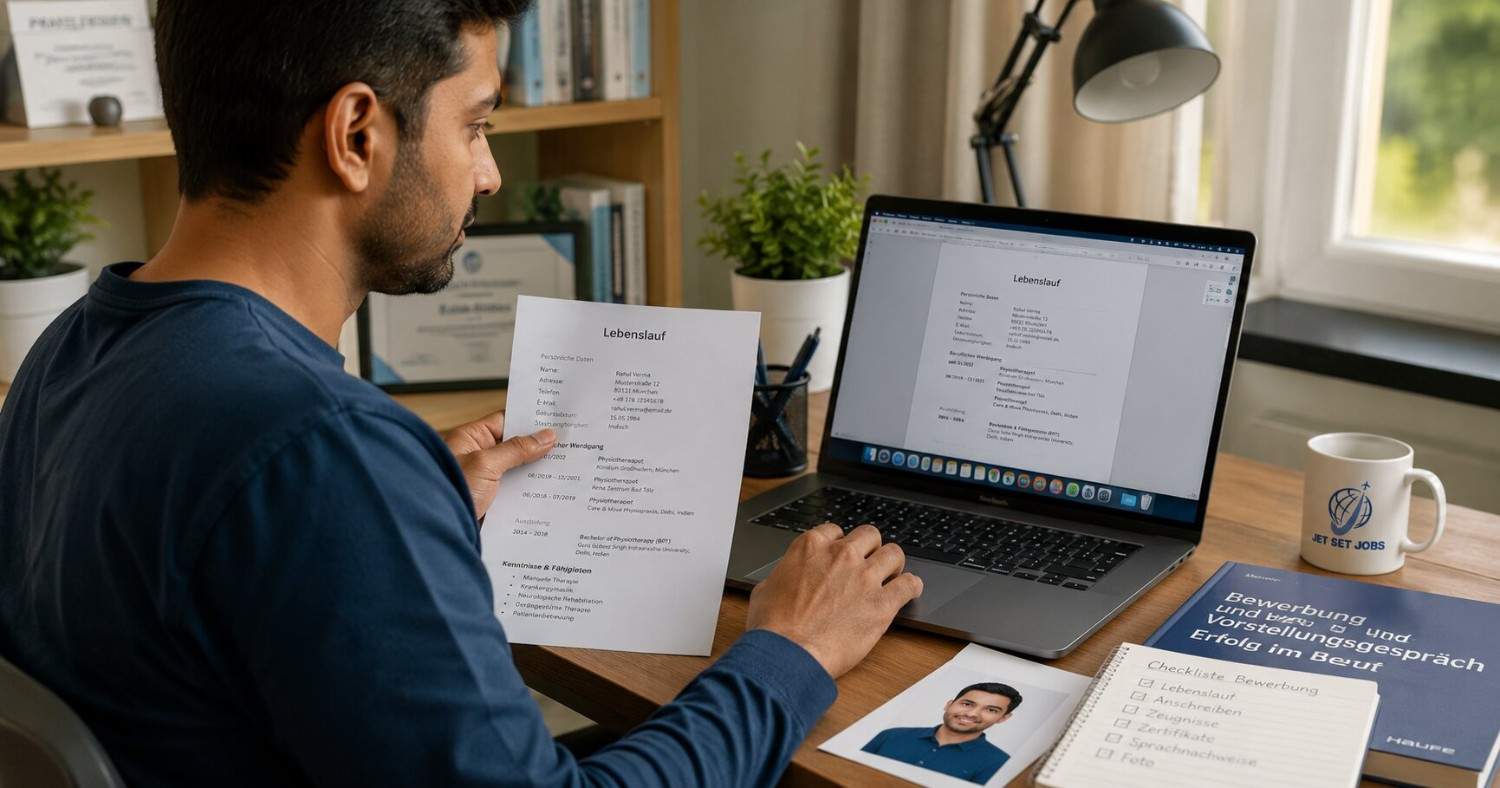
This blog opens our practical toolkit cluster - the hands-on documents and steps that turn a plan to work in Germany into an actual job. We start with the single most important document in any German job application: the Lebenslauf, or German CV. Get it right and a recruiter can see your fit in under a minute. Get it wrong - by sending a US- or UK-style resume - and your application may be filtered out before anyone reads it.
Here we explain how the German CV differs, the format and rules that recruiters expect in 2026, and the physiotherapy-specific details that make yours stand out. These are conventions, not laws, but following them signals that you understand the German market.
Unlike the achievement-driven, prose-heavy resumes common in the US, UK or India, the German Lebenslauf is a structured, factual document that lays out your history in a clean, tabular format (the tabellarischer Lebenslauf). Two columns, dates on the left, details on the right, most recent first. There is almost no flowing prose - just short, precise entries. German recruiters see hundreds of applications and scan structure, not stories, so this format lets them judge your fit in seconds. If your German is not yet fluent, this is actually an advantage: short factual bullets are far easier to get right than full sentences.
Keep to a clear set of conventions:
Two features surprise applicants from India, the UK or the US. First, the photo: a professional headshot (Bewerbungsfoto), usually top-right, is still expected by most German employers in 2026. Since the General Equal Treatment Act, it is legally optional - but culturally, especially in traditional and healthcare settings, omitting it can count against you. Invest in a proper professional photo, not a selfie. Second, personal details: a German CV typically includes your date and place of birth and your nationality, and sometimes marital status. In the German hiring context this is normal and not seen as discriminatory, though including it is increasingly a personal choice.
A standard Lebenslauf follows a fixed order of sections, which recruiters expect:
| Section (German) | What it contains |
|---|---|
| Persönliche Daten | Name, contact, photo, date/place of birth, nationality |
| Berufserfahrung | Work experience, reverse chronological, with concise bullets |
| Ausbildung | Education and professional training |
| Qualifikationen / Weiterbildungen | Recognition, licences and certificates (MT, Bobath, MLD) |
| Sprachen | Languages with CEFR levels (German level is critical) |
| Weitere / Interessen | Other skills or relevant interests (optional) |
End with the place, date and your signature at the bottom. This traditional touch (for example, 'München, 10.05.2026' followed by your signature) is becoming less common for digital applications, but many German employers still expect it, and including it signals that you stand by the information.
For a physiotherapist, three details carry the most weight, so make them impossible to miss:
Also list your clinical experience with specific settings and patient types, and quantify where you can (caseloads, specialisms). German employers value precise, concrete detail over general claims.
Finally, remember the Lebenslauf rarely travels alone. A complete German application (Bewerbung) usually includes a one-page cover letter (Anschreiben) and a set of supporting certificates (Zeugnisse) - your degree, your recognition documents, language certificates and any work references. In Germany the work-reference certificate (Arbeitszeugnis) is a big deal; if you don't have German-style references, explain your experience clearly in the cover letter instead. We'll cover more of these documents in the blogs that follow.
For candidates on our pathway, a strong Lebenslauf is where your job search becomes real. The good news is that everything German recruiters look for - recognition, language level, specialisations - maps exactly onto the journey you're already on. We help candidates present these clearly and in the right format, so your CV opens doors rather than quietly closing them. As always, this is practical guidance on a supported pathway; the certificates and language levels you list must, of course, be genuine.
📞 Book Your Free Counselling Session
Call / WhatsApp: +91 96259 66817 | +91 98100 08070
Email: support@jetsetjobs.in | www.jetsetjobs.in
500+ healthcare professionals are on their way to Germany & Austria with us.
Settle Abroad with Jet Set Jobs