🛡️ Licensed by Ministry of External Affairs · RA:
B-3413/DEL/COM/1000+/5/11419/2026
📞 +91 96259 66817
📍 15, 2nd Floor, South Patel Nagar, Delhi-110008
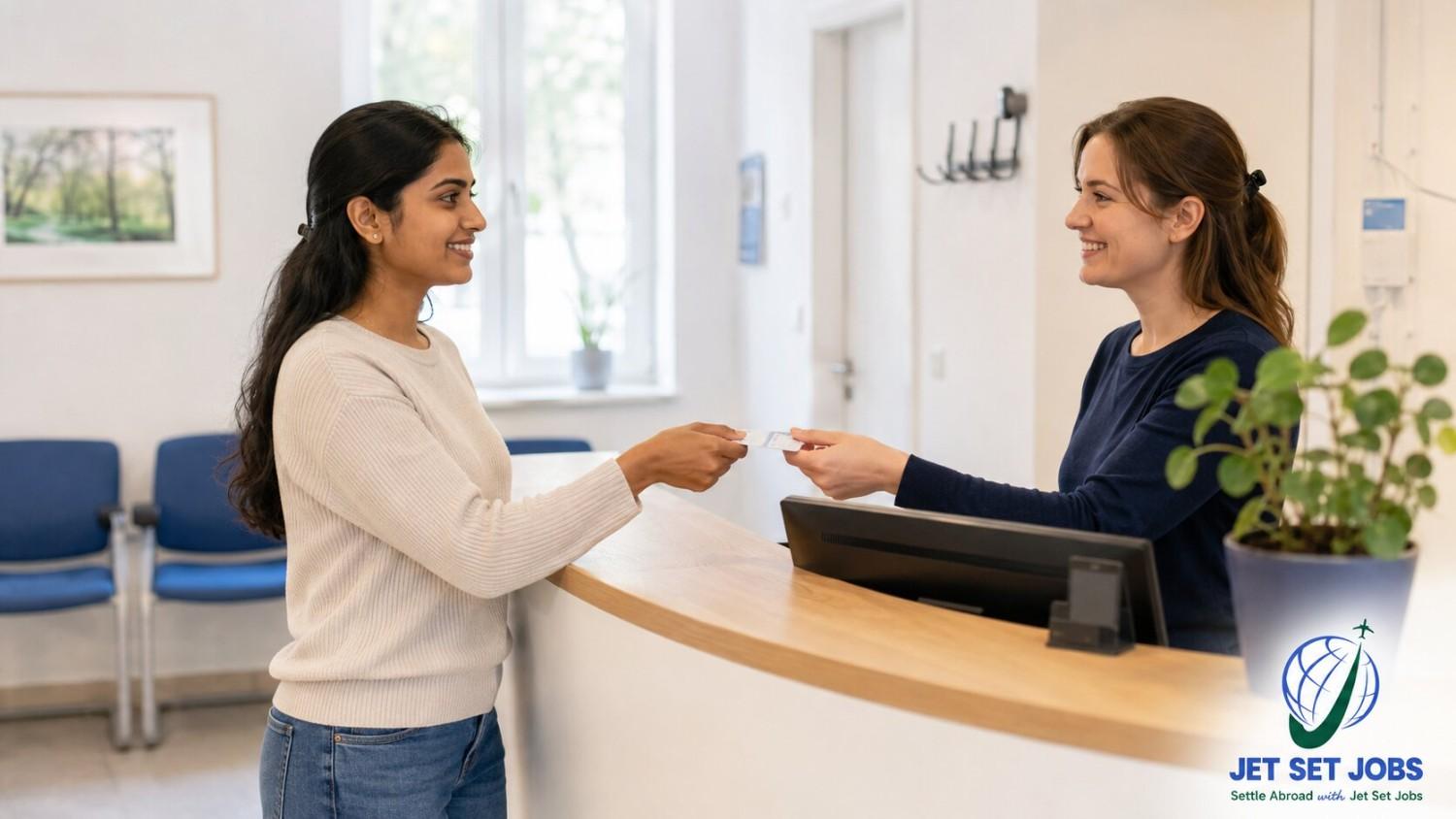
Germany's outpatient system is built around the Hausarzt - a general practitioner who becomes your doctor. You have free choice of doctor (freie Arztwahl): pick any practice accepting new public patients, near home or work. Your Hausarzt handles everyday illness, prescriptions, referrals and your sick notes - and knowing you over time is exactly the point. Register with one in your first weeks, while you are healthy - searching for a doctor while sick with a fever, in German, is the avoidable version of this story.
Most practices work by appointment (Termin) - booked by phone or, increasingly, online booking platforms where you can even filter for English-speaking doctors. Expect a rhythm that surprises newcomers: morning hours from roughly 8:00–13:00, afternoon hours 15:00–18:00, and many practices closed on Wednesday afternoons. Some Hausarzt practices also run open walk-in hours (Sprechstunde) where you wait your turn. Bring your Gesundheitskarte (health card) to every visit - it is swiped first, before anything else happens.
Save 116117 in your phone today - it does two jobs. First, it is the appointment service (Terminservicestelle): if you need a specialist and cannot get a slot, this legally-backed service must find you one - within four weeks, faster for urgent referrals from your Hausarzt. Second, outside office hours it becomes the on-call medical service (ärztlicher Bereitschaftsdienst), 24/7: a professional assesses you by phone and either advises you, directs you to an open on-call practice (Bereitschaftspraxis), or in some regions sends a doctor to your home. It is exactly for the "too sick to wait until Monday, but not dying" situations - high fever, vomiting, a bad infection on a Saturday night.
| Situation | Call |
|---|---|
| Chest pain, stroke signs, severe breathing trouble, unconsciousness, serious accident | 112 - emergency, ambulance, free |
| Sick outside office hours, urgent but not life-threatening | 116117 - on-call service, 24/7 |
| Need a specialist appointment and can't get one | 116117 - appointment service |
| Everyday illness on a weekday | Your Hausarzt |
As a nurse you will grasp this triage instantly - but note the cultural point: Germans genuinely reserve the Notaufnahme (A&E) for real emergencies, and walking in with a cold is frowned upon. Use the system as designed and it works beautifully.
Public patients now usually receive an e-Rezept (electronic prescription) - the doctor issues it digitally and you collect your medicine at any Apotheke simply by inserting your health card. Two things will feel different from India: many familiar medicines are prescription-only here, and antibiotics are prescribed far more conservatively. At night and on Sundays, pharmacies close - but by law a rotating emergency pharmacy (Notdienst) is always open nearby: every pharmacy door displays the current one, or check aponet.de.
📞 Book Your Free Consultation
Call / WhatsApp: +91 96259 66817
Email: support@jetsetjobs.in | www.jetsetjobs.in
500+ nurses are on their way to Germany & Austria with us. Free B2 training. Zero recruitment fees.