🛡️ Licensed by Ministry of External Affairs · RA:
B-3413/DEL/COM/1000+/5/11419/2026
📞 +91 96259 66817
📍 15, 2nd Floor, South Patel Nagar, Delhi-110008
 JET SET JOBS
Settle Abroad with Jet Set Jobs
JET SET JOBS
Settle Abroad with Jet Set Jobs
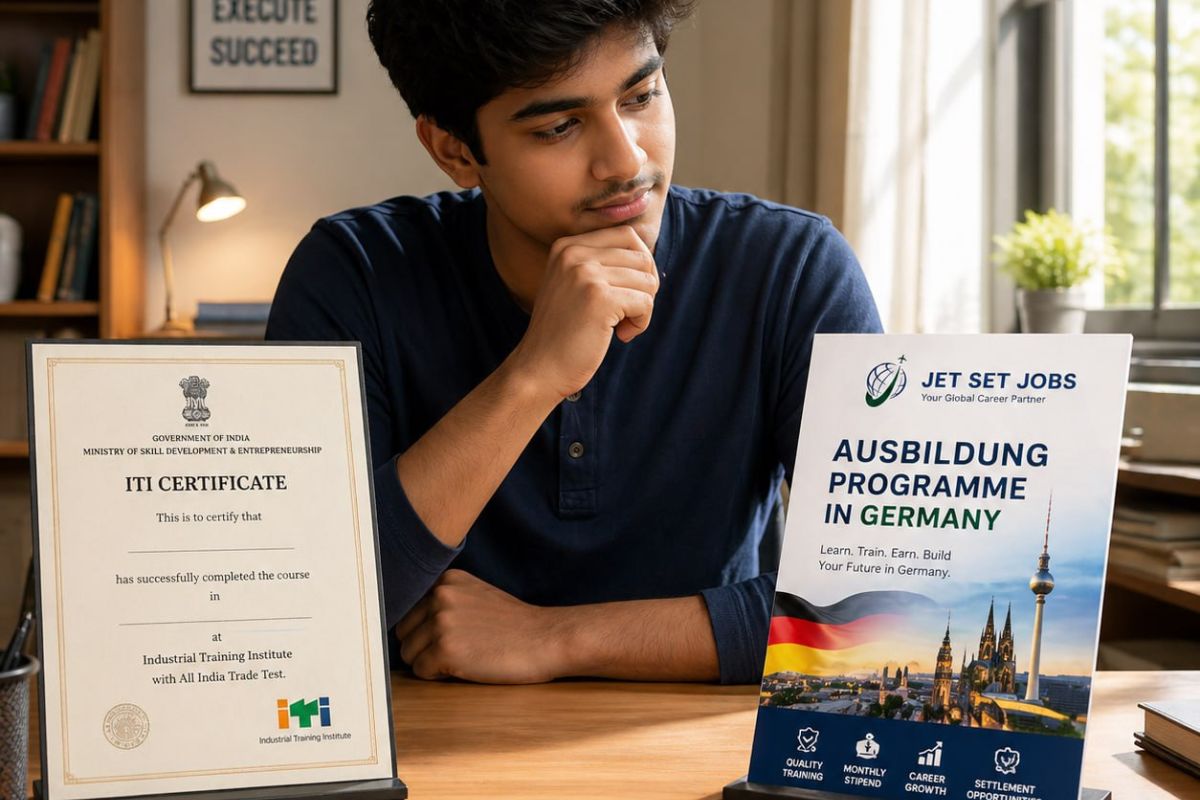
💡 In this blog: A clear, numbers-based comparison of Germany’s Ausbildung system against India’s ITI and polytechnic programmes -covering cost, duration, salary, career ceiling, and global mobility. Written for Class 12 students and parents who are weighing their vocational options.
Vocational training after Class 12 is not a new idea in India. ITI (Industrial Training Institute) programmes and polytechnic diplomas have been around for decades, producing millions of trained technicians, mechanics, electricians, and skilled workers every year. For many families, these are the default vocational pathway -affordable, nearby, and familiar.
Germany’s Ausbildung system is also vocational training. But the similarities largely end there. What you earn, where your qualification takes you, and what your career ceiling looks like are fundamentally different -and understanding those differences is worth the time it takes to read this blog.
ITI programmes in India are typically one to two years long and offered through government-run Industrial Training Institutes across the country. They cover trades like electrician, fitter, turner, plumber, welder, mechanic (motor vehicle), and computer operator. Fees at government ITIs are nominal -often under ₹10,000 for the full programme. Private ITIs charge more but rarely exceed ₹50,000–₹80,000 per year.
Polytechnic diplomas are three-year programmes offered after Class 10 or Class 12, covering engineering disciplines like civil, mechanical, electrical, and electronics. Government polytechnics charge ₹15,000–₹50,000 per year. Private polytechnics charge significantly more, sometimes up to ₹80,000–₹1,20,000 per year.
Both programmes are genuinely useful for building technical skills. The challenge is what comes after -the salary, the career growth, and the ceiling that most ITI and polytechnic graduates hit within a few years of working in India.
| Factor | Germany Ausbildung (via JSJ) | India ITI Programme | India Polytechnic Diploma |
|---|---|---|---|
| Duration | 3 years | 1–2 years | 3 years |
| Total cost to family | ₹2,50,000 + GST (JSJ fee -one time) | ₹10,000–₹80,000 (govt to private) | ₹45,000–₹3,60,000 (govt to private) |
| Income during programme | €1,000–€1,300/month (paid stipend) | ₹0 -you are spending, not earning | ₹0 -you are spending, not earning |
| Qualification issued by | German government (state examination) | NCVT / SCVT (India) | State polytechnic board (India) |
| Geographic validity | All 27 EU countries + globally recognised | India only (limited international scope) | India + some recognition in Middle East |
| Starting salary (post-training) | €2,500–€3,000/month in Germany | ₹8,000–₹18,000/month in India | ₹12,000–₹25,000/month in India |
| Career ceiling (10 years) | Team leader / unit manager -€4,000–€5,000/month | Supervisor / senior technician -₹25,000–₹45,000/month | Junior engineer / senior diploma -₹30,000–₹60,000/month |
| Path to overseas settlement | Direct -PR eligible 2 yrs post-qualification | No structured pathway | No structured pathway |
| Job secured on completion | Yes -training contract converts to employment | Not guaranteed | Not guaranteed |
The most striking difference between the two paths is not the starting salary -it is the trajectory. An ITI-trained electrician in India earning ₹15,000 per month in his first job will likely be earning ₹30,000–₹40,000 ten years later, assuming consistent employment and reasonable career progress. That is a real income, but it is also a ceiling that is difficult to break through without additional qualifications or moving to a large metro.
An Ausbildung-trained professional in Germany earning €2,500/month on qualification (roughly ₹2,20,000/month at current rates) has a fundamentally different trajectory. With a Weiterbildung (specialist qualification) and a Fachwirt (management diploma) -both employer-funded in most cases -that person can be earning €4,000–€5,000/month (₹3,50,000–₹4,40,000/month) within ten years. The structural difference is not just the starting point. It is the slope of the curve.
It would be unfair not to acknowledge what Indian vocational programmes do well. ITI is genuinely accessible -for a family in a small town with limited finances, a two-year ITI programme costing ₹20,000 in total gets a young person into skilled employment quickly, without the risk of overseas relocation or language learning. For many families, that certainty matters more than the potential of a higher ceiling abroad.
Polytechnic diplomas, similarly, provide a solid technical foundation that feeds into engineering roles across Indian manufacturing, construction, and services. The LATERAL ENTRY scheme even allows polytechnic diploma holders to enter the second year of an engineering degree directly -creating a continuing education pathway that the ITI system does not offer.
These programmes are not wrong choices. They are different choices -for different family situations, different risk appetites, and different career ambitions.
Three things about Germany’s Ausbildung system are genuinely impossible to replicate through Indian vocational training, regardless of how good the ITI or polytechnic programme is.
First: the employment guarantee. In Germany, you sign a training contract with a real employer before you even arrive. That employer is legally obligated to train you, pay you, and consider you for permanent employment on completion. No Indian ITI or polytechnic programme comes with this guarantee. You finish the course, then you find a job. In Germany, the job finds you first.
Second: the international qualification. A German Ausbildungsabschluss is recognised under EU professional qualification directives across all 27 EU member states. Your ITI certificate is recognised in India and, with effort, in some Gulf countries. The geographic ceiling of the two qualifications is not comparable.
Third: the earnings during training. The ₹2,50,000 + GST you pay for the JSJ Ausbildung programme is the total investment. Within the first year of being in Germany, you earn €12,000 gross -roughly ₹10,50,000 at current rates. Your training pays for itself in less than one year. No ITI or polytechnic programme pays you while you train.
Choose Germany Ausbildung if you are aged 18–25, have a Class 12 pass with a science background, are genuinely ready to live and work in Germany for three years, and want a career that has real global mobility and a ten-year income trajectory that Indian vocational training cannot match.
Stay with an Indian ITI or polytechnic if your family situation requires you to remain in India, you cannot commit to three years abroad, or you need employment income within six to twelve months and cannot wait for the Ausbildung visa and placement process.
The honest answer is that for the right candidate, Ausbildung in Germany is not just better than ITI or polytechnic -it is a categorically different opportunity. For the wrong candidate -someone not ready to live abroad, not motivated enough to learn German, or with pressing family obligations in India -it can be the wrong choice regardless of how attractive the numbers look.
Book a free demo class at our Karol Bagh centre or attend online. No commitment. No fees. Just one hour that could change your career.
Karol Bagh, New Delhi – 110008