
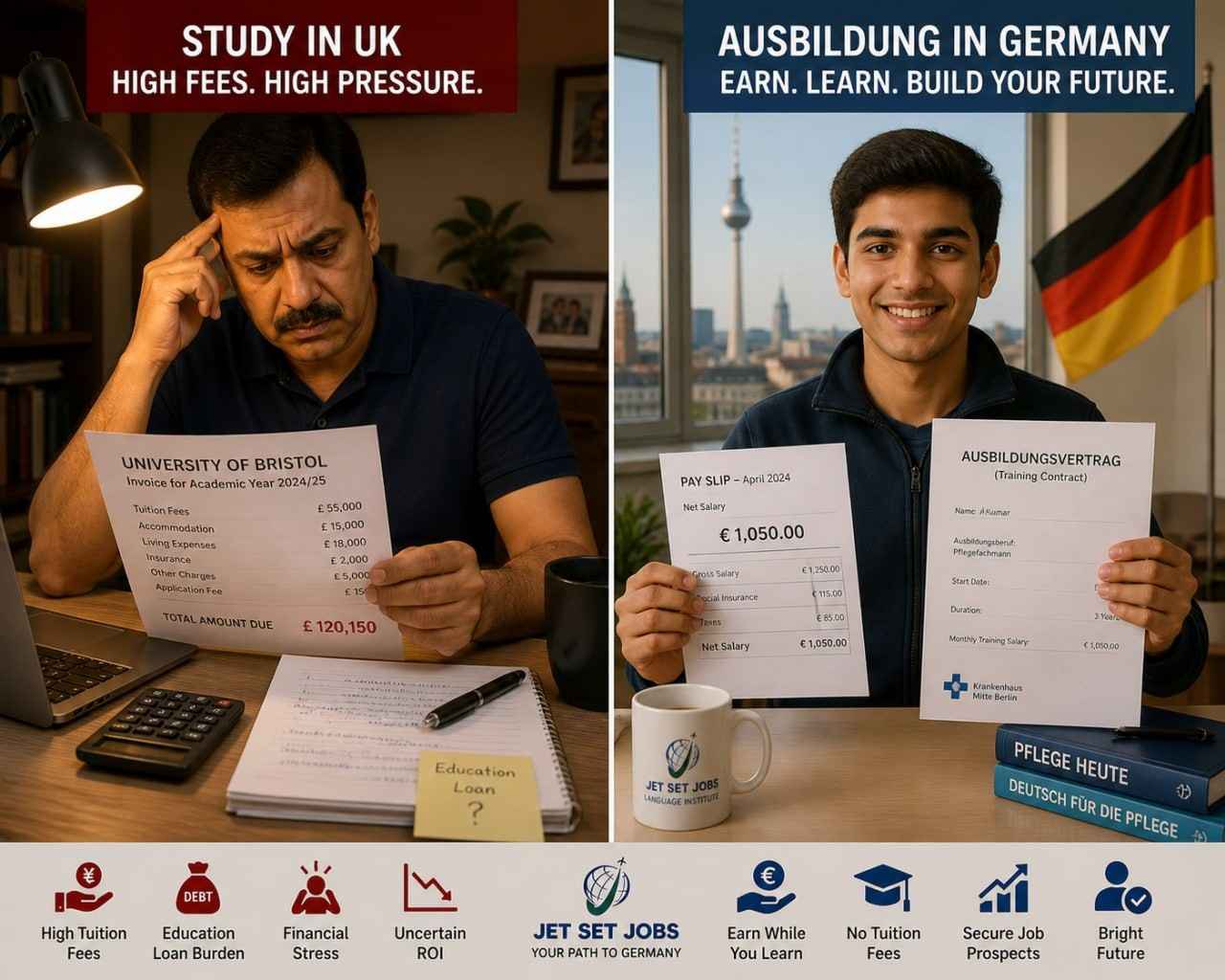
The United Kingdom has been a top destination for Indian students for generations. The shared language, the familiar university system, the cultural connection — all of it makes the UK feel like a natural choice for Indian families thinking about international education. And every year, a significant number of Indian families spend between ₹50 lakhs and ₹1.5 crore on a UK undergraduate degree for their 18-year-old.
Most of them have not compared that decision to Germany's Ausbildung. This blog makes that comparison — completely and honestly — because the numbers are significant enough to deserve a serious look before the first payment is made.
The Cost Reality of a UK Undergraduate Degree for International Students
Post-Brexit, Indian students are classified as international students in the UK and pay international tuition fees at every university. There is no exception for Commonwealth students. The fees are substantial — and rising every year.
| Cost Factor | 🇬🇧 UK Degree (3 years) | 🇩🇪 Germany Ausbildung (3 years) |
|---|---|---|
| Tuition fees | £22,000–£38,000/year (international rate) | Zero — employer funds vocational school |
| Accommodation | £8,000–£16,000/year | €4,800–€8,400/year — covered by stipend |
| Food and daily expenses | £4,000–£7,000/year | €2,400–€3,360/year — covered by stipend |
| Transport (local + India trips) | £2,000–£4,000/year | €800–€1,200/year |
| Health surcharge (IHS) | £776/year — mandatory for student visa | Zero — employer contributes from Day 1 |
| Books and university fees | £1,000–£2,500/year | Minimal |
| Visa fees | £490–£700 + IHS surcharge | ₹25,000–₹40,000 (§16d visa, one-time) |
| Total 3-year cost | £105,000–£200,000 (₹1.1–2.1 CRORE) | ₹2,50,000 programme fee — stipend covers living costs |
| Income during programme | Near zero (20 hrs/week max, minimum wage) | €1,000–€1,300/month — full employment income |
At current exchange rates, a three-year UK undergraduate degree for an Indian student costs between ₹1.1 and ₹2.1 crore, all in. The Germany Ausbildung costs ₹2,50,000 in programme fees — with the student earning approximately ₹33–37 lakhs in stipend during those same three years. The net financial gap between the two paths is between ₹1.5 and ₹2.5 crore. That is not a rounding difference. That is a fundamentally different financial outcome for the family.
The UK Graduate Route Visa — What It Is and What It Is Not
After Brexit, the UK introduced the Graduate Route visa — a post-study work visa allowing international graduates to work in the UK for two years after completing their degree. Here is what it does and does not provide:
✅ Duration: 2 years of unrestricted work in the UK. Any job, any sector, any employer.
🔴 Pathway to permanent residency: The Graduate Route does NOT directly lead to permanent residency. After 2 years, your child must switch to a Skilled Worker visa (employer-sponsored) to remain.
🔴 Skilled Worker visa: Requires a UK employer to sponsor for a role at £26,200/year minimum (rising to £38,700/year for most roles). Sponsorship is competitive and not guaranteed.
🔴 Indefinite Leave to Remain (ILR): Requires 5 years of continuous legal residence on a qualifying visa. The Graduate Route clock resets if your child does not switch immediately to Skilled Worker.
🔴 Total minimum time to UK PR: 3 years degree + 2 years Graduate Route + Skilled Worker status = 8+ years of continuous qualifying residence. In practice, often more.
🇬🇧 UK Path to Permanent Residency
Year 1–3: Undergraduate degree (₹1.1–2.1 crore)
Year 4–5: Graduate Route visa (2 years unrestricted work)
Year 5+: Must find Skilled Worker sponsorship OR leave UK
Year 5–8: Skilled Worker visa — employer-dependent
Year 8: Eligible for ILR — if continuous residence maintained
🇩🇪 Germany Ausbildung Path to PR
Year 1–3: Ausbildung (earning €1,000–€1,300/month)
Year 4–5: Post-qualification employment (€2,500–€3,000/month)
Year 5: Niederlassungserlaubnis — PERMANENT RESIDENCY
Same destination. UK: 8+ years, employer-dependent. Germany: 5 years, law-guaranteed.
The UK Cost of Living Crisis — What Indian Families Are Not Factoring In
London is now one of the most expensive cities in the world. Student accommodation in London averages £1,200–£1,800 per month — approximately ₹1.27–₹1.9 lakhs per month just for a room. Food, transport (the Tube is expensive), and basic living add another £600–£900 per month. A student in London spends £1,800–£2,700 per month in living costs alone — before tuition.
Even outside London — Manchester, Birmingham, Leeds — international student living costs are £900–£1,400 per month. The 20-hours-per-week maximum work allowance at the UK minimum wage of approximately £11.44/hour produces a maximum of about £900/month gross before tax. In most UK cities outside London, a student working maximum allowed hours can cover roughly half their living costs. The rest comes from the family.
In Germany, the Ausbildung stipend of €1,000–€1,300/month in a smaller German city covers full living costs — accommodation (employer often supports), food (Indian groceries available), and the €49 Deutschlandticket for unlimited regional travel. Your child is financially self-sufficient from month one. Not dependent. Not supplemented. Self-sufficient.