
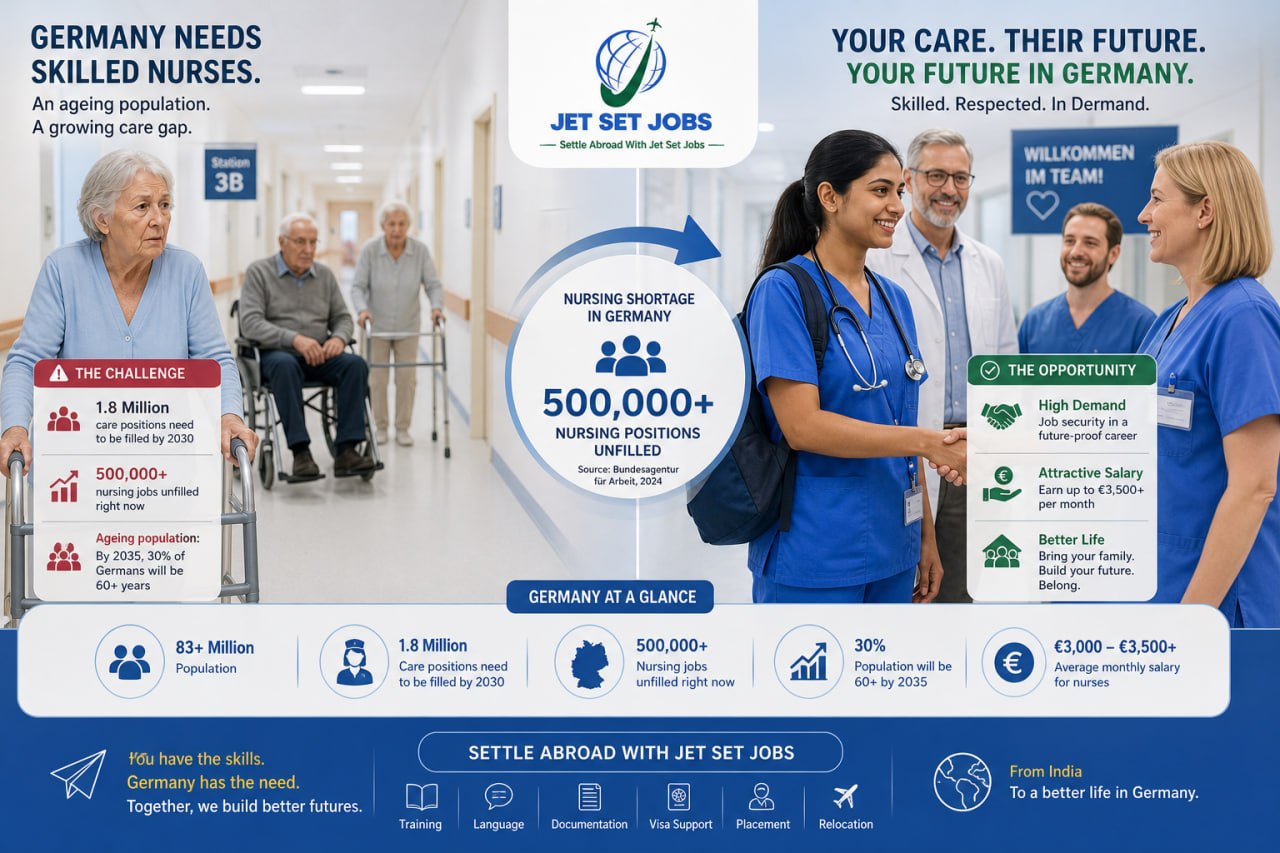
When Indian nurses hear that Germany needs them, many assume it is a temporary gap or an opportunity that might close. The reality is the opposite — Germany's need for international nursing professionals is structural, worsening year by year, and driven by factors that cannot be reversed by domestic policy alone. Understanding why this demand exists will give you a clearer picture of both the opportunity and its long-term security.
Germany's Demographic Crisis — The Root Cause
Everything begins with demographics. Germany is one of the most rapidly ageing societies in the world. The combination of a very low birth rate — one of the lowest in Europe — and increasing life expectancy has created a population structure where the number of people entering the workforce each year is far smaller than the number retiring from it.
In healthcare specifically, this creates a compounding problem: the population that needs nursing care (elderly people) is growing rapidly, while the domestic workforce available to provide that care is shrinking. Germany cannot train enough nurses domestically to meet the demand — the pipeline simply does not produce the volume required.
| Statistic | Data |
|---|---|
| German population aged 65+ | 22% (2023) — rising to estimated 30% by 2040 |
| Annual nursing shortfall | Currently 35,000–50,000 nurses per year — projected to worsen |
| Nursing vacancy rate | Over 35% of advertised nursing positions went unfilled in 2023 |
| German nursing graduates per year | Insufficient to replace retiring nurses — training output cannot close the gap |
| International nurses in Germany | 13.2% of all healthcare workers are foreign-trained (2023) — up from 6.3% in 2013 |
| Government target | 400,000 international skilled workers needed annually across all sectors |
Why India Specifically?
Germany recruits nurses from many countries — Philippines, Bosnia, Tunisia, Romania, and others. But India has become an increasingly important source country for several specific reasons:
1. Qualification Depth
Indian GNM and BSc Nursing graduates receive rigorous, clinical-heavy training. GNM is a 3-year hospital-based programme with extensive practical hours. BSc Nursing is a 4-year degree with both academic and clinical depth. German recognition authorities have become familiar with Indian nursing qualifications and the equivalence assessment process is now well-established.
2. Clinical Experience
Indian hospitals — both public and private — expose nurses to high patient volumes, diverse case types, and resource-constrained environments that build strong clinical adaptability. German employers consistently report that Indian nurses bring excellent hands-on skills and a high work ethic.
3. English Proficiency
English is the language of medical education in India. Indian nurses can read medical literature, communicate with international colleagues, and understand clinical documentation in English from Day 1 — which significantly reduces the non-German language barriers in the workplace.
4. The Scale of India's Nursing Workforce
India produces approximately 300,000 nursing graduates per year — one of the largest nursing education systems in the world. Germany's need for thousands of nurses annually is matched by India's capacity to supply them — at scale and consistently.
5. Cultural Work Ethic and Adaptability
German healthcare employers who have hired Indian nurses consistently report high levels of dedication, adaptability, and patient care quality. Indian nurses who complete B2 German training arrive with both the language and the motivation to integrate quickly and perform well.
Germany's Legal Response — Actively Opening the Door
Germany has not just acknowledged the shortage — it has systematically changed its immigration and recognition laws to make it easier for Indian nurses to come:
- The Fachkräfteeinwanderungsgesetz (Skilled Immigration Act) — significantly updated in 2023 — created new pathways specifically for healthcare workers from non-EU countries
- The §16d Recognition Visa was created specifically to allow nurses to enter Germany and work while their qualification recognition is in progress — removing a major bottleneck
- The Anerkennungsberatung (recognition counselling) network was expanded to make the Berufsanerkennung process more accessible and faster
- Germany signed bilateral agreements with India and other source countries to facilitate ethical, structured recruitment pipelines
The Long-Term Picture — Is This Demand Sustainable?
This is the question that matters most for nurses making a 2–5 year commitment. The answer is yes — for three structural reasons:
- Germany's demographic trajectory cannot be reversed by any domestic policy. The ageing population and low birth rate are generational facts that will continue to drive healthcare demand for decades
- The EU Blue Card and Fachkräfteeinwanderungsgesetz have been explicitly designed for long-term structural workforce needs — not temporary gap-filling
- German hospitals and care homes that have integrated Indian nurses are actively seeking more — the positive experience of the first generation of Indian nurses has created institutional demand and trust
What This Means for You
The demand for Indian nurses in Germany is real, backed by data, driven by irreversible demographics, and supported by German government policy. You are not chasing a trend — you are positioning yourself in a structural, long-term market that needs exactly what you have: nursing qualifications, clinical experience, and the willingness to learn German.
The only question is whether you are ready to make the investment in B2 German — the language that unlocks this opportunity. At Jet Set Jobs, that is exactly what we prepare you for.