🛡️ Licensed by Ministry of External Affairs · RA:
B-3413/DEL/COM/1000+/5/11419/2026
📞 +91 96259 66817
📍 15, 2nd Floor, South Patel Nagar, Delhi-110008
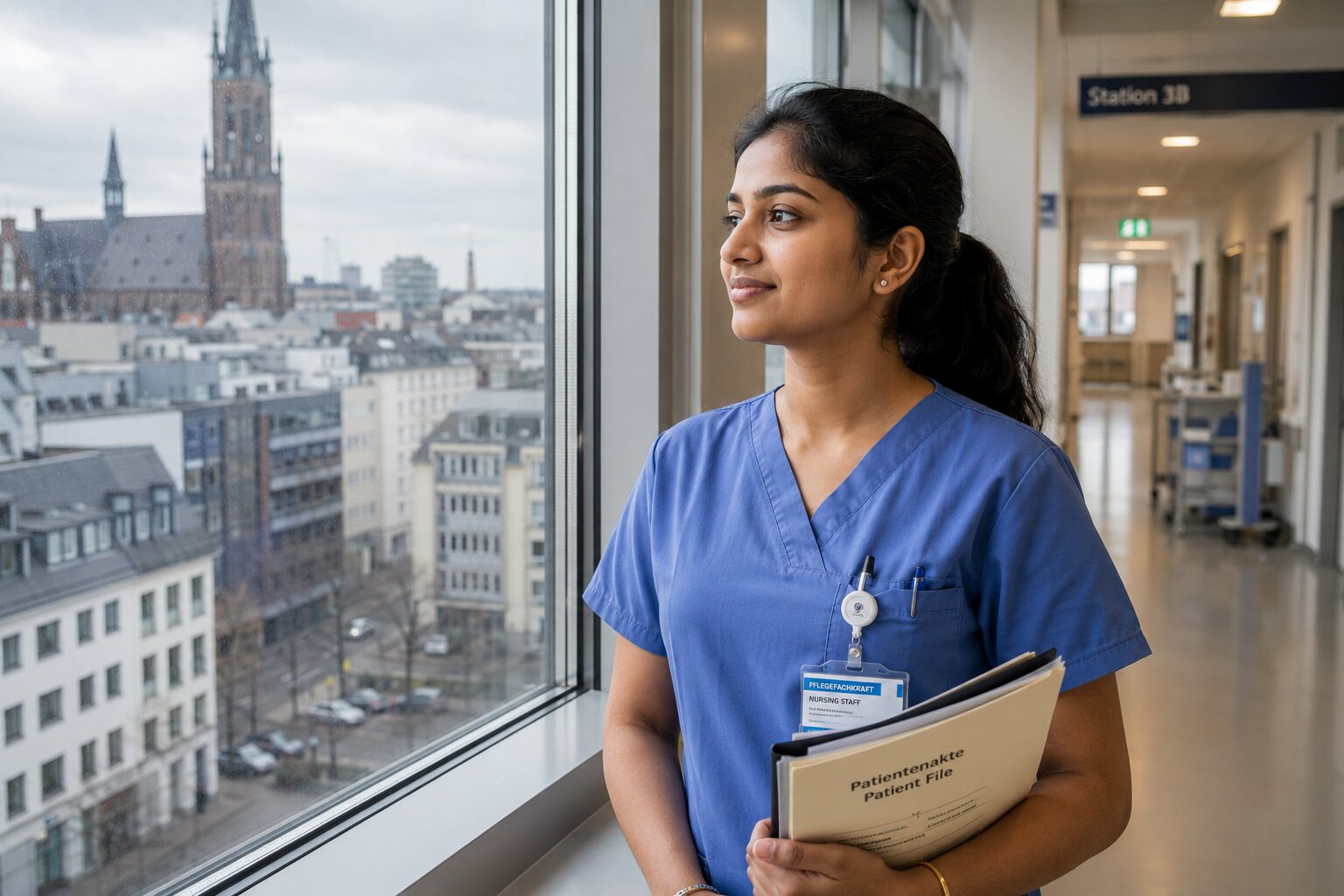
The Germany nursing journey has a clear beginning: the day you land at Frankfurt, Munich, Düsseldorf, or whichever airport is closest to your new workplace. After months — sometimes over a year — of language training, document preparation, and waiting, you are finally there. And then real life begins.
The first six months in Germany are the most intense of the entire journey. They are also the most transformative. This blog walks you through what those months honestly look like — week by week, phase by phase — so that you arrive prepared rather than surprised.
Most Indian nurses arrive under arrangements organised by their employer or placement partner. On arrival, your employer typically collects you from the airport, takes you to accommodation, and begins helping you with the immediate administrative tasks that must be completed within the first few days.
The most important of these is Anmeldung — registering your address with the local Einwohnermeldeamt (residents' registration office). This single step unlocks almost everything else: your tax number, your health insurance registration, your bank account, and eventually your residence permit. Your employer will usually help you with this, but knowing it is the first priority helps you stay focused when everything around you feels overwhelming.
The first week also involves getting a German SIM card, opening a bank account (N26 and DKB are popular with new arrivals as they can be opened online), and completing any pre-ward medical checks your employer requires. Many hospitals also run an internal orientation programme for new international nurses during this period — covering infection control protocols, the electronic patient record system, and the layout of the facility.
For most Indian nurses, the recognition phase — called the Anpassungslehrgang — begins within the first few weeks of arrival. This is the supervised adaptation period during which you work under the guidance of a Praxisanleiter (practice supervisor) while your skills and knowledge are formally assessed against German nursing standards.
The Anpassungslehrgang is not a probationary period in the negative sense. You are being paid the full recognition-phase salary (€2,800–€3,000 gross per month) and treated as a professional colleague. What makes it demanding is the language. Everything on the ward — patient notes, handover reports, medication charts, doctor's instructions, patient conversations — is in German. At B2 level, you can manage this. But there is a big difference between understanding German in a classroom and functioning in it on a busy ward with a patient in front of you and a colleague asking a question you only partially caught.
Most Indian nurses describe the first month on the ward as the most linguistically stressful part of the entire journey. The vocabulary is specialised, the pace is fast, and making errors in a clinical environment carries real consequences. The key is to ask questions — repeatedly, without embarrassment. German nursing colleagues generally respect a new international nurse who asks for clarification rather than guessing.
Germany is not what most Indian nurses imagine before they arrive. It is structured, efficient, and in many ways welcoming — but it operates on different social norms.
German professional culture is direct. A colleague who tells you your care documentation was incomplete is not being rude — they are being German. Feedback is given factually, not softened. Initially, this can feel cold or even critical. Over time, most Indian nurses come to appreciate it: you always know where you stand.
Social life outside the ward takes longer to develop. Germans tend to be reserved with new acquaintances and build friendships slowly. The Indian nursing community in Germany is growing rapidly, and most cities have WhatsApp groups, temple communities, or cultural associations where you can connect with people who understand your experience. Seeking out this community early — within the first month — makes the adjustment significantly easier.
Homesickness is real and normal. Video calls home help. So does keeping a routine — cooking familiar food on weekends, observing festivals even simply, and maintaining the religious or spiritual practices that ground you. The nurses who adjust best are those who build a life in Germany while staying connected to home, rather than trying to do one at the expense of the other.
| Expense Category | Typical Monthly Cost |
|---|---|
| Rent (shared or employer-provided) | €300–€600 (shared) / €600–€900 (own flat) |
| Food and groceries | €200–€300 |
| Public transport | €50–€100 (Deutschlandticket: €49/month) |
| Phone and internet | €20–€40 |
| Health insurance (if not employer-covered) | €80–€120 |
| Miscellaneous (clothing, leisure, etc.) | €100–€200 |
| Total estimated monthly expenses | €750–€1,300 |
| Net salary (Tax Class 1, recognition phase) | ~€1,850–€1,970 |
| Available to save / remit | €550–€1,200/month |
The most important financial step in the first month is to apply for a Steueridentifikationsnummer (tax ID) if your employer has not already arranged it. Without a tax ID, you are placed on the least favourable tax class automatically, which means higher deductions from your salary. This can usually be corrected retroactively, but it is easier to sort early.
By the third month, most Indian nurses report that the initial intensity starts to ease. Language comprehension on the ward improves noticeably — the brain adapts faster in an immersive environment than any language course can replicate. You begin to recognise patterns in how handovers are structured, how doctors communicate, and how patient care is documented. The ward stops feeling like a foreign country and starts feeling like your workplace.
This is also typically when the first performance review of the Anpassungslehrgang happens. Your Praxisanleiter and ward supervisor assess your progress against the competencies required for full recognition. For candidates who have trained to a strong B2 level and come with solid clinical experience from India, these reviews are generally positive.
By month six, most nurses have established a financial routine, started building friendships, and begun to feel genuinely settled. The Germany that felt overwhelming on day one has become, in the most practical sense, home.
After placing 583+ candidates who have started their Germany journey, JSJ has observed one consistent pattern: the nurses who thrive in the first six months are those who prepared their language skills most thoroughly before arrival. Not just exam-passing B2 — but genuinely confident, conversational B2 that holds up under stress on a busy ward.
The second factor is mindset. Germany will be hard in the first few months. That difficulty is not a sign that you made the wrong decision — it is a sign that you are doing something genuinely significant. Every nurse who has made it through the first six months says the same thing: it was worth it.
The first six months in Germany are the hardest and the most important. They lay the foundation for everything that follows — the full recognition, the higher salary, the PR application, the life you came to Germany to build. Go in prepared, go in with realistic expectations, and go in knowing that thousands of Indian nurses have walked exactly this path before you — and are now exactly where they hoped to be.
📞 Book Your Free Consultation
Call / WhatsApp: +91 96259 66817
Email: support@jetsetjobs.in | www.jetsetjobs.in
583+ candidates have started their Germany journey with us.
Refundable ₹75,000 deposit. Zero placement fees. MEA licensed.