🛡️ Licensed by Ministry of External Affairs · RA:
B-3413/DEL/COM/1000+/5/11419/2026
📞 +91 96259 66817
📍 15, 2nd Floor, South Patel Nagar, Delhi-110008
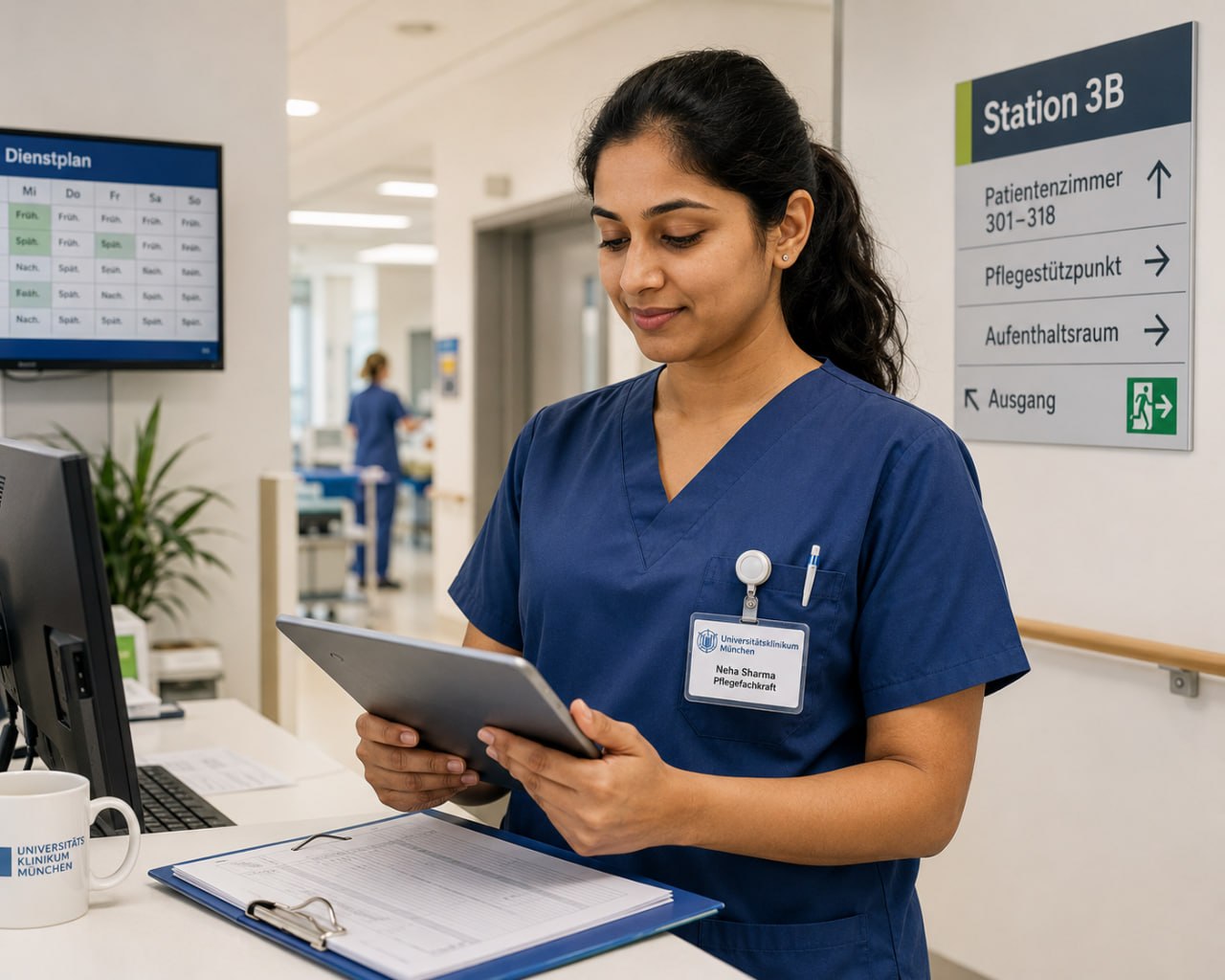
This is the most important distinction that most Delhi candidates do not fully understand before starting their Germany journey. A TELC Deutsch B2 certificate confirms that on the day of the examination, under controlled conditions, you demonstrated upper-intermediate German proficiency across reading, listening, writing, and speaking. It is a necessary document. Every German hospital, embassy, and recognition authority requires it. But passing the TELC B2 is not the same as being ready to work in German.
Working German is German under pressure. It is understanding a consultant’s verbal instruction during a ward round when they are speaking at natural speed with a regional accent. It is writing a nursing handover note accurately after twelve hours on shift. It is explaining a medication change to a patient who is anxious and asking questions in rapid colloquial German. These are B2-level tasks in theory, but they require a level of automaticity — where you do not have to consciously translate from Hindi or English before responding — that the TELC exam does not specifically test.
The good news is that this automaticity develops through the same structured A1 to B2 training that produces the TELC certificate — provided the training is done rigorously, with regular spoken practice, real listening exercises at natural speed, and consistent feedback. The difference between a candidate who passes the TELC and is ready for working German, and one who passes but struggles in their first months, almost always comes down to whether their B1 and B2 training included genuine spoken and listening practice at natural speed or relied primarily on grammar exercises and textbook reading.
At the application stage, German employers check for the B2 certificate as a binary requirement. Either the candidate has a TELC Deutsch B2 or Goethe-Institut B2 certificate — both issued within the past five years — or they do not. Applications without a valid B2 certificate are not reviewed by hospital HR departments for nursing and clinical roles. This is not a soft preference — it is a hard gate. No certificate means no interview, regardless of clinical experience or qualifications.
German employers conducting recruitment interviews with Indian candidates use video calls. The interview is conducted in German. This is the point where many candidates who passed TELC B2 but did not develop working fluency discover the gap. They can read German, they can write it in the structured format the exam uses, but when a German HR manager speaks naturally at full speed, asking follow-up questions and expecting spontaneous responses, the automaticity gap becomes visible.
German HR interviewers are not trying to trick candidates. They are assessing whether this person can communicate clearly and reliably in a German-speaking workplace. They will ask about your nursing experience, your reason for wanting to work in Germany, your understanding of what the recognition process involves, and your plans for settling in Germany. They assess not just what you say but how fluently and accurately you say it — pauses, grammar errors, and vocabulary gaps all register.
The first weeks in Germany are the hardest for most candidates regardless of their B2 level. German as spoken in hospitals differs from German as taught in classrooms. Regional accents, medical abbreviations, fast-paced handover communication, and informal colleague conversation all present challenges that classroom German only partially prepares you for. The candidates who navigate this transition successfully are those whose German training included authentic listening material — radio, podcasts, natural-speed dialogue — from B1 onwards.
| Job Type | Minimum German Level | What Employers Actually Assess | Notes |
|---|---|---|---|
| GNM/BSc Nurse (Pflegefachkraft) | B2 (TELC or Goethe certificate mandatory) | Spoken fluency in ward communication, handover accuracy, patient interaction | B2 exam certificate + working fluency both required |
| Ausbildung (Healthcare/Elder Care) | B1 minimum, B2 strongly preferred | Basic workplace communication, classroom participation | B2 candidates significantly more competitive at interview |
| Ausbildung (IT/Logistics/Hospitality) | B1 minimum | Workplace communication, team interaction | English accepted in some IT roles at entry level |
| Skilled Worker (Fachkraft) | B2 for most roles | Professional communication, written correspondence, meeting participation | Depends on sector — some IT roles accept B1 + English |
| German university student | B2–C1 (depends on programme) | Academic reading, essay writing, seminar discussion | TestDaF or DSH may be required instead of TELC/Goethe |
German employers recruiting Indian nurses know that the recognition process (Berufsanerkennung) will take three to six months after arrival. What they are looking for is that you understand the process, have the right documents ready, and are prepared to work under the recognition pathway without resistance or confusion.
German workplace culture values precision, punctuality, and direct communication. In a healthcare setting, this translates to: starting and finishing shifts on time without exception, documenting accurately and completely, communicating directly with colleagues and supervisors, and following protocols exactly as stated. Indian candidates who have researched and understood this cultural context before the interview make a noticeably stronger impression than those who have not.
German hospitals invest significantly in recruiting, relocating, and onboarding foreign nurses. The Berufsanerkennung process alone takes six months of supervised employment. Employers are therefore looking for candidates who have a genuine, long-term intention to stay in Germany — not those treating Germany as a temporary earning opportunity. How you articulate your reasons for choosing Germany, and your plans for settling there, matters in the interview.
German employers require documented evidence of your clinical experience alongside your language certificate. Specifically: your original nursing degree certificate and transcripts, a detailed employment certificate from your Indian hospital showing your role, years of experience, and areas of specialisation, and ideally a reference letter from a senior clinical supervisor. Candidates with specialisation in ICU, OT, dialysis, or oncology nursing receive more employer attention than generalist ward nurses.
TELC and Goethe B2 certificates issued more than five years ago are not accepted by the German embassy or recognition authorities. If your certificate is approaching five years since the issue date, you will need to resit the examination before applying. This is worth noting for anyone who sat a B2 exam earlier and has delayed their application.
At Jet Set Jobs in South Patel Nagar, the B1 and B2 modules are designed with the working German gap explicitly in mind. The B2 batch includes authentic German listening material — radio features, hospital dialogue recordings, and natural-speed conversation exercises — alongside the exam preparation content. The speaking practice at B2 includes simulated ward handovers, patient interaction role plays, and informal colleague dialogue, not just the presentation and role-play format of the TELC oral examination.
The healthcare vocabulary supplement developed by JSJ trainers — covering ward communication, medication terminology, nursing documentation language, and patient interaction phrases — is integrated into both the B1 and B2 modules. Candidates who complete their B2 training at JSJ leave with both a TELC-ready exam foundation and a vocabulary set that is immediately applicable in a German hospital setting.
583+ candidates have started their Germany journey through Jet Set Jobs. The ones who have progressed furthest in the recognition process are consistently those who used the full B1 and B2 training to develop working fluency alongside exam technique — not those who treated B2 preparation purely as an exam to pass.
B2 German is mandatory for all nursing jobs in Germany. A valid TELC Deutsch B2 or Goethe-Institut B2 certificate is required at the application stage — no certificate means no interview, regardless of clinical experience.
TELC B2 is necessary but not sufficient on its own. German employers also assess working fluency in the video interview — spontaneous spoken German at natural speed. Candidates whose B2 training included authentic listening and speaking practice are significantly better prepared than those who focused only on exam technique.
Five things: Berufsanerkennung readiness, adaptability to German work culture, stability of intention to stay in Germany long-term, clinical competency documentation, and a B2 certificate issued within the past five years.
Free demo classes are available at morning (9 AM) and evening (3 PM), both offline at the Patel Nagar centre and online via LMS. Call or WhatsApp +91 96259 66817 or email support@jetsetjobs.in to book.
Call / WhatsApp: +91 96259 66817
support@jetsetjobs.in | www.jetsetjobs.in
583+ candidates have started their Germany journey with us.
A1–B2 Offline ₹75,000 | Online ₹65,000 | Per Level ₹20,000 | All + GST
Book Free Demo →