
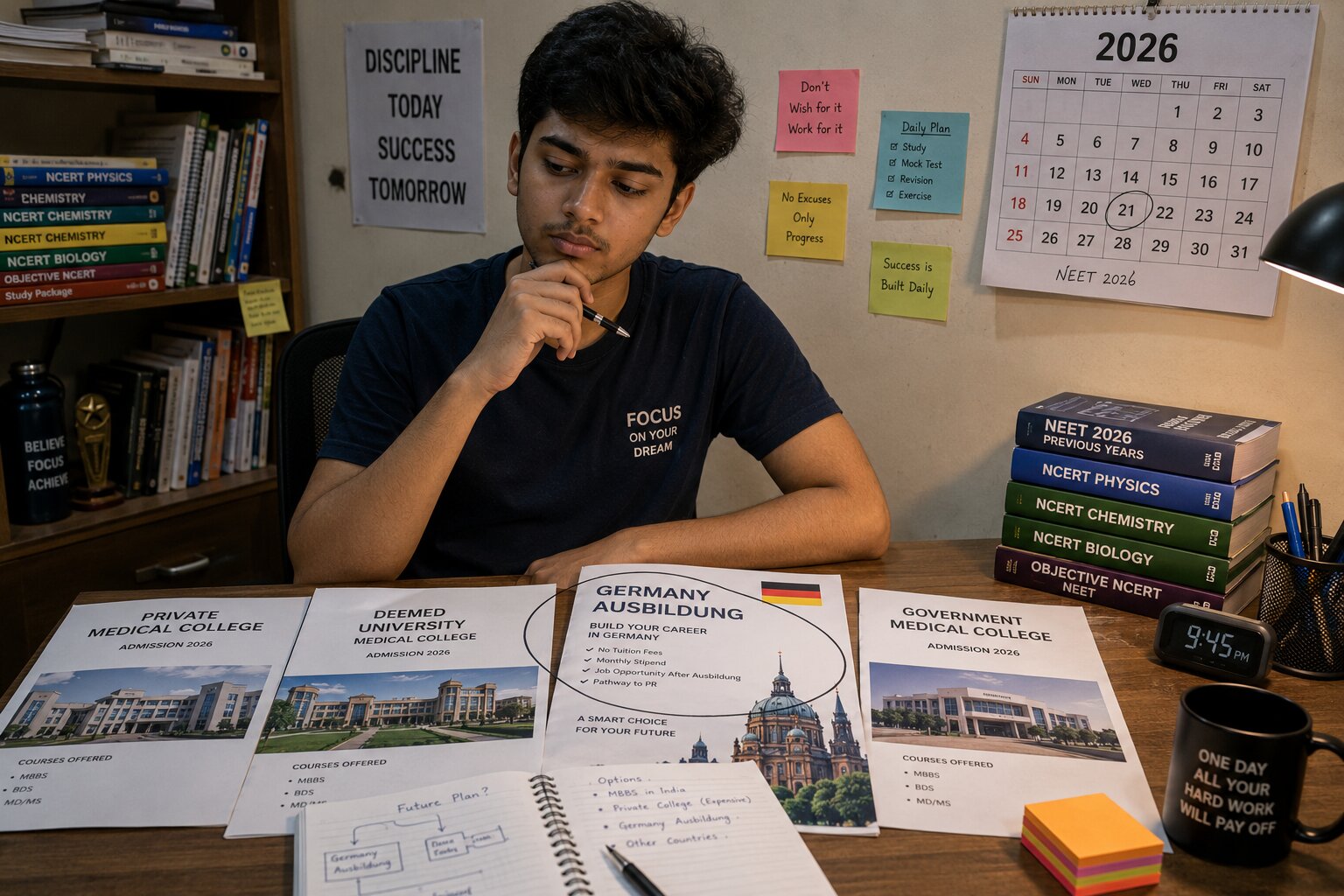
NEET 2026 results are out — or Re-NEET results are coming. Either way, you are now at the decision point that millions of Indian students face every year: what do I do next? The internet is full of lists telling you to 'explore AYUSH' or 'consider allied health' without telling you what those paths actually look like five years from now.
This blog does something different. It ranks every real career option available to you after NEET 2026 — honestly, with real numbers, real timelines, and a frank assessment of who each option is actually right for. Including one option most Indian career guides don't mention at all: Germany's Ausbildung programme.
First: Understand What Your NEET Score Actually Opens
Before looking at options, you need to know which category your score puts you in. This determines which doors are genuinely open and which require honest reconsideration.
| Score Range | What It Realistically Opens | Honest Assessment |
|---|---|---|
| 720–600 Top percentile |
Government MBBS — AIIMS, top state colleges possible | This is the target. Pursue counselling immediately and seriously. |
| 599–500 Upper mid-range |
Government MBBS at mid-tier state colleges, BDS at good colleges | Strong options available. Counselling round 2–3 may yield better seats than round 1. |
| 499–400 Mid-range |
Private MBBS (₹1–2.5 crore), BDS, BAMS, BHMS, BUMS | Private MBBS is financially very heavy. BDS or AYUSH are more realistic without family funding. |
| 399–250 Lower mid |
BAMS, BHMS, allied health, B.Sc. paramedical | No government MBBS. Private MBBS only at significant cost. Alternatives deserve serious consideration. |
| Below 250 / DNQ Did not qualify |
No NEET-based medical admissions. Re-attempt or pivot. | Honest moment: is another year of NEET preparation the right choice? Evaluate carefully. |
Option 1: Government MBBS / BDS — The Gold Standard
If your score gets you a government MBBS seat, take it. This is the strongest outcome NEET can produce — a fully subsidised medical degree at a reputable institution, leading to one of the most respected careers in India and internationally. The path is hard (6.5 years before you earn), the competition for seats is brutal (less than 5% of NEET takers), but if the seat is there, pursue it without hesitation.
BDS (dentistry) at a government college is also an underrated option — a 5-year degree, independent practice, and growing earning potential as India's dental health market expands. Many students who couldn't get MBBS and chose BDS at a good government college look back with zero regret.
Option 2: Private MBBS in India — The Real Cost
Private MBBS is available across India for scores that don't reach government cutoffs. The degree is real, the MBBS qualification is the same, and many private colleges have decent hospitals attached. But the financial reality is non-negotiable: ₹1 crore to ₹2.5 crore for four years, all-in. Management quota seats can run higher.
This is the option that requires the most honest family conversation. The question is not just 'can we pay it' but 'what does the family's financial situation look like while this money is being spent, and what does it look like when the MBBS completes at age 25 and the doctor's salary in India starts at ₹60,000–₹1,20,000/month for a fresh graduate?' Run the full numbers before deciding.
Option 3: MBBS Abroad (Russia, Ukraine, Philippines, Uzbekistan)
MBBS abroad is heavily marketed to Indian students with mid-range NEET scores. The pitch is: lower fees than Indian private colleges, English medium, NMC-recognised. The reality is more complicated. NMC recognition requires passing the Foreign Medical Graduates Examination (FMGE/NExT) after returning — which has historically had a pass rate of 15–25% for foreign MBBS graduates. Language barriers, clinical exposure quality, and post-return recognition challenges are real and frequently understated by consultants who earn commission on your enrolment.
Ukraine's universities have been disrupted by ongoing conflict. Russia carries international sanctions complications. Philippines programmes are strongest but cost-equivalent to many Indian private options. This path requires detailed independent research, not consultant presentations.
Option 4: AYUSH (BAMS, BHMS, BUMS, BNYS)
AYUSH courses are 5.5-year programmes in Ayurveda, Homeopathy, Unani, and Naturopathy. They are NEET-based admissions, which means they are academically credible pathways. The honest challenge is that AYUSH practitioners in India face significant earning pressure — the market is growing but is also crowded. For students genuinely interested in traditional medicine systems, BAMS has the strongest career structure. For students choosing it purely as a NEET fallback, the 5.5-year commitment deserves serious thought.
Option 5: Allied Health Sciences (BPT, BMLT, B.Sc. Radiology, etc.)
Allied health programmes — physiotherapy (BPT), medical lab technology (BMLT), radiology, optometry — are 4-year programmes that lead to genuine healthcare careers with consistent employment demand. Starting salaries are lower than MBBS but grow significantly with experience and specialisation. These are particularly strong options for students who want to work in healthcare without the 6.5-year MBBS commitment or the financial burden of private medical seats.
Option 6: Germany Ausbildung 2027 — The Option Most Guides Don't Mention
Germany's Ausbildung programme is a 3-year paid vocational training contract in Germany. It is not a university degree. It is not MBBS. But for a specific profile of NEET student — Class 12 Science pass, age 18–25, willing to learn German to B2 level, interested in a healthcare-adjacent career — the financial and career case is stronger than almost any other option on this list.
Why Germany Ausbildung competes seriously with every other option on this list:
€1,000–€1,300/month stipend from Day 1 in Germany — you earn while you train
Total programme cost: ₹2,50,000 + GST (vs ₹1–2.5 crore for private MBBS)
No entrance exam — Class 12 pass + B2 German is the full requirement
German government-recognised qualification valid across all 27 EU countries
Permanent residency (Niederlassungserlaubnis) at approximately age 23
By age 25 — when a private MBBS student is just graduating — an Ausbildung candidate has 3+ years of German work experience, a professional credential, PR in hand, and has earned approximately ₹50–60 lakhs in stipend
| Factor | Private MBBS India | Germany Ausbildung 2027 |
|---|---|---|
| Total family cost | ₹1–2.5 crore+ | ₹2,50,000 + GST |
| Income during programme | Zero | €1,000–€1,300/month |
| Years before earning | 6.5+ years | 3 months — from Day 1 |
| Qualification validity | India (foreign recognition complex) | Germany + all 27 EU countries |
| PR pathway | No direct pathway | Yes — at ~age 23 |
| Requires NEET score | Yes | No — zero dependency on NEET |
How to Actually Decide
The right answer depends on your score, your family's financial situation, your own honest assessment of where you want to be at age 25, and how much of the next 5–6 years you are willing to invest in a single pathway.
📞 Book Your Free Consultation — Jet Set Jobs × Destination Germany
Ausbildung Programme Germany 2027 & 2028 | Age 18–25 | Class
12 pass | Science background preferred
Programme fee: ₹2,50,000 + GST | German
A1–B2 training included | Stipend: €1,000–€1,300/month