🛡️ Licensed by Ministry of External Affairs · RA:
B-3413/DEL/COM/1000+/5/11419/2026
📞 +91 96259 66817
📍 15, 2nd Floor, South Patel Nagar, Delhi-110008
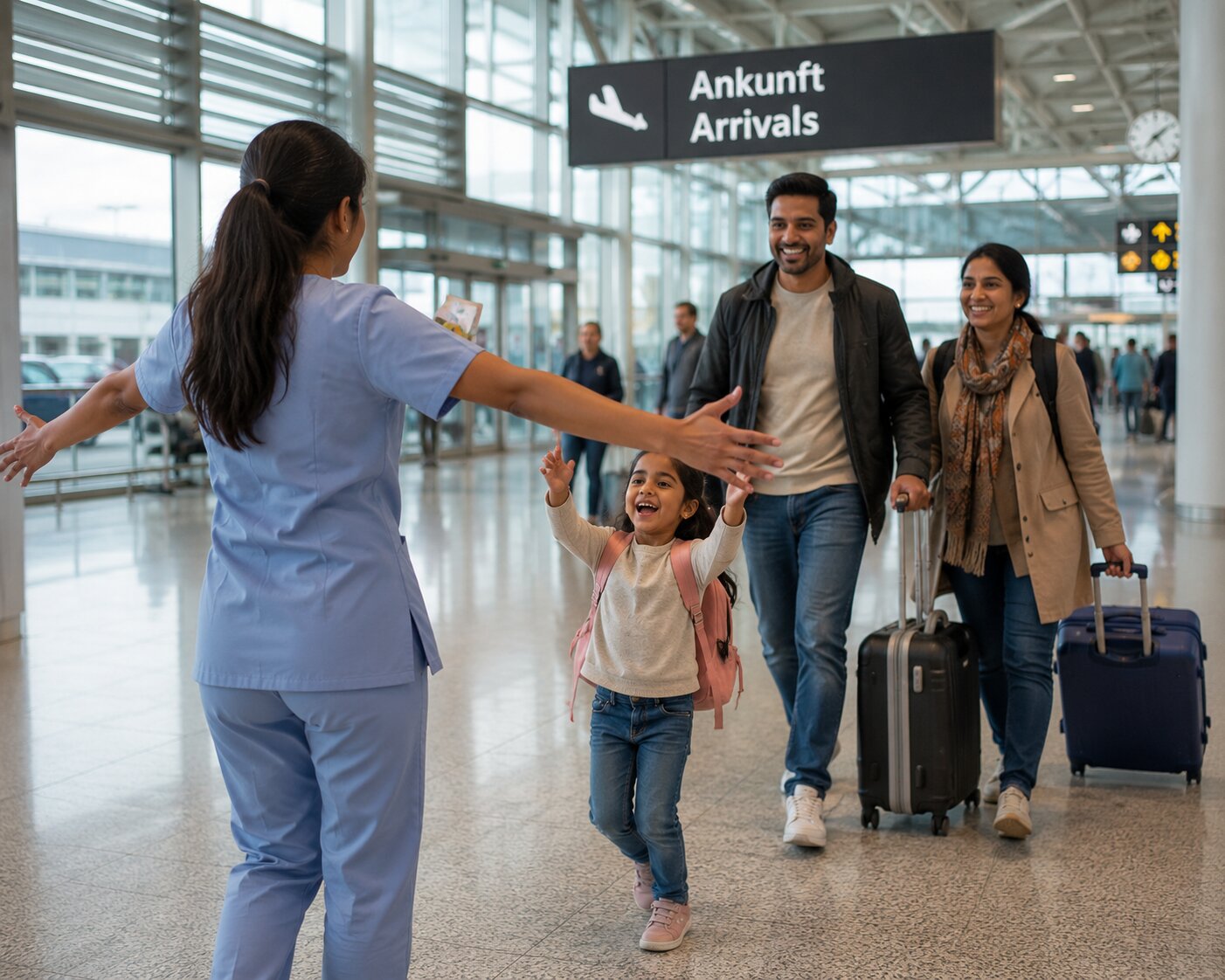
For many Indian nurses, the dream of going to Germany is not just about a salary or a career. It is about building a stable, secure life for the entire family. And that dream — of eventually having your spouse by your side and your children growing up in a country with world-class education and healthcare — is absolutely achievable through Germany's family reunification framework.
Family reunification in Germany is a legal right, not a favour. Once you have a valid residence permit and meet certain conditions, your immediate family members have the right to join you. Understanding the process, the timeline, and what to prepare is what makes the difference between a family separated for years and a family reunited within one to two years of your arrival.
Under German law, the right to family reunification applies to your immediate family members. For Indian nurses working in Germany on a skilled worker or recognition visa, this means your spouse (husband or wife) — legal marriage recognised in India and verifiable through official documents — and your unmarried children under the age of 18. In some cases, elderly dependent parents may qualify, but this route is significantly more restricted and requires additional proof of dependency.
Siblings, extended family members, and adult children do not qualify under standard family reunification rules. The focus is on the nuclear family unit.
You can begin the family reunification process once you have a valid German residence permit (Aufenthaltstitel) based on employment or recognition. In practical terms, this means after you have arrived in Germany, completed Anmeldung, and received your initial residence permit — typically within the first one to three months of arrival.
You do not need to wait until you have achieved full recognition (Berufsanerkennung) to apply. Your recognition-phase residence permit is sufficient. However, the application is processed by the German embassy or consulate in India, and your family members will need to attend a visa appointment in person — typically in Delhi, Mumbai, Chennai, Kolkata, or Hyderabad.
Germany sets three main conditions that must be met before a family reunification visa is granted.
You must demonstrate that you have adequate housing for your family. Immigration authorities apply a general rule of approximately 12 square metres of living space per person. A one-room studio flat is generally not considered adequate for a nurse plus spouse plus child. If your employer has provided shared accommodation, you may need to find your own flat before your family can join — plan for this financially in your first year.
You must show that your income is sufficient to support your family without recourse to social benefits. During the recognition phase, your gross salary of €2,800–€3,000/month is generally sufficient for a spouse and one child, though the authority will assess this based on the net income and actual cost of living in your specific city.
This is the requirement that most families underestimate. For a spouse to receive a family reunification visa to Germany, they must generally demonstrate A1 level German language ability. A1 is not difficult — it covers simple greetings, numbers, basic questions and answers, and everyday vocabulary. It can typically be achieved with 2–3 months of dedicated study. Many Indian families begin preparing the spouse for A1 while the nurse is still in the B1 or B2 phase of training, so the process can begin quickly after arrival.
| Stage | Who Does What | Approximate Timeframe |
|---|---|---|
| Nurse arrives in Germany | Anmeldung, bank account, settle in | Month 1–2 |
| Residence permit issued | Immigration office (Ausländerbehörde) | Month 1–3 |
| Spouse begins A1 German training | In India, at a Goethe Institut or language school | Month 2–5 |
| Family reunification application submitted | German embassy/consulate in India | Month 4–8 |
| Embassy appointment and visa decision | Consulate processing time | Month 6–12 |
| Family arrives in Germany | Reunion! | Month 10–18 from nurse's arrival |
The most variable part of this timeline is the embassy appointment waiting time. German embassies — particularly in Delhi — have historically had long waiting periods for visa appointments, sometimes 3–6 months just for a slot. Applying early and ensuring all documents are complete and correct the first time is essential to avoiding unnecessary delays.
The family reunification visa application requires a comprehensive set of documents from both the nurse in Germany and the family members in India. Key documents include: your valid German residence permit, proof of adequate housing (rental contract in Germany), three months of recent payslips, marriage certificate (apostilled and translated into German), birth certificates for children (apostilled and translated), passport photographs, and the spouse's A1 German language certificate from a recognised institution such as the Goethe Institut.
All Indian documents must be apostilled by the Ministry of External Affairs and accompanied by certified German translations from a sworn translator.
Once your family joins you in Germany, your spouse will receive a dependent residence permit initially. Over time, after meeting language and integration milestones, your spouse can apply for their own independent residence permit and eventually work authorisation. Germany actively encourages family members to integrate — free integration courses combining German language up to B1 and civic orientation are available and often required.
Children enrolled in German schools adapt remarkably quickly. German schools offer intensive German language support for newly arrived children, and most children reach functional German within one to two academic years. Germany's education system is strong and free at the state school level — one of the most tangible long-term benefits for Indian families who make this journey.
Nurses placed in Austria should be aware that family reunification there follows different and generally stricter rules. Austria requires a higher language level from the spouse, has longer processing times, and the overall PR and citizenship pathway for the family is longer and more complex than in Germany. If family reunification is a priority, Germany is the more straightforward destination.
Going to Germany as a nurse is not the end of your family's life together — it is the beginning of a new chapter for all of you. With the right preparation, realistic timelines, and a clear plan, the reunion is not a distant dream. It is a scheduled appointment on a calendar that is already being counted down to.
📞 Book Your Free Consultation
Call / WhatsApp: +91 96259 66817
Email: support@jetsetjobs.in | www.jetsetjobs.in
583+ candidates have started their Germany journey with us.
Refundable ₹75,000 deposit. Zero placement fees. MEA licensed.