🛡️ Licensed by Ministry of External Affairs · RA:
B-3413/DEL/COM/1000+/5/11419/2026
📞 +91 96259 66817
📍 15, 2nd Floor, South Patel Nagar, Delhi-110008
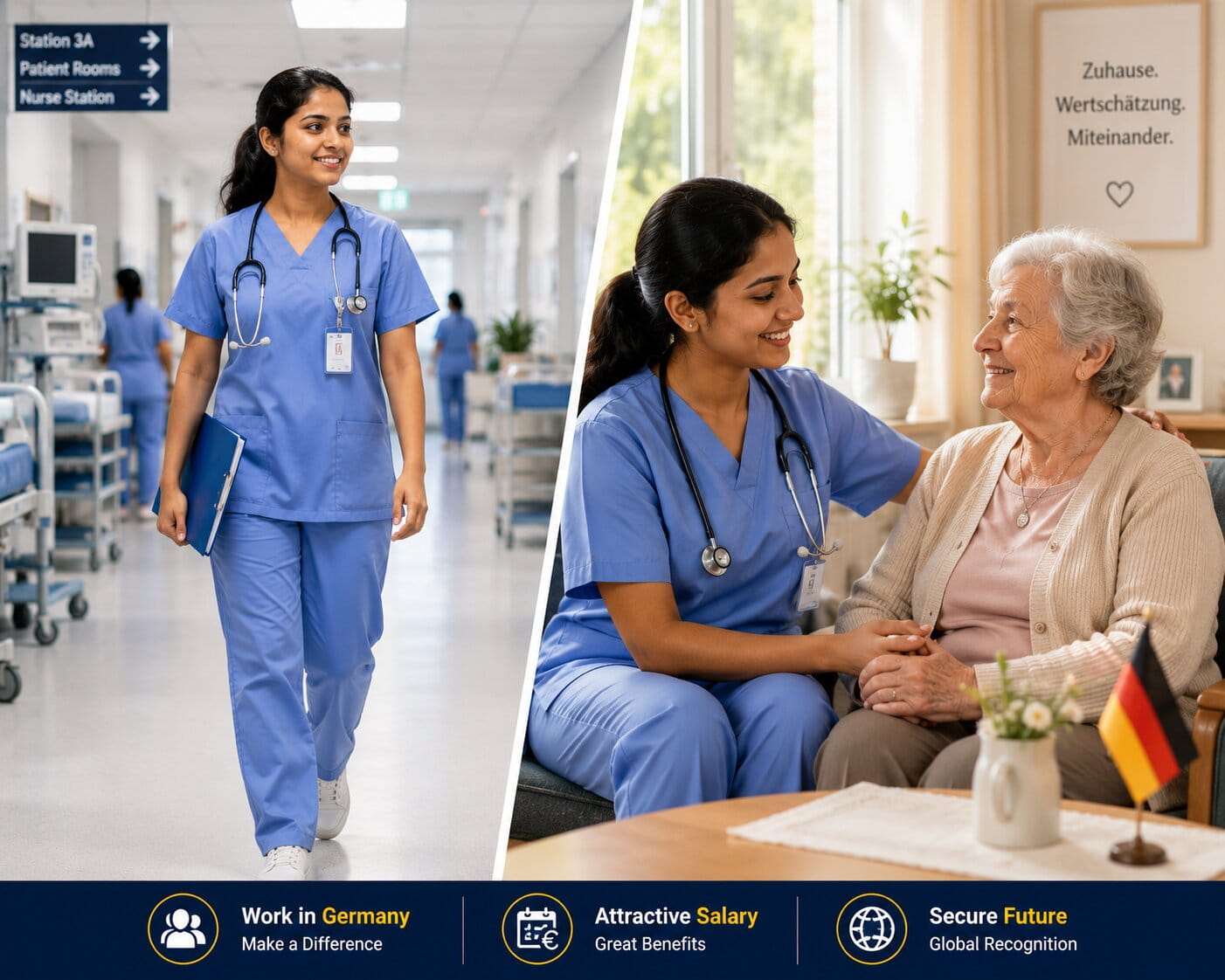
When Indian nurses are matched with German employers through JSJ, the placement is into one of two main types of healthcare settings: a Krankenhaus (hospital) or a Pflegeheim (care home or nursing home). Both are legitimate, well-paying, and career-building placements. But they are significantly different in terms of the daily work, the pace of the environment, the type of patients, and the career trajectory they offer.
Understanding these differences before you arrive — or even before you enrol — helps you go into the right setting with the right expectations. This blog gives you the honest comparison.
German hospitals range from small community facilities (Kreiskrankenhäuser) with a few hundred beds to large university hospitals (Universitätskliniken) with thousands of staff and highly specialised departments. Indian nurses are placed across this spectrum — in medical wards, surgical wards, orthopaedics, internal medicine, geriatrics, and neurology, among others.
Hospital nursing in Germany is fast-paced, procedure-dense, and documentation-heavy. Shifts follow a three-shift rotating system: morning (Frühdienst, typically 6:30 AM–2:30 PM), afternoon (Spätdienst, typically 2:00 PM–10:00 PM), and night (Nachtdienst, typically 10:00 PM–6:30 AM). Patient turnover is high — patients are admitted, treated, and discharged within days or weeks. This means you are constantly managing new patients, new diagnoses, new medication protocols, and new family dynamics.
The Übergabe (handover) in a hospital is detailed and medically precise. Doctor interactions are frequent. Documentation in the electronic health record system is extensive. The pace does not slow down significantly even outside of peak hours — there is always something to assess, administer, document, or communicate.
Hospitals typically have a higher language demand than care homes. The vocabulary is more specialised, doctor interaction is more frequent, and documentation requirements are more complex. A B2 level is the minimum — but nurses who push their German toward C1 after six to twelve months in Germany find hospital work significantly more comfortable. The Fachsprachprüfung (medical language exam) is more commonly required in hospital settings in certain German states.
A Pflegeheim is a residential nursing home providing long-term care, typically for elderly residents. Germany has a large and growing care home sector driven by its ageing population. Care homes range from small, privately run facilities with 30–50 residents to large group-operated homes with 100+ residents.
Care home nursing has a fundamentally different rhythm from hospital nursing. Residents are long-term — many live in the facility for years. You get to know your residents deeply: their preferences, their family members, their routines, and their moments of joy. This continuity of care is something many nurses find profoundly meaningful, particularly those who chose nursing out of a genuine vocation for caring for people.
The clinical tasks in a care home include morning and evening care routines, medication administration, wound care, monitoring of chronic conditions, fall prevention, nutritional support, and end-of-life care. The pace is more predictable than in a hospital — there are no emergency admissions, no sudden post-surgical complications, no rapid patient turnover. This makes care home work more manageable for nurses who are still developing their German language fluency in their first year.
The language environment in a care home is generally more forgiving for nurses at B2 level. Interactions with elderly residents tend to involve simpler, slower-paced communication — though many elderly residents speak in regional dialects or have cognitive conditions that affect communication, requiring patience and attentiveness as much as vocabulary. Doctor interactions are less frequent than in hospitals — a facility GP typically visits once or twice a week rather than daily.
For Indian nurses in the recognition phase, the salary range is broadly similar in both settings: €2,800–€3,000 gross per month. Post-recognition, hospitals and larger care home groups tend to offer comparable salaries (€3,300–€3,500 gross/month) under collective bargaining agreements such as TVöD. One note: some smaller, privately run care homes may not be covered by the major collective bargaining agreements, which can mean slightly lower salaries or less generous holiday provisions. JSJ's placement partners are vetted for compliance, but always review your employment contract carefully.
The Berufsanerkennung (recognition process) works the same way regardless of whether you are placed in a hospital or a care home. The Anpassungslehrgang (adaptation period) is supervised in either setting. However, the specific competencies assessed may differ slightly — hospital-based recognition tends to focus more on acute care procedures, while care home-based recognition emphasises long-term care protocols and geriatric nursing standards. JSJ's employer coordination team navigates the state-specific requirements on your behalf.
| If you value or prefer this... | Consider this setting |
|---|---|
| Clinical variety and fast-paced acute care | Hospital (Krankenhaus) |
| Building long-term relationships with patients | Care home (Pflegeheim) |
| High procedure volume and technical skill development | Hospital |
| More predictable daily routine | Care home |
| Specialist career progression (ICU, oncology, etc.) | Hospital |
| Meaningful end-of-life and geriatric care | Care home |
| Less intense language pressure in the first year | Care home |
| Frequent interaction with doctors and specialists | Hospital |
| Strong sense of community in the workplace | Care home (smaller facilities) |
There is no universally correct answer. Some nurses thrive in the structured intensity of a hospital ward and find care home work too slow. Others find hospital nursing impersonal and care home work deeply fulfilling. Many nurses who started in one setting have moved to the other after a few years in Germany — both pathways are open and neither closes the other permanently.
What matters most is that you enter your placement with accurate expectations of what that setting involves. At JSJ, candidate-employer matching takes your clinical experience, your stated preferences, and your language readiness into account alongside the employer's requirements.
Germany needs nurses in both hospitals and care homes — and both settings offer stable employment, a clear recognition pathway, and the same long-term outcome: permanent residency, a strong salary, and a career that is genuinely valued. The choice between them is not a career-defining decision. It is the beginning of a journey that will take you in more directions than you can currently see.
📞 Book Your Free Consultation
Call / WhatsApp: +91 96259 66817
Email: support@jetsetjobs.in | www.jetsetjobs.in
583+ candidates have started their Germany journey with us.
Refundable ₹75,000 deposit. Zero placement fees. MEA licensed.