🛡️ Licensed by Ministry of External Affairs · RA:
B-3413/DEL/COM/1000+/5/11419/2026
📞 +91 96259 66817
📍 15, 2nd Floor, South Patel Nagar, Delhi-110008
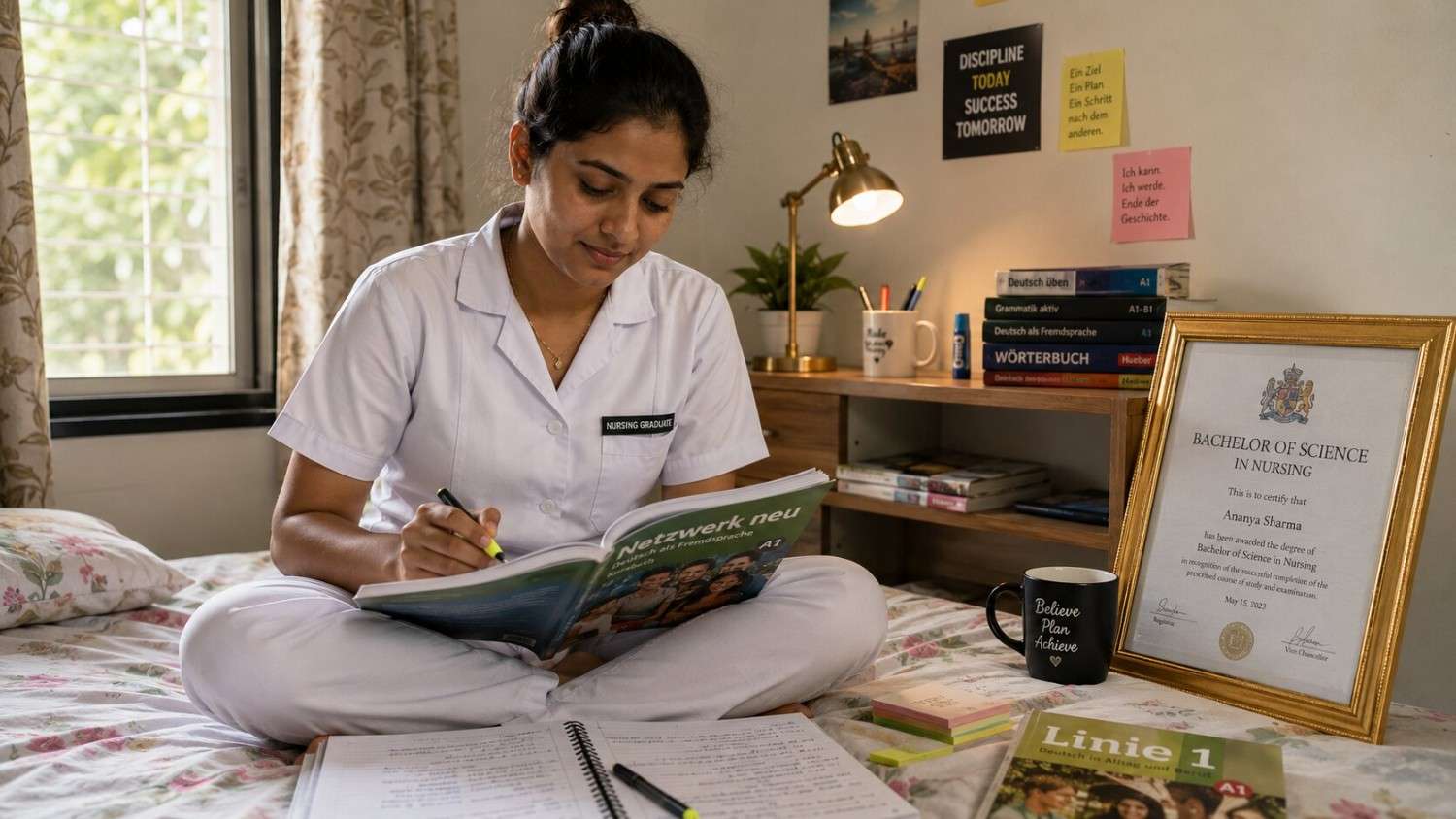
Most fresh nursing graduates who enquire about Germany assume — without checking — that they need years of experience to be eligible. They hear things like "you need at least 2 years of hospital experience" or "Germany only takes senior nurses" and take these as facts. They are not facts. They are assumptions, and in most cases they are wrong.
Germany is facing one of the most acute nursing shortages in Europe. The country is projected to need over 500,000 additional nursing professionals by 2030. The shortage is not selective — it affects hospitals, care homes, rehabilitation centres, and community health facilities across every German state. In this context, Germany is not in a position to turn away qualified nurses simply because they graduated recently.
What Germany requires is a valid nursing qualification from a recognised institution, B2 level German language proficiency, and the willingness to go through the Berufsanerkennung (professional recognition) process. None of these requirements specify a minimum number of years of work experience.
The honest answer: it depends on the employer, not the law. The German visa and recognition framework does not legally require Indian nurses to have a minimum number of years of post-qualification work experience. The Berufsanerkennung process evaluates your nursing degree — its content, duration, and clinical training hours — not the jobs you held after graduating.
However, individual German hospitals and care homes may have their own preferences. A university hospital in Munich with 200 applicants for each nursing post may prefer candidates with 2–3 years of specialised experience. A community care home in rural Bavaria that is struggling to fill positions will often be happy to hire a well-trained, B2-level nurse regardless of post-qualification experience.
JSJ's placement network includes both types of employers — and for fresh graduates, the placement focus is typically on care homes, smaller hospitals, and facilities in mid-sized cities rather than large urban university hospitals. These are stable, well-paying placements with genuine career progression — not lesser options.
Both GNM (3-year diploma + 6-month internship) and BSc Nursing (4-year degree with integrated clinical rotations) include substantial supervised clinical training as part of the degree itself. This clinical training counts when Germany evaluates your qualification.
Your internship, your ward postings, your clinical rotations — all of these are part of your degree record and are included in the Berufsanerkennung assessment. A fresh graduate is not someone with zero clinical experience. You have hundreds of supervised hours across different care settings. That is what the recognition authority is looking at.
For a fresh graduate considering Germany, the language is genuinely the first and most important step. Not experience. Not additional certifications. Not a gap year in a hospital. German at B2 level.
The A1 to B2 journey at Jet Set Jobs takes 10 to 12 months with 48 weeks of structured training including exam preparation. This timeline fits naturally with a fresh graduate's situation — you have just completed your degree, you may or may not be working, and you have the focus and energy to commit to intensive language training.
Many of JSJ's freshest candidates — nurses who enrolled within weeks of completing their final exams — have gone on to clear B2 and receive their job offers. The language is learnable. It requires consistency and effort, but it is not a barrier that only experienced nurses can cross.
| Factor | Fresh Graduate | Experienced Nurse (3+ years) |
|---|---|---|
| Germany visa eligibility | Yes — same process | Yes — same process |
| Recognition process | Same Berufsanerkennung | Same Berufsanerkennung |
| Employer preferences | Care homes, smaller hospitals | Hospitals, specialist wards |
| Salary (pre-recognition) | €2,800–€3,200/month gross | €2,800–€3,200/month gross |
| Salary (post-recognition) | €3,300–€3,500/month gross | €3,300–€3,500/month gross |
| Adaptation course likely? | Yes — GNM typically | Yes — GNM typically |
| Language training timeline | 10–12 months A1 to B2 | 10–12 months A1 to B2 |
| Family situation | Usually simpler | May involve spouse/children |
The salary is the same. The visa is the same. The recognition process is the same. The main practical difference is employer type — not outcome. Both fresh graduates and experienced nurses end up as fully recognised, fully paid registered nurses in Germany.
This is the most common dilemma for fresh graduates. The practical answer depends on your personal situation, not on a universal rule.
You have no family commitments yet. You have maximum flexibility in your schedule for language training. The sooner you start, the sooner you arrive — and the longer your career runway in Germany. Waiting to "gain experience" costs time, and the Germany opportunity does not get better with waiting.
If your nursing internship was limited in clinical breadth, a year of actual ward experience in India can make your adaptation course in Germany go faster. Specialist experience in ICU, OT, or oncology can also widen your employer options. Some nurses also need time to save money for the transition, support family obligations, or simply feel more confident before making the move.
Here is what the journey typically looks like for a nurse who enrolls with JSJ within six months of graduation:
From the day of enrollment to working as a fully recognised nurse in Germany: roughly 18 to 24 months. For a fresh graduate of 23 or 24, that means arriving in Germany at 25 or 26 — with a full European nursing career ahead.
JSJ does not filter candidates by years of experience. The criteria are: a valid GNM or BSc Nursing degree from an INC-affiliated institution, genuine commitment to completing the language training, and the ability to make the programme deposit. Everything else — your clinical specialty, your city, your batch timing — is worked around to fit your situation.
500+ nurses are currently learning German with JSJ, and a meaningful proportion of them enrolled as fresh graduates or with less than two years of experience. They are progressing through A1, A2, B1, and B2 the same as everyone else. Experience does not give you a faster path through the language. Only consistent study does.
📞 Book Your Free Consultation
Call / WhatsApp: +91 96259 66817
Email: support@jetsetjobs.in | www.jetsetjobs.in
500+ nurses currently learning German with JSJ. Free B2 training. Zero recruitment fees.