🛡️ Licensed by Ministry of External Affairs · RA:
B-3413/DEL/COM/1000+/5/11419/2026
📞 +91 96259 66817
📍 15, 2nd Floor, South Patel Nagar, Delhi-110008
📌 What You'll Learn
This blog covers the most common reasons Indian candidates face German Ausbildung visa rejections — and the specific steps you can take to make sure your application is solid before it reaches the Embassy.
Getting an Ausbildungsvertrag — a training contract with a German employer — is a significant achievement. It means an employer has interviewed you, selected you over other candidates, and is ready to invest 3 years in your training. A visa rejection after all of that is genuinely painful, and avoidable in most cases.
The German Embassy in New Delhi and the Consulates in Mumbai, Chennai, Kolkata, and Bengaluru process thousands of Ausbildung visa applications from Indian nationals every year. They have seen every type of incomplete, inconsistent, and poorly prepared application. The good news: most rejection reasons are known, documented, and preventable if you prepare correctly.
The visa you apply for is a national visa (Type D) — specifically an Ausbildungsvisum under Section 16a of the German Residence Act. It is a long-stay visa that allows you to enter Germany and begin your vocational training. Unlike a tourist visa, it requires an invitation from a German employer (your Ausbildungsvertrag) and proof that you meet the language and eligibility requirements.
The German Embassy does not approve or reject your Ausbildung — the employer does. The Embassy's job is to verify that your documents are genuine, consistent, and complete, and that you genuinely intend to train in Germany and not use the visa for unauthorised purposes.
This is the single most common reason for Ausbildung visa rejection. The Embassy requires proof of B2 level German proficiency from a recognised examining body — TELC or Goethe-Institut. A B1 certificate is not sufficient. An internal institute certificate is not accepted. The exam must be from an officially recognised body.
⚠️ Language Rule
B2 is the hard requirement. JSJ trains candidates from A1 to B2 using qualified trainers and an online LMS platform. Do not apply for a visa with anything less than a valid TELC or Goethe-Institut B2 certificate.
The German Embassy cross-checks every document you submit. If your name is spelled differently across your passport, marksheet, Aadhaar card, and the employer's Ausbildungsvertrag, it raises a red flag. If your birth date is inconsistent, or your Class 12 certificate shows a different institution than your transfer certificate, the application may be rejected or delayed for weeks.
German visa rules require you to demonstrate that you can support yourself financially upon arrival in Germany — typically until your first stipend payment.
Applications that show bank statements from an Indian account with insufficient funds are frequently rejected. The Embassy wants certainty — not a promise that you have money.
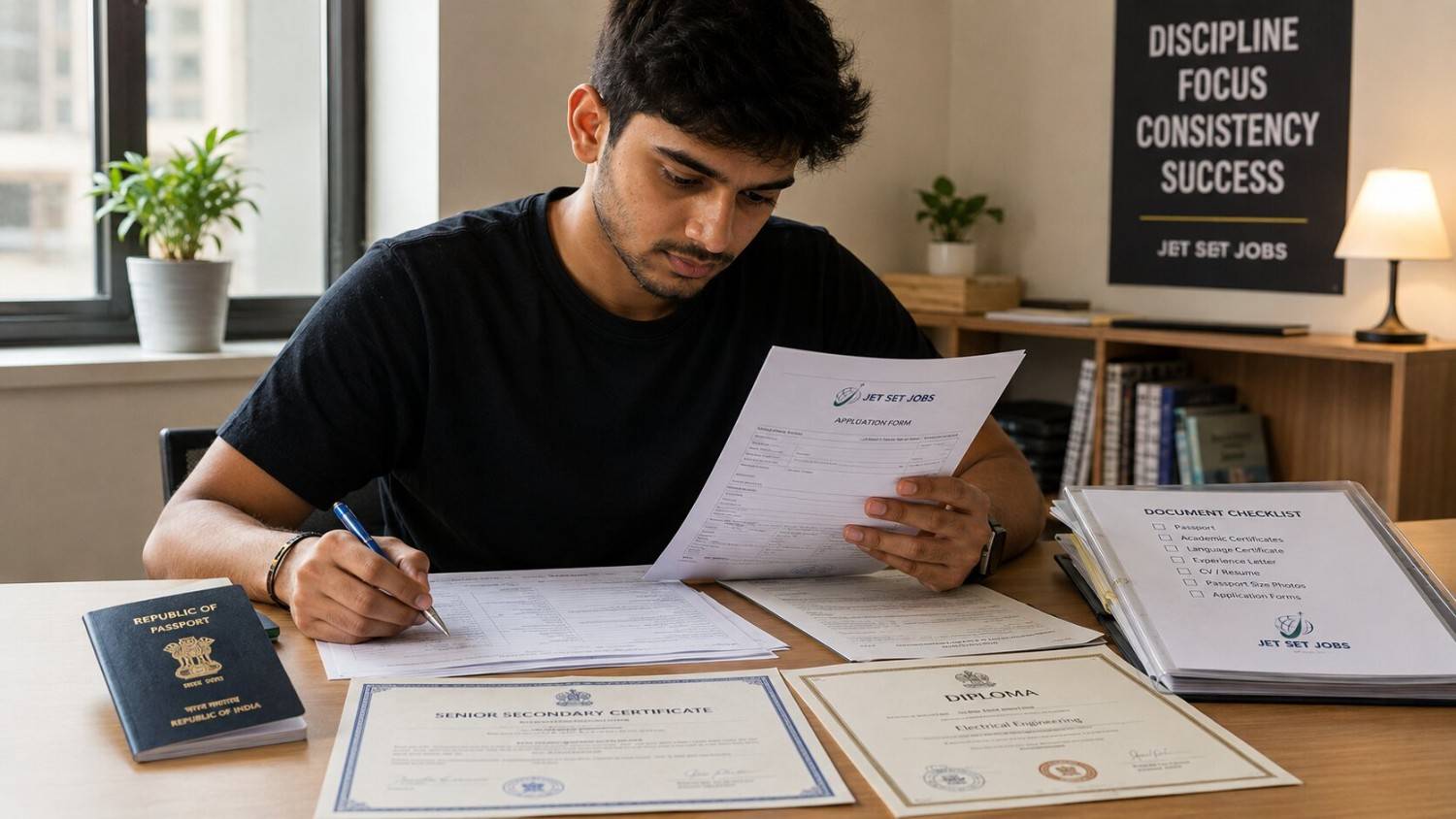
German authorities require specific documents to be notarised, apostilled, or attested. Class 12 certificates, birth certificates, and other educational documents must typically be apostilled under the Hague Convention — a process that goes through the relevant State government in India. Many candidates submit plain photocopies or self-attested copies instead of properly apostilled originals.
The German Embassy officer is trained to identify applicants who may be using the Ausbildung visa as a route to enter the Schengen area for purposes other than training. Red flags include: no genuine engagement with German language learning, vague answers about the employer or the training content, or a profile that does not match the Ausbildung sector.
The best defence against this concern is genuine preparation. If you can speak basic German, explain what your Ausbildung entails, name your employer and city, and demonstrate that you have been actively training, the officer's doubts disappear.
You must have valid health insurance from the moment you land in Germany. Public German health insurance (gesetzliche Krankenversicherung) typically kicks in once you begin your Ausbildung. For the gap between arrival and first working day, you need travel health insurance that is valid in Germany. Applications without proof of health insurance coverage are returned or rejected.
| Rejection Reason | Preventive Action |
|---|---|
| No B2 certificate / only B1 | Complete TELC or Goethe B2 before applying |
| Name inconsistency across documents | Notarised affidavit explaining discrepancy |
| Insufficient funds | Ensure adequate financial proof before applying |
| Documents not apostilled | Apostille Class 12, birth cert via state authority |
| Vague answers at visa interview | Prepare with JSJ counsellors — role-play the interview |
| No health insurance proof | Arrange travel health insurance for arrival gap |
| Passport expiry too soon | Renew passport — must be valid 6+ months after arrival |
| Ausbildungsvertrag mismatch with profile | Confirm all details match exactly with employer contract |
JSJ and Destination Germany provide visa document guidance as part of the programme. This includes a personalised document checklist, support with apostille and notarisation requirements, and pre-visa interview preparation with our counsellors.
No agent — including JSJ — can guarantee a visa approval because that decision rests with the German Embassy. What we can ensure is that your application is complete, consistent, correctly notarised, and submitted with the strongest possible supporting documentation.
🎯 JSJ Track Record
500+ candidates have started their Germany journey with Jet Set Jobs. Our team has seen what works and what does not at every stage of the visa process. Lean on that experience.
📞 Book Your Free Consultation — Jet Set Jobs × Destination Germany
Call / WhatsApp: +91 96259 66817
Email: support@jetsetjobs.in | www.jetsetjobs.in
Ausbildung Programme Germany 2027
Eligibility: Age 18–25 | Class 12 pass | Science background preferred
Programme Fee: ₹2,50,000 + GST in 3 instalments
Free German A1–B2 training included | Stipend: €1,000–€1,300/month