Process & Visa
How to Prepare for a German Employer Interview as an Indian Nurse
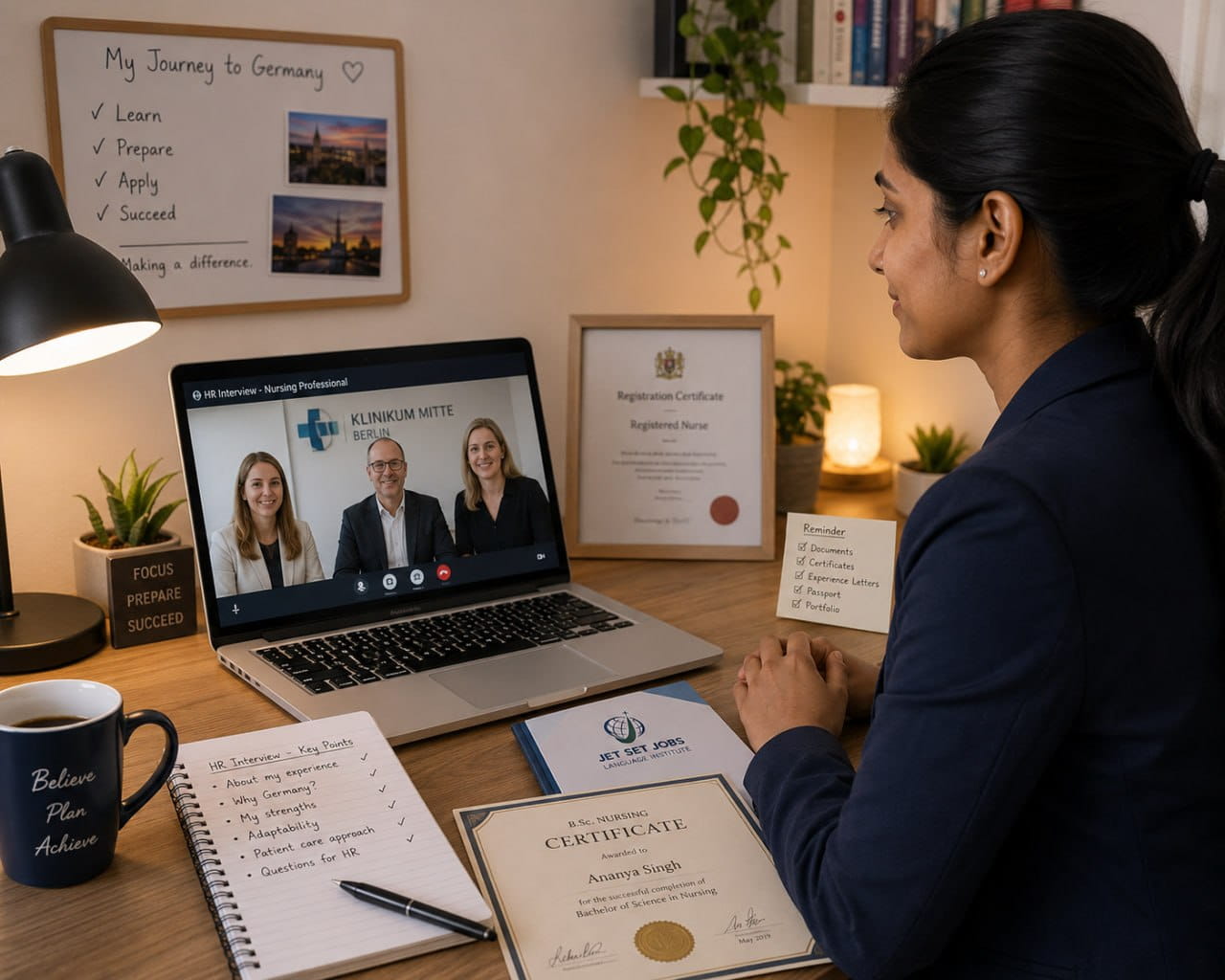
🎯 The employer interview is the moment that determines whether you get a Germany job offer.
This complete guide tells you exactly what to expect, what questions you will be asked in German, how to answer
them, and how to make the strongest possible impression.
For most Indian nurses, the German employer interview is one of the most anxiety-inducing parts of the entire
Germany process. It is conducted in German, with a hospital or care home team you have never met, about a job that
will change your life. The stakes feel enormous.
The good news: German employer interviews for international nurses are highly structured and predictable. The
questions are largely the same across employers. The format is consistent. And strong preparation — both language
and content — makes an enormous difference to how confident you feel and how well you perform.
What the Interview Format Looks Like
German employer interviews for internationally recruited nurses are almost always conducted via video call —
Google Meet, Zoom, or Microsoft Teams. In-person interviews at the German Embassy stage are rare at this point;
most employers conduct the interview from their hospital or care home, with you joining from India.
| Element |
Detail |
| Format |
Video call — Google Meet, Zoom, or Teams |
| Duration |
30–60 minutes typically |
| Language |
German — with some employers switching to English for clarification if needed |
| Participants |
Hospital HR + Ward Manager or Director of Nursing — typically 2–3 people |
| Stage |
After B2 certificate is received and your profile is submitted to the employer |
| Outcome |
Job offer within 1–3 weeks if successful |
What German Employers Are Looking For
Understanding what the interviewer actually wants to see helps you frame every answer correctly:
- German language ability — they want to assess whether your spoken German is functional for
clinical communication. They are not expecting perfect grammar. They are assessing whether they can work with
you day to day.
- Clinical competence — your nursing background, what departments you have worked in, what
procedures you are comfortable with
- Motivation — why Germany specifically, why this hospital, why nursing in Germany
- Personality and fit — are you someone their team will want to work with every day? German
workplaces value reliability, honesty, and calm professionalism
- Practical readiness — do you have your documents in order? Are you ready to travel within a
realistic timeline?
The Most Common Interview Questions — With Suggested Answers
1. Stellen Sie sich bitte vor. (Please introduce yourself.)
Prepare a 90-second self-introduction in German. Cover: your name, where you are from in India, your nursing
qualification (GNM or BSc), how many years of experience you have, which departments you have worked in, and why
you want to work in Germany.
„Mein Name ist [Name]. Ich komme aus [Stadt] in Indien. Ich bin examinierte
Krankenschwester mit [X] Jahren Berufserfahrung. Ich habe hauptsächlich auf der [Abteilung] gearbeitet. Ich möchte
in Deutschland arbeiten, weil..."
2. Warum möchten Sie in Deutschland arbeiten? (Why do you want to work in Germany?)
Be genuine but professional. Mention: Germany's reputation for quality healthcare, the professional development
opportunities, the structured recognition process, and your long-term commitment to working in Germany. Avoid
answers that are purely about salary — even if salary is a factor, frame it as part of a broader picture.
3. Welche Erfahrungen haben Sie in der Pflege? (What nursing experience do you have?)
Be specific — name the departments, the patient groups, the procedures.
„Ich habe zwei Jahre auf der chirurgischen Station gearbeitet und habe Erfahrung in der
Wundversorgung, Medikamentengabe und Patientendokumentation."
Specificity builds confidence.
4. Wie gut sprechen Sie Deutsch? (How well do you speak German?)
Be honest.
„Ich habe das TELC B2-Zertifikat bestanden und lerne jeden Tag weiter. Ich verstehe,
dass ich in der Praxis noch viel lernen werde, und ich bin bereit dafür."
This shows honesty, self-awareness, and motivation — all qualities German employers value.
5. Wann könnten Sie anfangen? (When could you start?)
Give a realistic answer — visa processing typically takes 8–14 weeks from offer.
„Nach Erhalt des Jobangebots benötige ich etwa drei bis vier Monate für die
Visumsbeantragung und die Vorbereitung. Ich hoffe, dass ich [Monat] anfangen kann."
6. Haben Sie Fragen an uns? (Do you have questions for us?)
Always prepare 2–3 questions. This signals genuine interest and preparation:
- Wie sieht die Einarbeitungszeit für internationale Pflegekräfte aus? (What does the onboarding period
look like for international nurses?)
- Bieten Sie Unterstützung bei der Wohnungssuche an? (Do you offer support with finding accommodation?)
- Wie viele internationale Pflegekräfte arbeiten bereits in Ihrer Einrichtung? (How many international
nurses already work at your facility?)
Language Preparation — What to Practise Before the Interview
- Record yourself giving your self-introduction — listen back and identify unclear pronunciation
- Practise all 6 question types above out loud — not just reading them silently
- Ask your JSJ German trainer for a mock interview session — Jet Set Jobs conducts these for B2-level candidates
preparing for employer interviews
- Review your clinical German vocabulary for the specific department the employer works in — if it is a surgical
ward, review surgical terminology
- Practise numbers and dates in German — salary discussions, start dates, work experience years — these come up
and stumbling on numbers looks unconfident
Practical Interview Day Tips
- Test your video call setup the day before — camera angle, lighting, microphone quality, stable internet
connection
- Dress professionally — German hospital standard — even though it is a video call. First impressions are
visual.
- Have your CV, degree certificate, and B2 certificate on your desk — you may be asked to confirm details
- Find a quiet room with no background noise or interruptions — plan for the full hour
- Log in 5 minutes early — technical punctuality is noticed
- Speak slowly and clearly — not because your German is weak, but because it is a professional communication
habit German employers appreciate
- If you do not understand a question, it is completely acceptable to say: „Könnten Sie die Frage bitte
wiederholen?" (Could you please repeat the question?) This is professional, not weak.
After the Interview
Send a brief thank-you email within 24 hours — in German. It takes 2 minutes and almost no other candidate does
it. It leaves a lasting positive impression:
„Sehr geehrte Damen und Herren, ich möchte mich herzlich für das Gespräch von heute
bedanken. Das Gespräch hat mein Interesse an einer Stelle in Ihrer Einrichtung nochmals bestärkt. Ich freue mich
auf Ihre Rückmeldung. Mit freundlichen Grüßen, [Ihr Name]"
💡 At Jet Set Jobs we run mock German employer interviews for B2-level candidates. Ask
your trainer to schedule one before your official interview date.
📞 Book Your Free Consultation
Call / WhatsApp: +91 96259 66817 | support@jetsetjobs.in | www.jetsetjobs.in
583+ candidates have started their Germany journey with us. Refundable ₹75,000 deposit. Zero placement fees.
MEA licensed.