🛡️ Licensed by Ministry of External Affairs · RA:
B-3413/DEL/COM/1000+/5/11419/2026
📞 +91 96259 66817
📍 15, 2nd Floor, South Patel Nagar, Delhi-110008
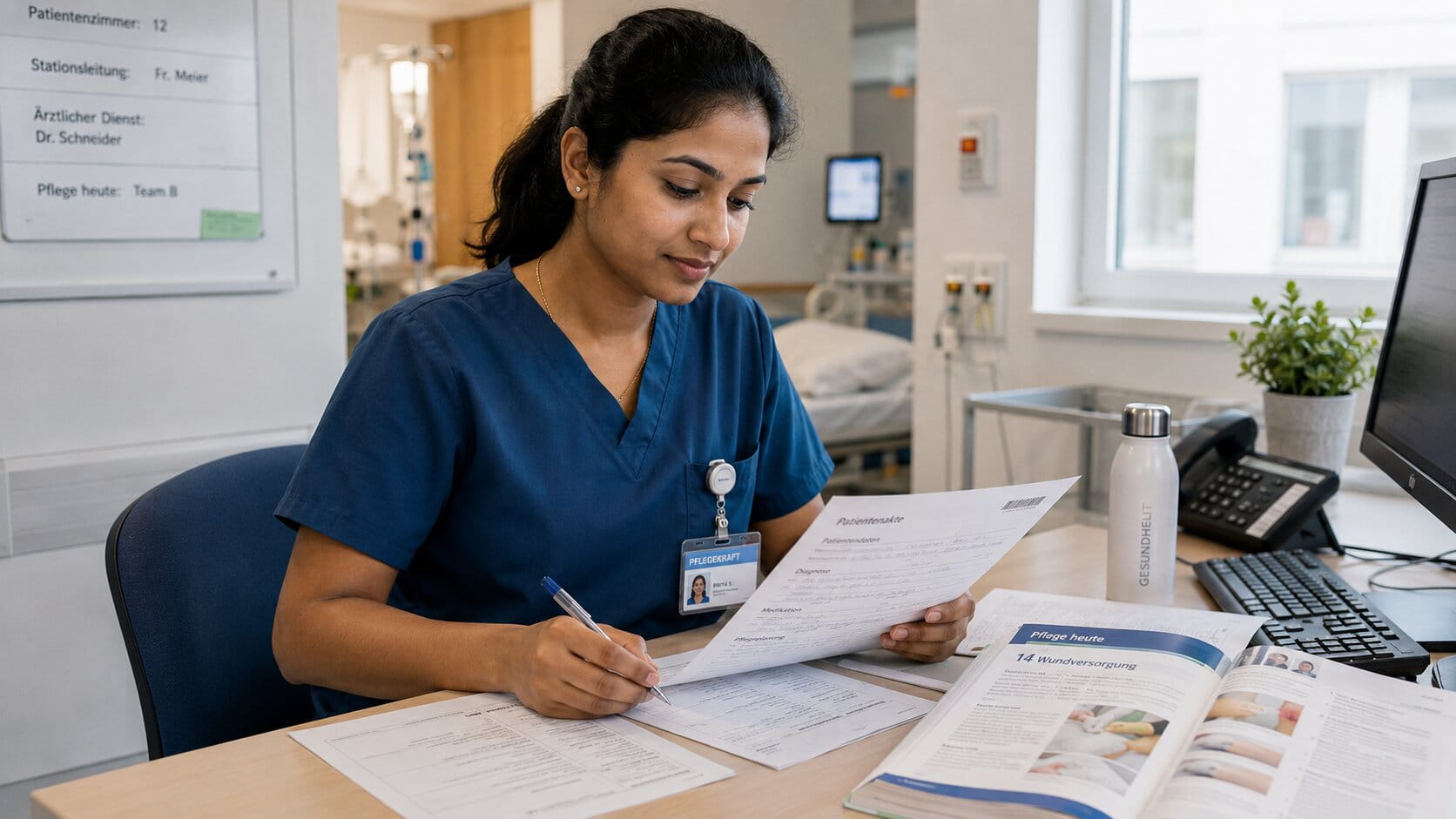
When an Indian nurse applies for professional recognition (Berufsanerkennung) in Germany, the state recognition authority compares her nursing qualification to the German nursing standard. For most Indian nurses — whether GNM or BSc — the outcome is partial recognition (teilweise Gleichwertigkeit). This means the authority found that the training is broadly equivalent but identified specific gaps in certain care areas, typically psychiatric nursing, elderly care, or documentation standards.
Partial recognition is not rejection. It is a finding that says: most of what you know meets German standards — here is what still needs to be demonstrated. German law gives nurses with partial recognition two paths to close those gaps and receive their full nursing licence. The first is the Anpassungslehrgang — a supervised adaptation course inside a German hospital, lasting 3 to 12 months. The second is the Kenntnisprüfung — a knowledge and aptitude test that lets you demonstrate the identified competencies in a formal examination setting.
This blog focuses on the Kenntnisprüfung: what it involves, how it differs from the adaptation course, who it suits, and what to expect if you choose this route.
The Kenntnisprüfung — pronounced roughly as "KEN-tnis-PROO-fung" — translates as "knowledge test" or "aptitude test." It is a formal examination administered by the German state recognition authority (such as the Regierungspräsidium in Baden-Württemberg or the Landesprüfungsamt in Bavaria) that assesses whether you have the specific nursing competencies identified as gaps in your partial recognition decision.
Crucially, the Kenntnisprüfung does not test everything you know about nursing. It is targeted specifically at the gaps identified in your individual recognition decision. If your gap report says your training was insufficient in psychiatric nursing and elderly palliative care, the Kenntnisprüfung will test you on precisely those areas — not on surgical nursing or intensive care, where your Indian training was deemed sufficient.
This makes the Kenntnisprüfung a focused examination, not a comprehensive re-testing of your entire nursing education.
The exam has two components — a theoretical part and a practical part — and is conducted entirely in German.
The theoretical part tests your knowledge of the nursing concepts, clinical guidelines, and care standards relevant to the gap areas identified in your recognition decision. Depending on the state and the specific gaps, this may be a written examination, an oral examination, or both. Questions are based on German nursing standards, care protocols, and patient safety frameworks — not the Indian nursing curriculum you originally studied.
You will be expected to demonstrate knowledge of things like: German psychiatric nursing approaches and patient rights frameworks, German elderly care standards and dementia care protocols, pharmacological knowledge relevant to the identified care areas, and documentation requirements under German nursing law.
The practical part involves demonstrating specific clinical skills and care competencies in a supervised setting — typically in a hospital or simulation environment. An examiner observes you performing care tasks, conducting a patient assessment, or managing a clinical scenario relevant to your identified gap areas. You may be required to communicate with a patient (played by an actor or examiner), perform hands-on care procedures, and document your actions in German.
This section assesses not just knowledge but application — whether you can actually deliver care to German standards in a real clinical context.
This is the most important decision a nurse with partial recognition has to make. Both routes lead to the same outcome — a full nursing licence — but the experience, timeline, and suitability differ significantly.
| Factor | Kenntnisprüfung | Anpassungslehrgang (Adaptation Course) |
|---|---|---|
| Format | Formal exam — theoretical + practical | Supervised work in a hospital or care home |
| Duration | One exam session (1–2 days) | 3 to 12 months of supervised employment |
| Conducted in | German (mandatory) | German workplace environment |
| Salary during this period | No salary — exam only | €2,800–€3,200/month gross (employed) |
| Best suited for | Strong German, confident in gap subjects | Nurses building confidence gradually |
| Faster route? | Yes — if you pass first time | Slower but steadier |
| Risk if unsuccessful | Must retake or switch to adaptation course | Low — continuous supervised progress |
| Language demand | High — exam fully in German | Lower — language builds naturally on the job |
The adaptation course is the preferred route for the majority of Indian nurses placed by Jet Set Jobs — primarily because it allows nurses to earn a salary while completing recognition, builds language confidence in a real workplace environment, and does not carry the pressure of a single high-stakes examination. The Kenntnisprüfung suits nurses who have very strong German language skills, are highly confident in the specific gap subject areas, and want to complete recognition as quickly as possible without an extended adaptation period.
Like the adaptation course, the Kenntnisprüfung takes place after you arrive in Germany — not in India. The typical sequence looks like this:
An unsuccessful Kenntnisprüfung is not the end of the road. Most German states allow the exam to be retaken — typically once or twice — after a waiting period. If a nurse is unsuccessful on retake, the state authority may direct her to complete the Anpassungslehrgang instead. Your provisional work permit (Berufserlaubnis) remains valid throughout this process, so you can continue working while preparing to retake.
The most common reason for not passing is not lack of nursing knowledge — it is insufficient German language proficiency at the clinical and professional level. The exam demands precise, professional-register German: medical terminology, structured case presentations, and clinical reasoning communicated clearly. Nurses who attempt the Kenntnisprüfung without consolidating their clinical German well beyond everyday B2 are at a disadvantage.
At Jet Set Jobs, candidates are informed about both recognition pathways — Kenntnisprüfung and Anpassungslehrgang — from early in the programme, not as a surprise after they arrive in Germany. Understanding both options allows nurses to make an informed choice based on their individual language level, clinical confidence, and personal preferences.
As candidates approach B2 in their training, JSJ trainers introduce clinical German vocabulary, patient communication frameworks, and care scenario practice that build the foundation needed for both pathways. Nurses who complete the full 48-week A1 to B2 programme and continue developing their clinical German on arrival are consistently better positioned — whether they choose the Kenntnisprüfung or the adaptation course.
500+ nurses are on their way to Germany and Austria with us. The ones who understand the recognition process before they leave India — not after they arrive — are the ones who move through it with confidence and without surprises.
📞 Book Your Free Consultation
Call / WhatsApp: +91 96259 66817
Email: support@jetsetjobs.in | www.jetsetjobs.in
500+ nurses are on their way to Germany & Austria with us. Free B2 training. Zero recruitment fees.