🛡️ Licensed by Ministry of External Affairs · RA:
B-3413/DEL/COM/1000+/5/11419/2026
📞 +91 96259 66817
📍 15, 2nd Floor, South Patel Nagar, Delhi-110008
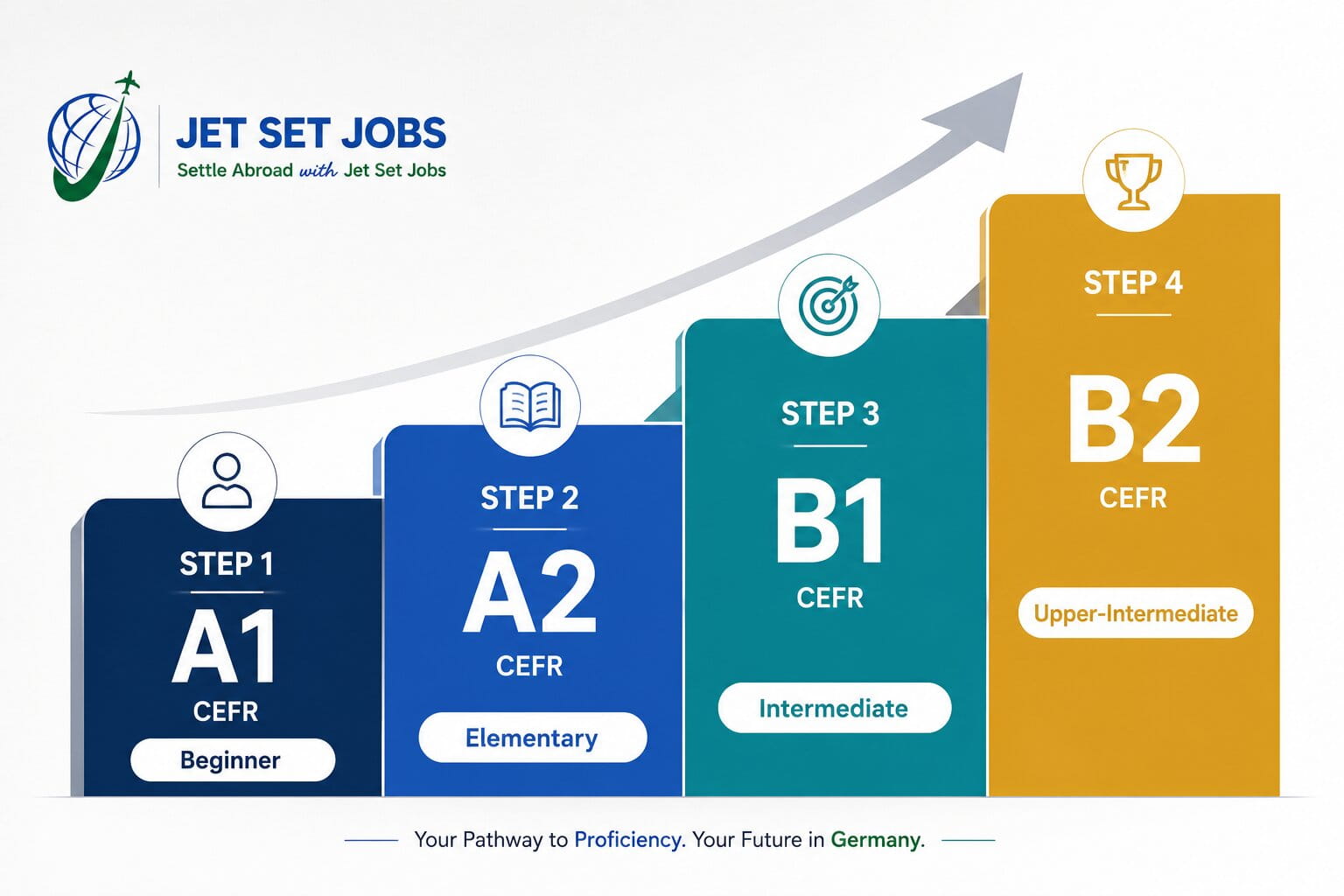
📌 Quick answer: A1 = beginner | A2 = elementary | B1 = intermediate | B2 = upper intermediate
📌 Germany career pathway (nursing, Ausbildung, skilled worker visa) requires B2.
📌 At Jet Set Jobs: A1 = 3 months | A2 = 2 months | B1 = 3 months | B2 = 2 months | Total = 10–12 months
📞 Questions? Call +91 96259 66817
One of the most common sources of confusion for students in Patel Nagar, Karol Bagh, and Rajender Nagar who are exploring German language courses is the level terminology. What exactly is A1? Is B1 enough for Germany? What does B2 actually mean in practice?
These are not just academic questions — they determine which course you need to enrol in, how long you need to study, what you will pay, and whether the certificate you receive will actually be accepted by German employers and immigration authorities. This guide explains all four levels clearly, without jargon.
A1, A2, B1, and B2 are not labels invented by language institutes. They come from the CEFR — the Common European Framework of Reference for Languages — an internationally recognised standard created by the Council of Europe that describes language proficiency across six levels from A1 (complete beginner) to C2 (mastery). Every serious German language examination — TELC, Goethe-Institut, ÖSD — uses the CEFR levels.
📌 The six CEFR levels: A1 → A2 → B1 → B2 → C1 → C2
📌 For Germany nursing, Ausbildung, and skilled worker visa: B2 is the standard
📌 A Goethe B2 and a TELC B2 are equivalent in level — both accepted for Germany pathways
A1 is the 'breakthrough' level — where you move from zero knowledge to basic communication ability. It is the first, most fundamental stage of language learning.
| A1 — Key Facts | Details |
|---|---|
| What you can do | Introduce yourself and others; ask and answer basic questions about personal details; interact simply when the other person speaks slowly |
| Grammar at A1 | Present tense verb conjugation, nominative and accusative cases, der/die/das (article genders), basic sentence structure |
| Vocabulary at A1 | Numbers, colours, family, food, greetings, days of the week — approximately 500–800 words |
| Duration at JSJ | 3 months |
| Fee at JSJ | ₹20,000 offline | ₹17,500 online |
| Is A1 enough for Germany? | No — Germany requires B2. A1 is the first step toward B2. |
A2 is the 'waystage' level — you can now handle routine, everyday interactions and not just the most basic exchanges. The grammar becomes meaningfully more complex.
| A2 — Key Facts | Details |
|---|---|
| What you can do | Communicate in simple and routine tasks; describe aspects of your background, environment, and daily routine; handle short social interactions |
| Grammar at A2 | Dative case (the third major case), Perfekt tense (everyday past tense), separable verbs, two-way prepositions with dative/accusative, comparative adjectives |
| Vocabulary at A2 | Health, housing, work, shopping, leisure, travel — approximately 1,000–1,500 words |
| Duration at JSJ | 2 months |
| Fee at JSJ | ₹20,000 offline | ₹17,500 online |
| Is A2 enough for Germany? | No — A2 is not accepted for any Germany visa or placement pathway. It is the necessary bridge between A1 and B1. |
📌 The dative case — introduced at A2 — is one of the most important grammar concepts in German. It is the foundation for complex sentence structures at B1 and B2.
📌 Students who skip or rush A2 consistently struggle at B1. Two months is the minimum to absorb dative and Perfekt properly.
B1 is the 'threshold' level — the point at which you can function independently in most everyday situations. This is a significant jump from A2.
| B1 — Key Facts | Details |
|---|---|
| What you can do | Follow extended speech and argumentation; write simple formal texts; express and explain viewpoints; describe experiences; handle most everyday situations in Germany |
| Grammar at B1 | Subordinate clauses, relative clauses, passive voice, Konjunktiv II for polite requests, advanced modal verbs, Plusquamperfekt |
| Vocabulary at B1 | Professional, environmental, media, travel, health — approximately 2,500–3,000 words |
| Healthcare vocab at JSJ | Ward communication, patient interaction, basic clinical terminology — introduced at B1 for nursing pathway students |
| Duration at JSJ | 3 months |
| Fee at JSJ | ₹20,000 offline | ₹17,500 online |
| Is B1 enough for Germany? | Generally no — B2 is the standard for nursing, Ausbildung, and most skilled worker visa applications. |
B2 is the 'vantage' level — the point at which you can use German effectively in professional and academic contexts. This is the certification that matters for the Germany career pathway.
| B2 — Key Facts | Details |
|---|---|
| What you can do | Understand complex texts; give presentations; participate in discussions on abstract and professional topics; write structured formal documents; function professionally in a German workplace |
| Grammar at B2 | Subjunctive II for hypothetical situations, passive with modal verbs, extended participial phrases, advanced connectors, complex sentence architecture |
| Vocabulary at B2 | Academic, formal, professional, idiomatic — approximately 4,000–5,000 words across formal and informal registers |
| Healthcare vocab at JSJ | Extended clinical German — patient documentation, ward management, specialist terminology, complex patient scenarios |
| Duration at JSJ | 2 months |
| Fee at JSJ | ₹20,000 offline | ₹17,500 online |
| Is B2 enough for Germany? | Yes — TELC Deutsch B2 or Goethe-Zertifikat B2 is the standard accepted for nursing Berufsanerkennung, Ausbildung, and skilled worker visas |
📌 B2 certifications accepted for Germany:
→ TELC Deutsch B2 (general) — most employers and recognition authorities
→ TELC Deutsch B2 Pflege (Healthcare) — specifically for nursing Berufsanerkennung
→ Goethe-Zertifikat B2 — universities, some employers, general B2 proof
📌 Exam fees (separate from course): TELC B2 ≈ ₹16,500–₹18,000 | Goethe B2 ≈ ₹18,000–₹21,200
| Situation | A1 | A2 | B1 | B2 |
|---|---|---|---|---|
| Introduce yourself in German | ✅ Yes | ✅ Yes | ✅ Yes | ✅ Yes |
| Handle a medical appointment in Germany | ❌ No | ❌ Barely | ⚠️ Partially | ✅ Yes |
| Read a German newspaper article | ❌ No | ❌ No | ⚠️ Main ideas only | ✅ Yes |
| Write a formal email or letter | ❌ No | ⚠️ Very simple only | ✅ Simple formal texts | ✅ Professional standard |
| Follow a conversation at normal speed | ❌ No | ⚠️ Familiar topics only | ✅ Most situations | ✅ Complex discussion |
| Pass TELC/Goethe B2 exam | ❌ No | ❌ No | ❌ No | ✅ Yes — if properly prepared |
| Apply for Germany nursing Berufsanerkennung | ❌ No | ❌ No | ❌ No | ✅ Yes |
| Join Ausbildung programme in Germany | ❌ No | ❌ No | ❌ No | ✅ Yes |
B2 — specifically TELC Deutsch B2 Healthcare (Pflege) is most commonly required for nursing Berufsanerkennung in Germany. Standard TELC B2 and Goethe B2 are also accepted by most state authorities. A1, A2, or B1 are not sufficient for nursing Berufsanerkennung or work authorisation in Germany.
If you have never studied German formally, you are at A1 (or pre-A1). If you have done A1 at another institute, a short assessment at JSJ will confirm whether you are ready for A2. The most common misconception is self-assessing at A2 when the A1 grammar foundation — particularly dative case and case-changing articles — is incomplete.
B1 is a valid language level but is not the standard required for the main Germany career pathways. Nursing visas, Ausbildung placements, and skilled worker visas all require B2. Do not stop at B1 if your goal is Germany.
No — not in any legitimate CEFR-aligned programme. A2 introduces the dative case, Perfekt tense, and separable verbs that are the foundation of B1 grammar. Attempting B1 without solid A2 almost always results in the student struggling with subordinate clauses. At Jet Set Jobs, A2 is always completed before B1 begins.
Jet Set Jobs in South Patel Nagar offers the complete A1 to B2 programme — same institute, same trainers, same structured curriculum from the first A1 session to the final B2 mock exam. The centre is 3 km from Karol Bagh and 2 km from Rajender Nagar. Online batch also available at 3 hours/day via LMS. Call +91 96259 66817 to book a free demo.
At Jet Set Jobs: ₹75,000 for the full A1–B2 programme offline (₹65,000 online), all + GST. Per-level: ₹20,000 offline / ₹17,500 online. The full programme saves ₹5,000 compared to paying per level separately. Visit www.jetsetjobs.in/contact to book a free demo.
Call / WhatsApp: +91 96259 66817
support@jetsetjobs.in | www.jetsetjobs.in
583+ candidates have started their Germany journey with us.
A1–B2 Offline ₹75,000 | Online ₹65,000 | Per Level ₹20,000 | All + GST
Book Free Demo →