🛡️ Licensed by Ministry of External Affairs · RA:
B-3413/DEL/COM/1000+/5/11419/2026
📞 +91 96259 66817
📍 15, 2nd Floor, South Patel Nagar, Delhi-110008
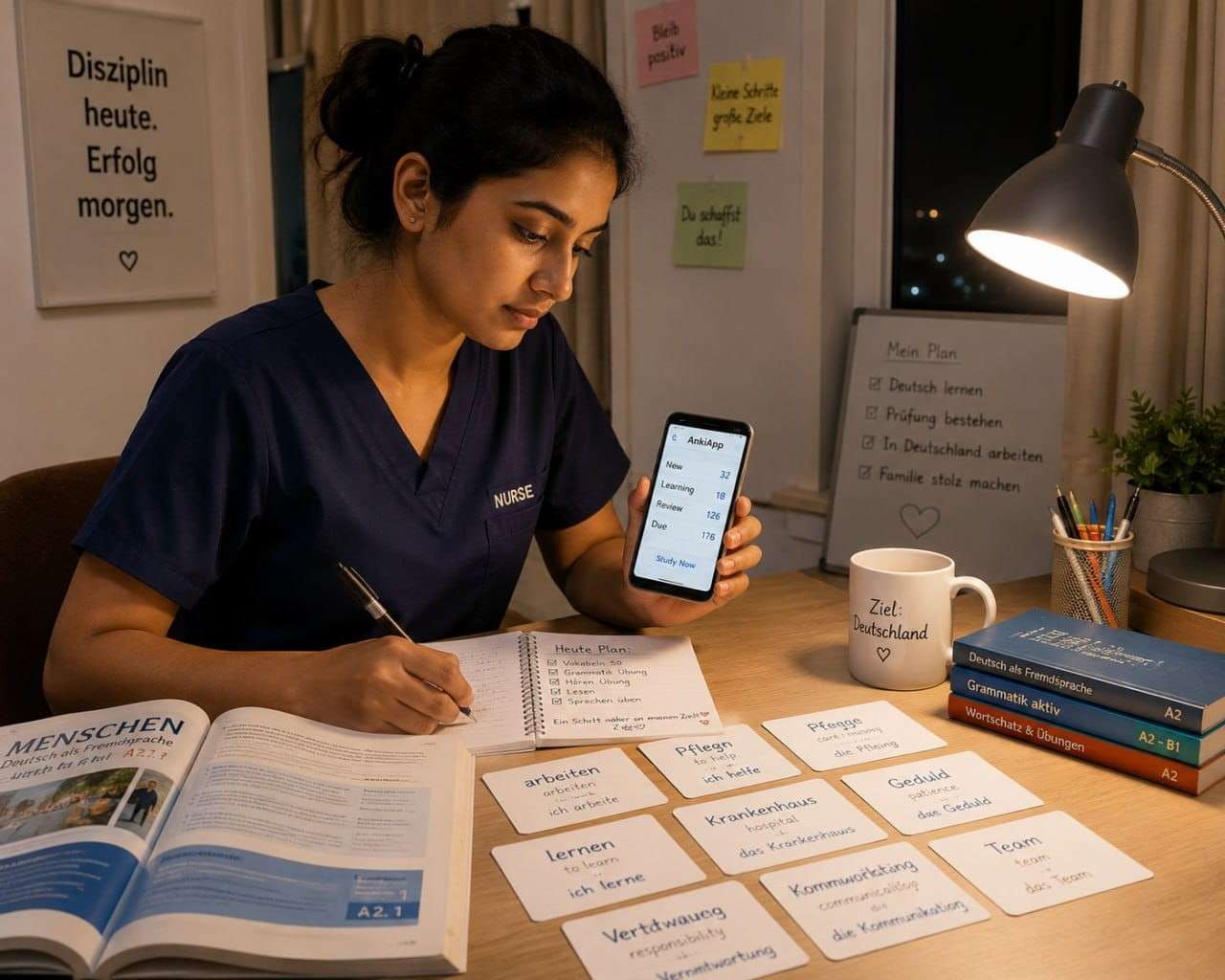
At Jet Set Jobs, our Monday to Friday classroom training gives you the structure, the grammar, and the foundation. But 3 hours a day, 5 days a week — while excellent — is not enough on its own to reach B2 as fast as possible. The nurses who clear B2 in 10–12 months versus those who take 14–16 months share one common trait: they extend German learning into their daily life outside class.
Here are the 10 most effective strategies — tested and recommended by nurses who have already made the journey.
AnkiApp is a free flashcard application that uses spaced repetition — a scientifically proven memory technique that shows you words just before you are about to forget them. This is the single most efficient way to build vocabulary outside class.
Deutsche Welle (dw.com/en/learn-german) is Germany's international broadcaster — and it offers completely free, structured German courses specifically designed for English speakers. Their Nicos Weg series (A1 to B1) is particularly good — video episodes with real German characters in everyday situations, with exercises after each episode.
This sounds small but it creates significant daily exposure. Every notification, every app label, every settings menu — in German. You will encounter 50–100 German words and phrases daily without any additional study time.
Start with phone language at A2 level — by then you will recognise enough to navigate comfortably. By B1, your phone in German will feel completely natural.
If you have a commute — even 15 minutes — use it for German listening practice. Recommended podcasts for nurses:
Listening to natural German speech — even if you do not understand everything — trains your ear for the rhythm, intonation, and speed of real spoken German. This directly improves your TELC listening score and your Day 1 performance in Germany.
Writing activates a different part of the brain than reading or listening. Nurses who write German daily — even just one or two sentences in a diary — consolidate grammar rules faster than those who only consume German passively.
A Tandem partner is a native German speaker who wants to practise English or Hindi — and you help each other. This gives you free, regular spoken German practice with a native speaker.
YouTube has thousands of German channels across every topic. The key is to watch with German subtitles (not English) — this forces your brain to connect spoken sounds to written German simultaneously, which is one of the fastest ways to improve both listening and reading at once.
Reading is one of the most underused learning strategies among language students. German reading builds vocabulary in context, reinforces grammar patterns, and improves your TELC reading section performance directly.
Many nurses practise German in their head — reading silently, thinking in German. This builds reading but not speaking. Speaking ability comes from speaking — even when you are alone.
Research on sleep and memory consistently shows that information reviewed immediately before sleep is consolidated more effectively overnight. Use the last 10 minutes before you sleep for German review — not social media, not news. Just German.
This one habit alone — consistently applied — can accelerate your B2 timeline by 4–6 weeks.
| Practice Pattern | Weekly German Exposure | Impact |
|---|---|---|
| Class only (3 hrs/day, 5 days/week) | 15 hours/week | Solid — but slower B2 progress |
| Class + AnkiApp (15 min/day) | 16.75 hours/week | Significantly better vocabulary retention |
| Class + AnkiApp + Podcast (15 min commute) | 18.5 hours/week | Listening comprehension improves noticeably |
| Class + all 10 strategies (avg 45 min/day extra) | 20+ hours/week | Fastest possible B2 route — nurses clear B2 2–3 months earlier |
📞 Book Your Free Consultation
Call / WhatsApp: +91 96259 66817 | support@jetsetjobs.in | www.jetsetjobs.in
583+ candidates have started their Germany journey with us. Refundable ₹75,000 deposit. Zero placement fees. MEA licensed.