🛡️ Licensed by Ministry of External Affairs · RA:
B-3413/DEL/COM/1000+/5/11419/2026
📞 +91 96259 66817
📍 15, 2nd Floor, South Patel Nagar, Delhi-110008
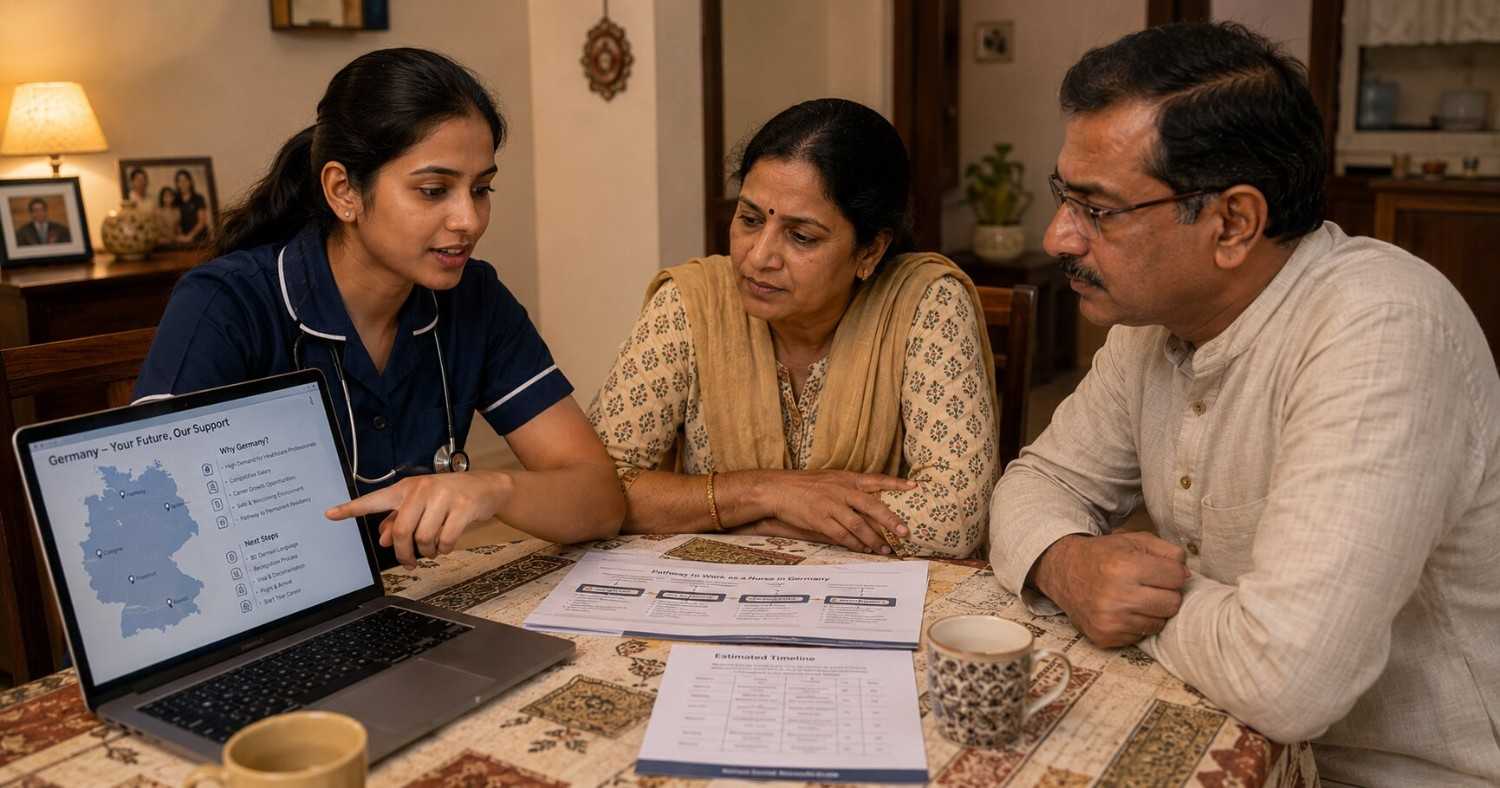
Your parents are not being difficult. They are being parents. When they imagine their daughter — or daughter-in-law — moving thousands of kilometres away to a country where nobody speaks Hindi, where the culture is completely different, and where they cannot reach her in an emergency within hours, the fear is a natural response to a real situation.
The problem is not that they are afraid. The problem is that the information most Indian families have about Germany — if they have any at all — comes from fragments: a news headline, a relative's impression, a neighbour's opinion. This information is rarely accurate, and it rarely tells the story that the data actually shows.
This blog addresses the most common safety fears that parents of JSJ candidates have raised during family consultations — one by one, with specific facts, not generic reassurance.
This is the most common fear, and it deserves a direct answer. Germany ranks consistently among the top 15 to 20 safest countries in the world on the Global Peace Index — above the United States, France, and Italy, all of which Indian families generally consider acceptable destinations for travel or work. Germany's violent crime rate is among the lowest in Europe.
The specific cities where JSJ places nurses — Stuttgart, Munich, Nuremberg, Frankfurt, Cologne — are large, well-policed, urban centres with excellent public transport, well-lit streets, and significant international populations. These are not remote or unfamiliar environments. They are modern European cities where hundreds of Indian nurses already live and work.
German law — the Allgemeines Gleichbehandlungsgesetz, or AGG — explicitly prohibits discrimination by race, gender, or national origin in the workplace and in housing. An Indian nurse has the same legal protections as a German nurse from day one of employment.
This fear is understandable, but it does not match the reality of how JSJ placements work. Nurses placed through JSJ do not arrive in Germany alone and unsupported. The structure of the placement ensures this at multiple levels.
First, the German employer is a partner in the process — not just a job provider. Employers who recruit through structured programmes like JSJ typically provide accommodation support for international staff during the first 3 to 6 months. Many nurses live in hospital staff housing or employer-arranged flats close to the workplace, often with other Indian or international nursing staff.
Second, there is already an established and growing community of Indian nurses in Germany. In Stuttgart, Munich, Frankfurt, and Cologne, there are active WhatsApp groups, Facebook communities, and in-person networks of Indian healthcare workers. A nurse arriving through JSJ is not the first Indian woman in her city. She is joining a community that already exists and actively supports new arrivals.
Third, JSJ provides post-placement support. If something goes wrong at work, with accommodation, or with paperwork, there is a team in New Delhi that the nurse and her family can reach. She is not navigating Germany alone.
This is perhaps the most emotionally loaded fear — the helplessness that parents feel at physical distance. It is worth addressing honestly, because distance is real and it does not disappear.
What does change is the safety net available to the nurse in Germany. German hospitals provide mandatory health insurance from day one of employment. This is not optional or additional — it is part of the employment contract, paid jointly by the employer and the employee. If a nurse falls ill, has an accident, or needs medical care, the German public health system covers it fully.
For family emergencies back home, German employment law provides for compassionate leave. Nurses can take emergency leave and fly home when needed. Employers in the healthcare sector are accustomed to international staff with family in other countries. This is a known situation, not an unusual request.
The practical distance from India to Germany has also compressed dramatically. A direct flight from Delhi to Frankfurt is approximately 8 hours. WhatsApp video calls, voice notes, and daily contact are the norm for every JSJ nurse — not a special arrangement. The emotional distance of being abroad is real. The practical inaccessibility parents fear is much smaller than they imagine.
German culture is different from Indian culture. This is true and it is not worth minimising. Germans are more direct in communication, more formal in professional settings, and less demonstrative in social interaction than most Indian families are accustomed to. The adjustment takes time and deliberate effort.
What the data also shows is that Indian nurses adjust. The Indian nursing community in Germany is not a temporary population — many nurses have been there for 5, 7, or 10 years. They have built lives, made friends, celebrated festivals, found Indian grocery stores, and created communities that balance German professional life with Indian personal identity. This is not an exceptional outcome. It is the normal trajectory.
The adjustment is harder in the first three months. This is the window when JSJ's post-placement support, the Indian nurse community, and regular contact with family at home matter most. Nurses who enter this period knowing it will be challenging — and who have a plan for managing it — come through it significantly better than those who were told everything would be easy.
Parents who remain uncertain after reading this blog are welcome to call JSJ directly on +91 96259 66817. JSJ counsellors regularly speak with the families of candidates — not just the candidates themselves. In some cases, JSJ connects families with the families of nurses already in Germany: parents who had the same fears, asked the same questions, and can now speak from the other side of the experience.
500+ nurses are on their way to Germany and Austria with us. Behind each one of those nurses is a family that asked these questions. The answers did not make the fear disappear. But they made the decision possible — and the nurses who left with their family's understanding have a fundamentally different experience in Germany than those who left without it.
📞 Book Your Free Consultation
Call / WhatsApp: +91 96259 66817
Email: support@jetsetjobs.in | www.jetsetjobs.in
500+ nurses are on their way to Germany & Austria with us. Free B2 training. Zero recruitment fees.