🛡️ Licensed by Ministry of External Affairs · RA:
B-3413/DEL/COM/1000+/5/11419/2026
📞 +91 96259 66817
📍 15, 2nd Floor, South Patel Nagar, Delhi-110008
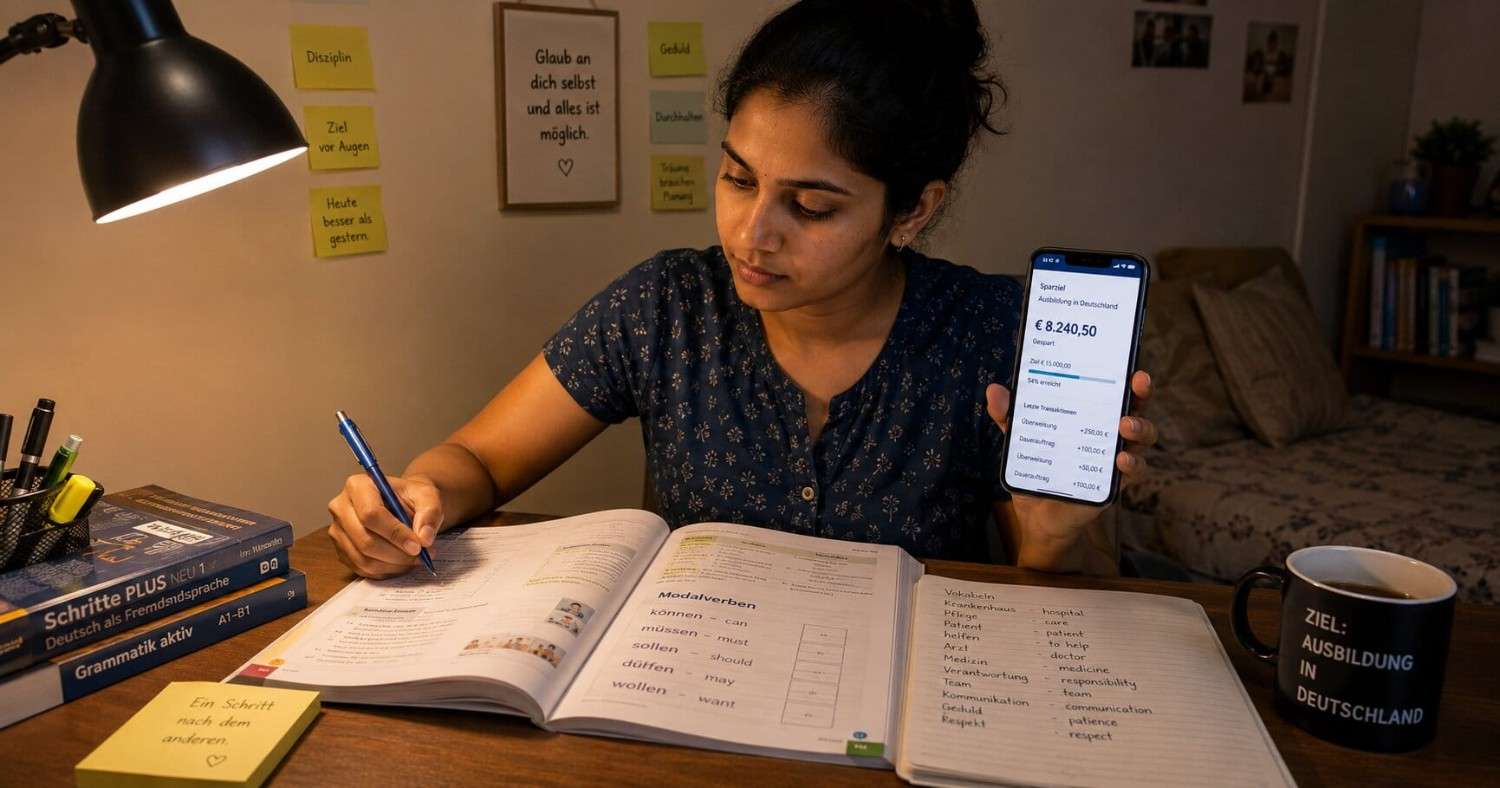
A nurse from Rajasthan shared something in her consultation that JSJ's counsellors hear regularly: another agency had told her that to learn German properly, she would need to stop working for at least eight months. The implication was that language training is incompatible with employment.
This advice causes real damage. For a nurse earning ₹18,000 to ₹25,000 per month, quitting work for eight months means giving up ₹1.5 lakh or more of household income — on top of whatever the training programme costs. For most Indian nursing families, this is simply not possible. The result is that nurses who cannot afford to quit conclude they cannot afford Germany, when the actual conclusion should be that they cannot afford that particular programme or approach.
JSJ's position is straightforward: you should not have to quit your job to learn German. The training structure should fit around employment, not require you to abandon it.
There is a widespread assumption that more hours equals faster B2 — that a full-time student will always outpace a working nurse. This is only partially true. By B1 and B2, what matters most is accumulated exposure and practice, not raw hours per day. A nurse who has been studying consistently for 12 months — even if only 60 to 90 minutes daily — often has better retention, more stable vocabulary, and more robust grammar than a full-time student who rushed through in 8 months and then had large gaps.
Additionally, employed candidates have something full-time students often do not: financial security. They are not draining savings or taking on debt to fund their training period. They arrive at B2 with their finances intact, which means they can manage the next phase — document preparation, visa fees, the programme deposit — without being financially stretched.
Understanding the real financial picture removes a lot of the fear. Here is what the Germany process costs for a JSJ candidate, broken down honestly:
| Cost Item | Amount | When |
|---|---|---|
| JSJ programme deposit | ₹75,000 (refundable if you do not travel) | At enrolment |
| German language training | Free — included in JSJ programme | Throughout training |
| B2 exam fee (TELC or Goethe) | ₹12,000–₹18,000 | When you register for exam |
| Document apostille and translation | ₹15,000–₹25,000 | During recognition process |
| Visa application fee | Approximately ₹9,500 | At visa application |
| Flight to Germany | ₹35,000–₹55,000 (varies) | Before departure |
| Initial settlement fund (1 month) | ₹60,000–₹80,000 equivalent | On arrival |
The refundable deposit is the largest single upfront cost. Everything else is either spread across 12 to 18 months or comes when you are already earning in Germany. A nurse earning ₹20,000 per month who saves ₹8,000 to ₹10,000 monthly will have the deposit ready in 8 to 9 months — while continuing to work and study simultaneously.
The most common financial question in JSJ counselling sessions is whether the deposit can be paid in instalments. A lump sum payment of ₹75,000 is significant for most nursing families, particularly those supporting parents or siblings. JSJ's counselling team works with candidates on payment timing depending on the candidate's situation — when they want to start, which batch they are joining, and their financial position. The conversation is worth having directly rather than assuming a rigid one-time payment is the only option.
Some nurses are in positions where their income covers basic expenses with little left to save. For this group, the most practical options are:
Studying German while working does cost something — it costs evenings, weekends, and the comfortable exhaustion of doing nothing after a long shift. That is a real sacrifice and it is worth naming honestly. The nurses who make it through are not the ones who found it easy. They are the ones who decided the trade-off was worth it — because on the other side of 10 to 12 months is a salary three to four times higher than anything available in India, in one of the safest and most stable countries in the world.
That is not a small thing. It is worth 60 minutes a day. For most nurses, even the ones who cannot afford to quit, 60 minutes a day is available. The question is whether they decide to use it.
📞 Book Your Free Consultation
Call / WhatsApp: +91 96259 66817
Email: support@jetsetjobs.in | www.jetsetjobs.in
500+ nurses are on their way to Germany & Austria with us. Free B2 training. Zero recruitment fees.