🛡️ Licensed by Ministry of External Affairs · RA:
B-3413/DEL/COM/1000+/5/11419/2026
📞 +91 96259 66817
📍 15, 2nd Floor, South Patel Nagar, Delhi-110008
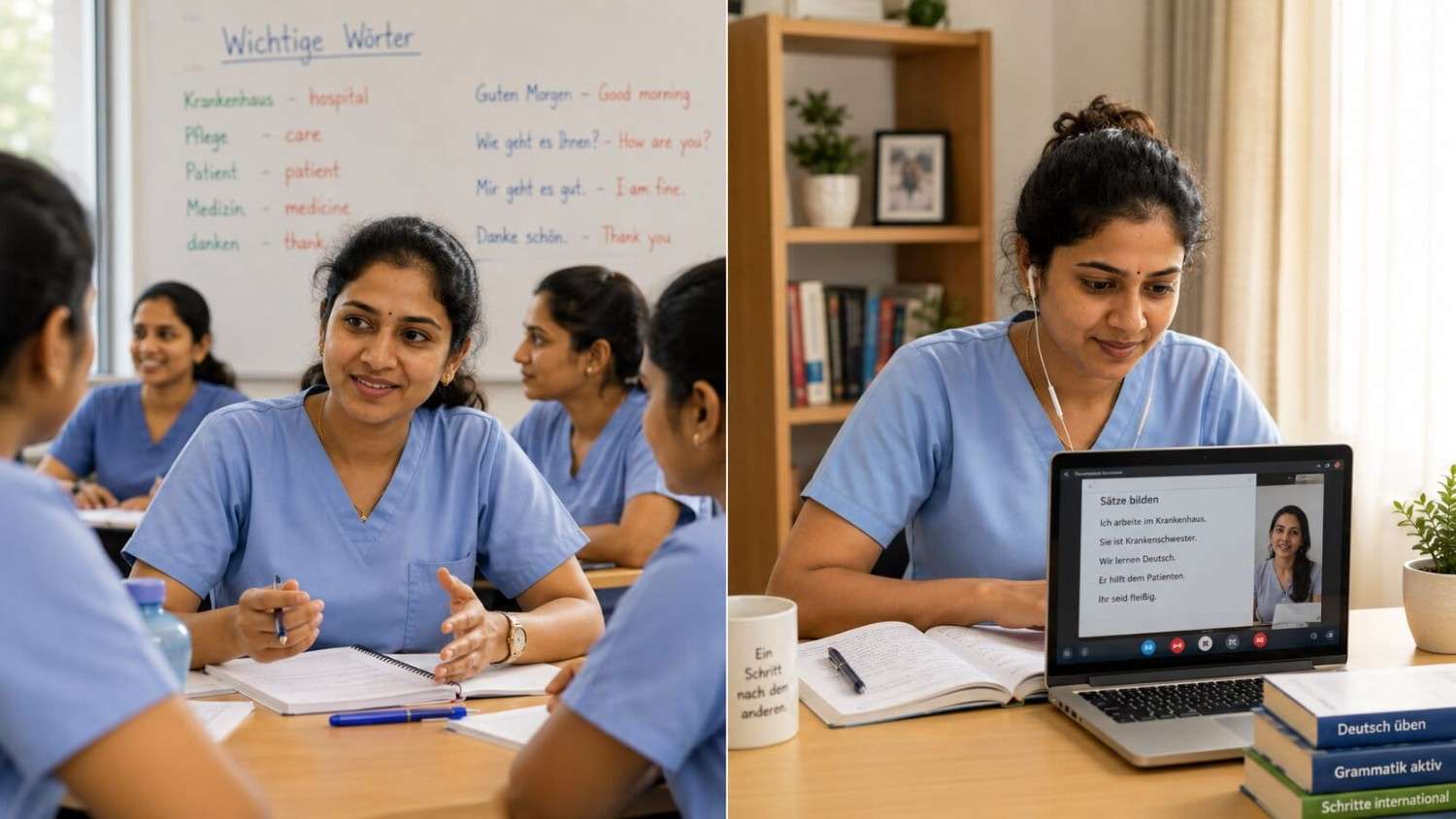
When nurses enquire about JSJ's German training programme, one of the first questions they ask is whether classes are online or offline — and whether they can choose. The question matters more than it might seem. A nurse who needs offline classes but is enrolled in an online-only programme will not complete B2. And a nurse who needs the flexibility of online learning but is locked into fixed classroom timings will drop out within months.
Getting this right is not about which format is objectively better. It is about which format matches your life. This blog gives you the framework to make that decision clearly, and explains what JSJ actually provides across both modes.
The strongest argument for offline German classes is accountability. When you have to physically get up, travel to a classroom, and sit with other people — a trainer is watching, batchmates expect you, there is a seat with your name on it — the activation energy to attend is lower than it sounds. Getting out the door is the hardest part. Once you are in the room, the session happens.
Online classes require a different kind of discipline: you have to close your phone, ignore the pressure to be available for family, resist the impulse to pause the class and come back to it "later." Many nurses who have strong intentions but weaker study habits genuinely perform better in a room with other people.
German B2 requires strong spoken communication — and in-person group practice creates more natural speaking conditions than a video call. The hesitation before speaking, the self-correction in real time, the listening to other people's pronunciation — all of this is slightly more effective when done face to face. Trainers can also observe body language, identify tension in speaking, and give real-time correction more fluidly in a physical classroom.
Nurses who live within commuting distance of a JSJ classroom centre (New Delhi), who have predictable enough schedules to attend fixed-time sessions, who know they need social accountability to study consistently, and who have previously dropped out of online courses benefit most from offline training.
Online German training through JSJ's LMS platform allows nurses to attend morning, afternoon, or evening batches — and to access recorded sessions when shifts conflict. For a nurse in Kerala working rotating shifts, or a nurse in Kolkata who cannot relocate to Delhi for training, online is not a compromise. It is the only practical option, and JSJ has designed the online curriculum to be as complete as the classroom experience.
The ability to review recordings after a live session is a significant advantage for nurses with demanding jobs. If you attend a live class at 7 PM but are exhausted after a day shift and retain only 60% of the content, watching the recording the next morning — when you are rested — locks in what was missed. Offline classes do not offer this.
Online training means the quality of instruction does not depend on which city you live in. JSJ's online trainers are the same C1-certified instructors who teach the classroom batches. A nurse in Chhattisgarh receives the same vocabulary drilling, the same grammar explanation, and the same speaking practice as a nurse sitting in the New Delhi classroom. The quality of German instruction varies enormously across India — having access to consistently strong teaching regardless of location is a genuine advantage.
Nurses who live outside Delhi or in cities without an offline centre, nurses on rotating or night shifts who cannot commit to fixed class times, nurses with young children who need maximum schedule flexibility, and nurses who are self-disciplined enough to attend consistently without physical accountability benefit most from online training.
| Factor | Offline (Classroom) | Online (LMS Platform) |
|---|---|---|
| Location | New Delhi only | Anywhere in India — and abroad |
| Flexibility | Fixed batch timings | Multiple time slots + session recordings |
| Speaking practice | Richer — in-person group interaction | Good — video call interaction |
| Accountability | High — physical presence, social context | Requires self-discipline |
| Missed session recovery | Limited — must catch up independently | Full recording available |
| Trainer quality | JSJ's C1-certified team | Same JSJ C1-certified team |
| Suitable for shift workers | Difficult with rotating shifts | Well-suited |
| Suitable for outstation nurses | Only if you can relocate | Fully accessible |
| Cost difference | Same — included in JSJ programme | Same — included in JSJ programme |
In practice, the online vs offline question is less binary than it appears. Many JSJ candidates start in one format and shift to the other as their circumstances change. A nurse who begins with offline classroom training in Delhi may transition to online batches when her hospital schedule changes, without losing progress or continuity. The curriculum is the same across both formats, which means transitions are seamless.
Some candidates combine formats deliberately — attending live online sessions for most of the week and coming to the Delhi classroom for speaking practice sessions and mock exam preparation, where face-to-face interaction is particularly valuable.
500+ nurses are currently learning German with JSJ. Both formats are active, both produce B2 completers, and both have the same trainers, the same curriculum, and the same outcome waiting at the end.
📞 Book Your Free Consultation
Call / WhatsApp: +91 96259 66817
Email: support@jetsetjobs.in | www.jetsetjobs.in
500+ nurses are on their way to Germany & Austria with us. Free B2 training. Zero recruitment fees.